
A dismissed Nigerian soldier, Rotimi Olamilekan, popularly known as Soja Boi, has challenged the Nigerian Army to make its payroll public, as controversy continues over his claims about poor pay and welfare conditions for soldiers.
Olamilekan, a former lance corporal, made the fresh allegations in a video released on Tuesday, where he displayed bank transaction alerts to support his argument that soldiers earn modest wages and often spend their own money on protective gear.
The development comes shortly after the Army dismissed his earlier claims as false and misleading, setting the stage for a growing public dispute between the ex-soldier and the military authorities.
In the video, Olamilekan said he was not trying to damage the image of the Army but felt compelled to speak out.
“I am not trying to spoil the Nigerian Army’s image,” he said. “But I am just speaking the facts and I will be backing them with evidence.”
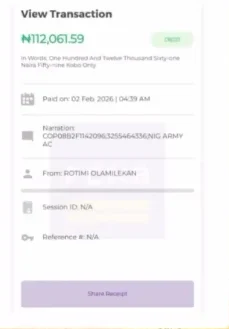
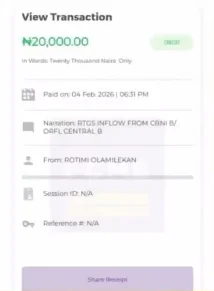
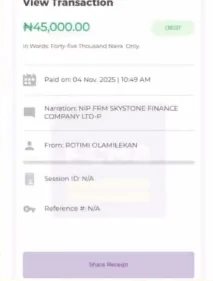
To support his claims, he showed three bank alerts which he said reflected payments he received while still in service. One of the alerts, dated February 2, 2026, showed a credit of N112,061.59, which he described as his monthly salary. Another alert, dated February 4, 2026, showed a N20,000 payment, which he identified as a “grumbling allowance.” A third alert, from November 2025, showed a N45,000 payment, which he said was an operational allowance for soldiers deployed to conflict zones such as Maiduguri.
According to him, the operational allowance is not paid regularly and is only given when a soldier is actively involved in military operations.
“If you are not in operation, they don’t pay you that one,” he said. “If you go on operation, they will pay you.”
He also mentioned a smaller security allowance of about N6,000, while noting that soldiers stationed in barracks typically receive only their salary and the N20,000 allowance.
Beyond pay, Olamilekan repeated his earlier claim that soldiers often have to purchase their own protective equipment, including helmets and fragmentation jackets, which are essential for safety during operations.
“Helmet, you go buy. Fragmentation jacket, you go buy them,” he said in the video.
He urged Nigerians with relatives in the military to verify his claims, suggesting that many serving personnel may be unable to speak openly.
“Call your brother, call your sister, and ask them if I am lying,” he said.
Olamilekan also directly challenged the Army to publish its payroll records to prove him wrong.
“If they say I am lying, they should bring out their payroll. How much are they paying soldiers?” he asked.
However, the Nigerian Army has firmly rejected his allegations. In a statement issued on Tuesday by its Acting Director of Army Public Relations, Appolonia Anaele, the military described his claims as baseless and misleading.
The Army maintained that all personnel are properly equipped through established logistics systems and that no soldier is deployed to operational areas without adequate protective gear.
It acknowledged that some soldiers may choose to purchase additional items for personal comfort, but insisted that such actions are voluntary and not due to shortages.
On the issue of pay, the Army said its personnel receive consolidated salaries along with various allowances, including uniform and operational allowances, all of which are paid directly into their bank accounts.
The clash between Olamilekan and the Army has attracted widespread attention, especially on social media, where debates about the welfare of Nigerian soldiers have intensified.
Maiduguri, which Olamilekan referenced, has been one of the key centres of military operations against insurgent groups for over a decade. Soldiers deployed to such areas often face difficult conditions, including harsh environments and security risks.
The Federal Government has repeatedly stated its commitment to improving the welfare of armed forces personnel, including better pay, housing, and equipment. However, critics argue that more needs to be done to meet the demands of modern military operations.
Olamilekan first came into the public spotlight in February 2026 when a video of him went viral. In the video, he called on political leaders, including governors, senators, and ministers, to send their children to serve in the Army.
The statement sparked widespread reactions and brought attention to his views on inequality and sacrifice within the military system.
Following the viral video, he was arrested and later dismissed from service. According to the Nigerian Army, his dismissal was due to repeated acts of indiscipline, including violations of the Armed Forces’ social media policy and unauthorised media appearances.
The Army insisted that his removal was not related to the content of his videos but rather to breaches of military rules and conduct.
Despite his dismissal, Olamilekan has continued to speak publicly, using social media to share his experiences and raise concerns about conditions within the military.
His latest claims, backed by what he says is evidence, have added a new dimension to the conversation, raising questions about transparency and accountability in the armed forces.
As the debate continues, many Nigerians are watching closely to see whether the Army will respond further to his challenge or provide additional details about soldiers’ pay and welfare.