
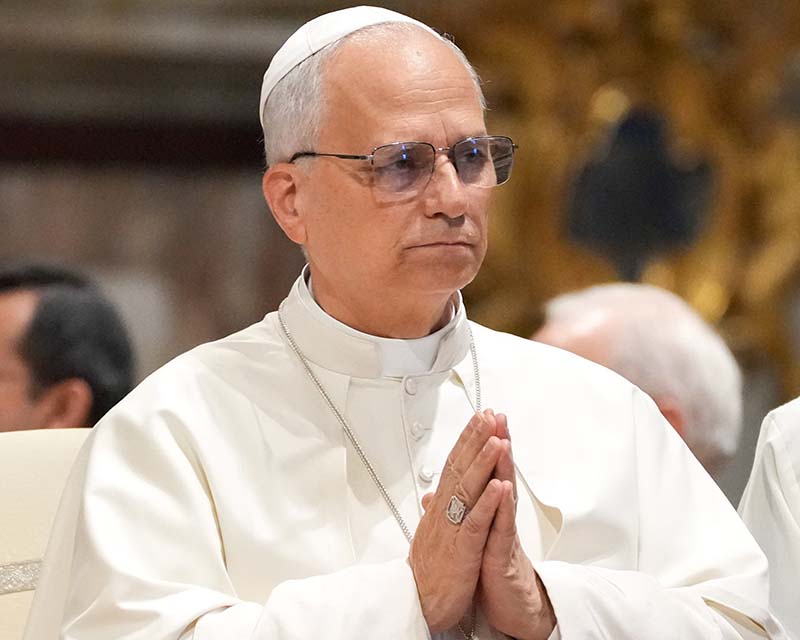
The head of the Catholic Church, Pope Leo XIV, has strongly condemned ongoing global conflicts, warning that war and military action cannot bring lasting peace.
His message comes at a time of rising tension in the Middle East, following the recent escalation involving the United States, Israel, and Iran.
On February 28, the United States and Israel carried out coordinated air strikes on Iran, targeting key military and nuclear facilities, as well as top officials. The action quickly triggered a wider conflict after Iran launched retaliatory attacks, raising fears of a prolonged regional war.
Reacting to the situation in a message posted on X (formerly Twitter), Pope Leo called on world leaders to abandon violence and embrace dialogue as the only path to peace.
“God does not bless any conflict,” the Pope said. “Anyone who follows Christ, the Prince of Peace, cannot support war.”
He stressed that military action, no matter the justification, cannot create the conditions needed for true peace and stability.
“Military action will not create space for freedom or peace,” he said. “Peace comes only through patience, coexistence, and dialogue among people.”
The Pope’s statement reflects growing global concern about the impact of the conflict, which has already led to loss of lives, destruction of property, and fears of wider instability across the Middle East.
Pope Leo also expressed concern about the use of religion to justify violence, warning that faith should never be used as a reason for war.
He urged Christians and people of all faiths to reject violence and work towards peaceful solutions.
“Faith must not be used to support war,” he said. “Those who believe in God must stand for peace, not violence.”
The Pope also drew attention to the impact of the conflict on religious and historical sites, especially in regions considered sacred to Christianity.
He said the ongoing violence has damaged holy places and disrespected the spiritual importance of these areas.
“Violence is spreading through the sacred places of the Christian East,” he said. “These holy sites are being destroyed, and human lives are treated as if they do not matter.”
He described the situation as both “absurd” and “inhuman,” adding that no political or economic interest should be placed above human life.
According to him, innocent people, including children and families, are often the ones who suffer the most during conflicts.
“No gain can be worth the life of the weakest,” he said. “No cause can justify the killing of innocent people.”
The Pope’s comments come as humanitarian agencies continue to warn about the impact of the conflict on civilians.
In many parts of the Middle East, ongoing violence has disrupted daily life, destroyed homes, and forced families to flee their communities.
Food shortages, rising prices, and limited access to healthcare have also become major concerns in affected areas.
Beyond the immediate conflict, Pope Leo also used the opportunity to speak about global inequality, linking it to the causes of unrest and instability in many parts of the world.
He noted that while millions of people live in extreme poverty, wealth remains concentrated in the hands of a few.
“Hundreds of millions of people are living in extreme poverty,” he said. “Yet, wealth is still controlled by a small number of people.”
He described this situation as unjust and called for a more fair and responsible distribution of resources.
“There are enough resources in the world,” he said. “The problem is how they are shared.”
The Pope urged governments, institutions, and individuals to act with honesty and moral responsibility in addressing inequality.
In Nigeria, where many citizens face economic challenges, the Pope’s message may resonate strongly.
The country has also faced its own security issues, including insurgency in the North-East and banditry in some rural areas, highlighting the need for peaceful solutions and effective governance.
Religious leaders in Nigeria have often called for unity and dialogue in addressing national challenges, echoing similar messages from global figures like the Pope.
Pope Leo’s statement adds to a growing number of international calls for de-escalation in the Middle East.
Many world leaders and organisations have urged all parties involved to return to the negotiating table and avoid further violence.
However, analysts say achieving peace may be difficult, given the deep political, religious, and economic interests involved.
Despite these challenges, the Pope remains hopeful that dialogue can lead to a better future.
He called on all people, especially leaders, to reflect on their actions and choose peace over conflict.
“It is time to question ourselves and make changes,” he said.
As the world watches the unfolding situation, the Pope’s message serves as a reminder of the human cost of war and the need for peaceful solutions.