
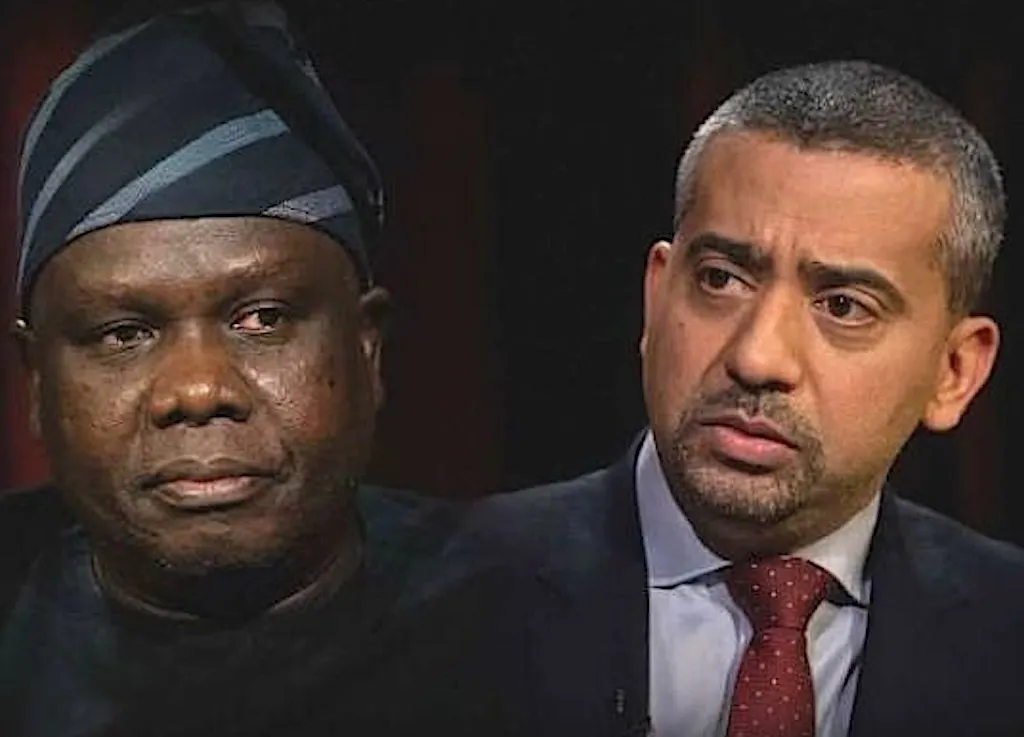
The Special Adviser to President Bola Tinubu on Policy Communication, Daniel Bwala, has revealed that he recently underwent throat surgery shortly after his controversial interview with Mehdi Hasan of Al Jazeera.
Bwala made the disclosure during an appearance on News Central’s program, 60 Minutes with Mr Kay, which aired on Friday. His comments come weeks after the interview sparked widespread reactions across social media, with many Nigerians debating his performance and the issues raised.
According to Bwala, the surgery took place about eight days after the interview. While he did not give full details about the medical condition, he suggested, in a light tone, that the stress surrounding the interview and reactions from critics may have played a role.
“Eight days after the interview with Mehdi Hasan, I underwent surgery on my throat. I don’t know whether it is the ‘Obidient’ people that threw that African thing, but in any case, I’m back and strong,” he said.
The interview in question quickly went viral after it was released online. In it, Hasan pressed Bwala on his past statements about President Bola Tinubu, especially comments he made before joining the current administration.
During the interview, Hasan repeatedly brought up previous criticisms made by Bwala against Tinubu. This line of questioning appeared to put the presidential aide on the defensive, as he tried to explain his change in position.
Speaking on News Central, Bwala described Hasan’s approach as “opposition-style journalism,” saying the interviewer was more focused on discrediting the government than having a balanced discussion.
“What Mehdi Hasan did was what we call opposition-style journalism, where you play the role of the opposition. In that interview, Mehdi sought to elicit information from me to discredit the government, but he could not,” Bwala said.
He explained that much of the early part of the interview focused on his past remarks about Tinubu when he was in the opposition. According to him, he admitted to making those statements but wanted the discussion to move to more current issues.
“In the first 15 minutes, he started by asking me to answer questions relating to things I said about President Tinubu when I was in the opposition. Repeatedly, I admitted to them — I even said I had said more than what he mentioned — but I asked that we move on to the purpose of the interview,” he said.
Bwala added that he became frustrated when the interviewer continued along the same line of questioning. He said he even warned Hasan that he would begin to deny the claims if the questions did not change.
“He continued doing it, and at a point, I warned him that if he kept going in that direction, I would deny it. He continued, and that was why I kept denying,” he explained.
However, the situation took a different turn during the interview when Hasan produced video evidence of Bwala’s past statements after he denied making some of them. This moment quickly gained attention online and led to criticism from viewers who accused Bwala of contradicting himself.
The clip spread widely on social media platforms, where many users described his performance as weak and embarrassing. Some commentators said the interview raised questions about credibility and consistency in political communication.
In response to the backlash, Bwala criticised a group of social media users he referred to as “Obidients,” a term commonly used to describe supporters of former presidential candidate Peter Obi. He accused them of putting political loyalty above national interest.
“I know the environment I come from; it’s an environment where there exists a species of ‘Trojans’ of social media called the ‘Obidient,’ who do not care about the national interest or the security of Nigeria and will do everything possible to achieve the aim of their hero, no matter the cost,” he said.
His comments have added another layer to the ongoing political tension between supporters of the current administration and opposition groups, especially on social media, where debates often become heated.
They also note that public officials are under increasing pressure to remain consistent in their statements, as past comments can easily be retrieved and compared with present positions.
The controversy surrounding Bwala’s interview is not an isolated case. In recent years, several Nigerian politicians have faced scrutiny over past remarks, especially when they switch political sides or take up new roles in government.
Despite the criticism, Bwala insisted that he handled the interview well and maintained that the interviewer did not succeed in undermining the government.
He also used the opportunity to reaffirm his commitment to his role as a spokesperson for the Tinubu administration, saying he remains focused on communicating government policies to the public.
For many Nigerians, however, the incident remains a talking point, especially as it touches on issues of accountability, transparency, and the role of the media in holding public officials to account.
As the debate continues, Bwala’s disclosure about his health adds a human angle to the story, showing the pressure that often comes with public office and media scrutiny.
While he says he has recovered and is “back and strong,” the conversation around his interview and the reactions it generated is likely to continue for some time, reflecting the deep political divisions and active public engagement that define Nigeria’s current political landscape.