
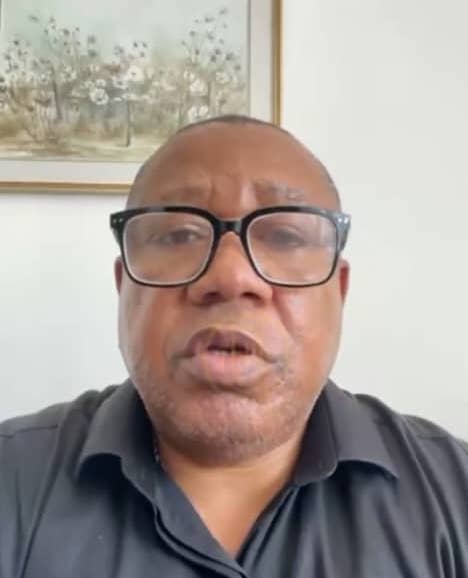
An Igbo community leader in South Africa, Solomon Obona Ezekiel, has publicly apologised over controversy surrounding his reported coronation, insisting that he was never crowned a king.
Ezekiel made the clarification in a statement shared on his X account on Saturday, where he expressed regret over the misunderstanding that followed an event held on March 14, 2026, in East London, Eastern Cape Province. The event, which was widely reported as a coronation ceremony, sparked outrage among South African traditional authorities and led to protests that later turned violent.
In his statement, Ezekiel said he was only recognised as a senior elder within the Igbo community and not installed as a traditional ruler.
“I want to make it clear I was not crowned as a king. I am not a king, and I do not claim to be a king,” he said. “What happened on that day was only my appointment as a senior elder in the Igbo community in Eastern Cape. It does not give me any authority as a king or traditional leader.”
He apologised to South African traditional leaders, including Kunkane Jobgolo Sandile, and the people of the Eastern Cape for the confusion caused by the event. Ezekiel also appealed for forgiveness from all those affected, stressing that he respects the authority of local leaders and the laws of South Africa.
“I take full responsibility for the misunderstanding, and I am truly sorry,” he added. “I support all efforts to restore peace, understanding and unity.”
The controversy began after reports emerged that Ezekiel had been crowned as “Eze Ndigbo na East London,” a title often used by Igbo communities in the diaspora to refer to their leaders. However, the use of such titles outside Nigeria has long been a sensitive issue, especially in countries with established traditional leadership systems.
In South Africa, traditional leadership is recognised by law and deeply rooted in the culture of indigenous communities. Authorities and local leaders reacted strongly to the reported coronation, describing it as a violation of local customs and an act that could undermine existing structures.
The Eastern Cape House of Traditional and Khoi-San Leaders condemned the event, calling it a “flagrant violation” of established protocols. Similarly, the Department of Cooperative Governance and Traditional Affairs declared the coronation illegal.
Tensions in the area escalated in the weeks following the event. On March 30, protests broke out in parts of East London, with demonstrators expressing anger over what they saw as an attempt to create a parallel traditional authority.
The protests later turned violent, leading to the destruction of property, including at least 13 vehicles. There were also reports of looting and a stabbing incident. South African police were forced to intervene, using stun grenades and tear gas to disperse the crowd and restore order.
The incident has drawn attention both in South Africa and Nigeria, raising questions about the activities of diaspora communities and the limits of cultural expression abroad.
Nigeria’s Federal Government quickly distanced itself from the development. Speaking through her Special Assistant on Communication and New Media, Magnus Eze, the Minister of State for Foreign Affairs, Bianca Odumegwu-Ojukwu, described the trend of installing “Eze Ndigbo” in foreign countries as embarrassing.
She made the remarks during a meeting of Imeobi, the highest decision-making body of Ohanaeze Ndigbo Worldwide, held in Enugu.
According to her, while Igbo associations abroad have the right to promote their culture, the practice of installing traditional rulers outside Igboland often creates tension both within host communities and among Nigerians.
“People can still express themselves culturally without causing nuisance to indigenes of host country and others,” she said.
Nigeria’s diplomatic mission in South Africa also reacted to the situation. The Nigerian Embassy in Pretoria issued a statement apologising for the incident and urging Nigerians living in South Africa to remain calm and avoid actions that could worsen the situation.
The embassy clarified that the event was a cultural gathering that had been misinterpreted and did not represent a recognised traditional institution under Nigerian law.
Meanwhile, the leadership of Ohanaeze Ndigbo Worldwide has taken a firm position on the matter. In response to the growing controversy, the group announced a ban on the conferment of Eze Ndigbo titles outside Igboland.
The President-General of the organisation, Azuta Mbata, said such titles are not recognised by the Igbo people and will no longer be tolerated.
“Anybody who is being awarded that type of title anywhere outside Igbo land is on his own,” Mbata said. “It is unknown to the Igbo people, and we will inform embassies around the world about this position.”
He added that the organisation, in collaboration with the South East Council of Traditional Rulers, would determine appropriate sanctions for individuals who continue to claim such titles abroad. According to him, any punishment decided upon would be enforced at the community level in the individual’s hometown.
The controversy highlights a long-standing issue within the Nigerian diaspora, particularly among Igbo communities, where the creation of traditional titles abroad has sometimes led to disputes and misunderstandings.
For many diaspora groups, such titles are seen as a way to maintain cultural identity and organise community affairs. However, critics argue that the practice can create confusion, especially in countries where traditional leadership structures are formally recognised and regulated.
In South Africa, where traditional rulers play an important role in governance and community life, any attempt to establish parallel authorities is likely to be met with resistance.
For now, Ezekiel’s apology appears to be a step towards calming tensions in the Eastern Cape. Whether it will fully resolve the crisis remains to be seen, as authorities and community leaders continue efforts to restore peace.