
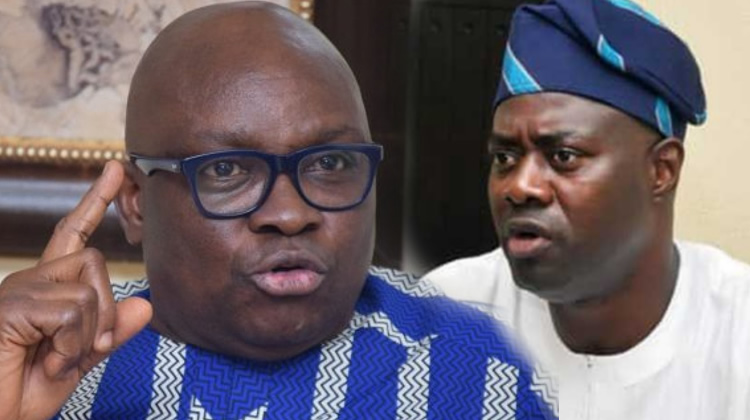
Political tension in Oyo State deepened on Tuesday as former Ekiti State Governor, Ayodele Fayose, renewed his allegation that Governor Seyi Makinde is plotting to remove the Olubadan of Ibadan, Oba Rashidi Ladoja.
Fayose made the claim during a visit to the monarch at his private residence in Bodija, Ibadan, where he said he came to show solidarity with the traditional institution.
The former governor had earlier raised concerns about an alleged plan to dethrone the Olubadan, a claim that has since stirred debate across the state. Speaking again on Tuesday, Fayose insisted that the situation was ongoing and that the governor was not backing down.
“I am in Ibadan to identify with the traditional institution. The truth about the whole saga will soon be revealed,” Fayose told journalists during the visit.
He maintained that his statements were not based on rumours but on credible information. According to him, his claims were supported by facts and insights from reliable sources.
“I stand by everything I have said. My disclosures were not speculative but based on facts available to me and insights from reliable sources,” he added.
Fayose further alleged that there was a deliberate plan targeting the Olubadan, even though the final outcome remained uncertain. He suggested that certain actions were being taken quietly behind the scenes.
He also referred to earlier claims involving a reported ₦50 billion issue, saying the matter was first raised by a commissioner and later supported with evidence. However, he did not provide details during his latest remarks.
According to Fayose, there were also plans to query the monarch over his alleged role in an aborted coronation, adding that recent developments indicated that the matter was more serious than it appeared.
“Recent developments within the last 48 hours suggest that there is more to the matter than meets the eye,” he said.
The former governor warned that the situation could escalate, noting that the current administration had installed several traditional rulers since coming into office.
In his response, Oba Rashidi Ladoja expressed appreciation to Fayose for the visit and for bringing attention to the issue.
“Thank you for the visit. Thank you for alerting us. I thank you very much,” the monarch said.
However, he struck a calm tone, assuring that the matter would be resolved internally without unnecessary conflict.
“We still have elders in Ibadan. We will resolve the family affairs. We will resolve it amicably because Ibadan people love their monarch,” he added.
His response reflects the long-standing tradition in Ibadan, where disputes involving the throne are often handled by a council of elders and chiefs rather than through public confrontation.
The Olubadan stool is one of the most respected traditional institutions in Yorubaland. Ibadan’s unique succession system, which allows chiefs to ascend the throne based on a well-defined order, has helped maintain stability over the years.
Unlike in some other traditional systems, the process is largely predictable, reducing disputes over succession.
Because of this, any suggestion of interference in the institution often attracts strong reactions from residents and cultural stakeholders.
Traditional rulers in Nigeria play important roles in community leadership, cultural preservation, and conflict resolution, even though they do not hold formal political power under the Constitution.
Fayose’s renewed claims have added to ongoing political discussions in Oyo State, where relations between political actors and traditional authorities have occasionally been tense.
The former governor, known for his outspoken style, has remained active in national and regional politics since leaving office. His comments often generate attention, especially when they involve high-profile figures.
Governor Seyi Makinde has not publicly responded to the latest allegations at the time of this report. However, his administration has previously maintained that it respects traditional institutions and follows due process in its dealings with them.
Residents of Ibadan and other parts of Oyo State are closely watching developments, as uncertainty continues around the claims.
Some have called for calm, urging all parties to avoid actions that could lead to unrest. Others have highlighted the need for transparency and clarity from those involved.
As the situation unfolds, attention is likely to remain on the key actors, including Fayose, Governor Makinde, and the Olubadan palace.
Many are waiting to see whether further details will emerge to support the allegations or if the issue will be resolved quietly, as suggested by the monarch.
For now, the Olubadan’s call for internal resolution may help calm tensions, even as public interest in the matter continues to grow.
The coming days are expected to provide more clarity on the situation, as stakeholders weigh their next steps in what has become a major talking point in Oyo State’s political and traditional landscape.