
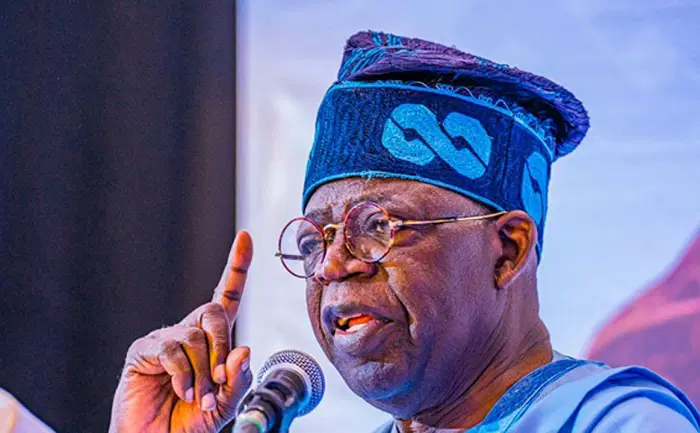
President Bola Ahmed Tinubu has taken a swipe at former Vice-President Atiku Abubakar, accusing him of attempting to take control of the African Democratic Congress (ADC) for personal interests.
Tinubu made the remarks on Thursday at the State House in Abuja while hosting a delegation of the Renewed Hope Ambassadors, a group supporting his administration. The president linked the ongoing leadership crisis in the ADC to what he described as efforts by Atiku to “privatise” the opposition party.
According to Tinubu, Atiku’s past involvement in Nigeria’s privatisation program did not produce positive results, and he suggested that a similar approach is now being applied in politics.
“The head was the chairman of the privatisation council of Nigeria. He privatised the steel industry in Delta; is it working today? No. He privatised Ajaokuta. Is it working today? No,” Tinubu said. “They privatise another man’s political party, but the man said no.”
The president’s comments come at a time when the ADC is facing serious internal divisions that threaten its stability ahead of future elections.
The crisis within the ADC began in July 2025 when an opposition coalition took over the party’s leadership. Since then, the party has been split into different factions, each claiming legitimacy.
One faction is led by former Senate President David Mark, while another is headed by Nafiu Bala, a former deputy national chairman. A third group is led by Ogga Kingsley.
Bala has openly challenged the emergence of Mark as leader, alleging that his appointment did not follow due process. This disagreement has led to a prolonged legal and political battle within the party.
The situation became more complicated on April 1 when the Independent National Electoral Commission (INEC) stepped in.
Following an interim ruling by the Court of Appeal, INEC announced that it would no longer recognise the factions led by David Mark and Nafiu Bala. This decision created further uncertainty, as none of the major factions currently has full official backing from the electoral body.
Attention is now on the Supreme Court, which has fixed April 22 to hear an appeal filed by David Mark. The appeal challenges a suit brought by Bala’s faction, which questions the legality of Mark’s leadership.
The court’s decision is expected to play a major role in determining the future of the ADC. It could either restore one faction as the recognised leadership or deepen the crisis if new disputes arise.
Tinubu’s criticism of Atiku also brings back the long-standing debate over Nigeria’s privatisation policy, especially during the early 2000s when Atiku played a key role as chairman of the National Council on Privatisation.
During that period, several government-owned enterprises were sold or concessioned to private investors, including major steel projects like Ajaokuta Steel Company. While the policy was aimed at improving efficiency and reducing government spending, many Nigerians argue that some of the privatised assets have not performed as expected.
The Ajaokuta Steel Company, in particular, has remained a symbol of unfulfilled industrial promise, as it has yet to operate at full capacity despite years of government efforts and policy changes.
Tinubu’s remarks are seen by some analysts as part of the ongoing political rivalry between him and Atiku, both of whom have been major figures in Nigeria’s politics for decades.
With the ADC crisis unfolding, the situation may also affect broader opposition politics. The party had recently been seen as a possible platform for coalition-building among opposition groups seeking to challenge the ruling party in future elections.
However, the internal disputes have raised doubts about its ability to serve that role.
For now, all eyes remain on the Supreme Court as Nigerians wait to see whether the legal battle will bring clarity or further confusion to the troubled party.
As the political tension continues, Tinubu’s comments have added a new layer to the debate, linking past economic policies to present-day political struggles.