
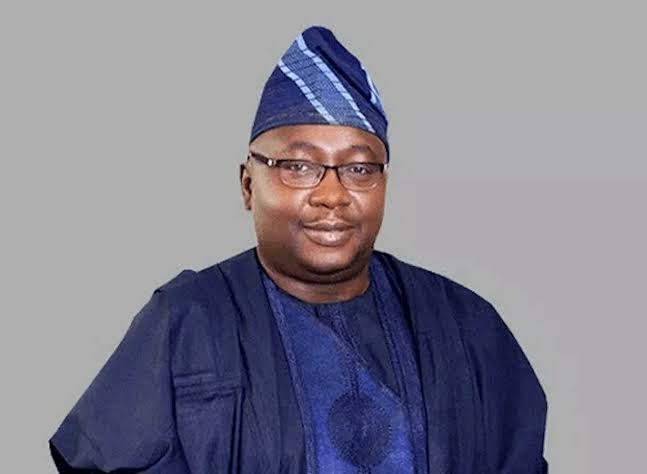
Nigeria’s Minister of Power, Adebayo Adelabu, has resigned from his position to pursue his ambition of becoming the next governor of Oyo State.
Adelabu made his decision known in a resignation letter dated April 22, 2026, and addressed to President Bola Ahmed Tinubu. According to the letter, his resignation will take effect from April 30, 2026, to allow for a smooth handover of responsibilities at the Ministry of Power.
In the letter, the outgoing minister expressed appreciation to the President for the opportunity to serve in the Federal Executive Council. He said he was stepping down with a “deep sense of honour and profound gratitude,” noting that his time in office had been a privilege.
His resignation marks a significant political move ahead of the expected build-up to the 2027 general elections, where governorship contests in states like Oyo are already beginning to attract attention.
Adelabu, a former deputy governor of the Central Bank of Nigeria (CBN), has long been active in Oyo State politics. He was the governorship candidate of the All Progressives Congress (APC) in the 2019 election but lost to the incumbent governor. His latest move signals a renewed attempt to secure the state’s top job.
His exit also comes at a critical time for Nigeria’s power sector, which continues to face major challenges, including unstable electricity supply, rising tariffs, and infrastructure gaps.
The Ministry of Power plays a central role in managing the country’s electricity generation, transmission, and distribution systems. Over the years, Nigerians have continued to express concern over poor power supply, which affects businesses, households, and overall economic growth.
During his time in office, Adelabu was involved in efforts to improve power generation and address issues in the sector. These included policies aimed at boosting electricity supply, encouraging investment, and improving coordination among key players in the industry.
However, like many before him, he faced the long-standing structural challenges that have made it difficult to achieve stable and reliable power supply across the country.
Nigeria’s power sector has undergone several reforms since the privatisation of electricity generation and distribution companies in 2013. Despite these reforms, the sector still struggles with problems such as insufficient generation capacity, weak transmission infrastructure, and financial constraints.
Adelabu’s resignation, therefore, raises questions about continuity in ongoing projects and policies within the ministry. It is expected that the Federal Government will appoint a replacement or an acting minister to ensure that operations continue without disruption.
Meanwhile, his governorship ambition is expected to reshape the political landscape in Oyo State. The state, located in the South-West region, is one of Nigeria’s politically active states and has a history of competitive elections.
The current governor, Seyi Makinde of the Peoples Democratic Party (PDP), is serving his second term, which will end in 2027. This means the race to succeed him is already attracting interest from various political actors.
Adelabu’s entry into the race is likely to intensify competition within the APC, as other aspirants may also be eyeing the ticket.
In his resignation letter, Adelabu emphasised the importance of ensuring a smooth transition at the Ministry of Power. By giving a one-week notice before his exit takes effect, he said he hopes to allow enough time for proper handover of duties.
Such transitions are important in government, especially in key ministries, to avoid disruption in ongoing projects and policy implementation.
His decision also reflects a common trend in Nigerian politics, where public office holders resign from their positions to contest elections. This is often done to comply with political and ethical expectations, as well as to focus fully on campaign activities.
For many Nigerians, the development highlights the close link between governance and politics in the country. While public officials are expected to deliver on their responsibilities, they also operate within a political system that requires them to seek electoral mandates.
As Adelabu prepares to leave office, attention will shift to both his political ambitions and the future direction of the power sector.
Residents of Oyo State will be watching closely to see how his campaign unfolds, while stakeholders in the power sector will be interested in how the government manages the transition and continues efforts to improve electricity supply.
The coming months are expected to bring more political activity as parties begin to position themselves for the 2027 elections.
For now, Adelabu’s resignation marks the beginning of a new phase in his political career, as he moves from the federal cabinet back to the political field in Oyo State.
At the national level, it also underscores the ongoing balancing act between governance and politics, especially as the country prepares for another election cycle.
As developments unfold, both the power sector and the political space in Oyo State are set to remain in focus, with many Nigerians keen to see what comes next.