
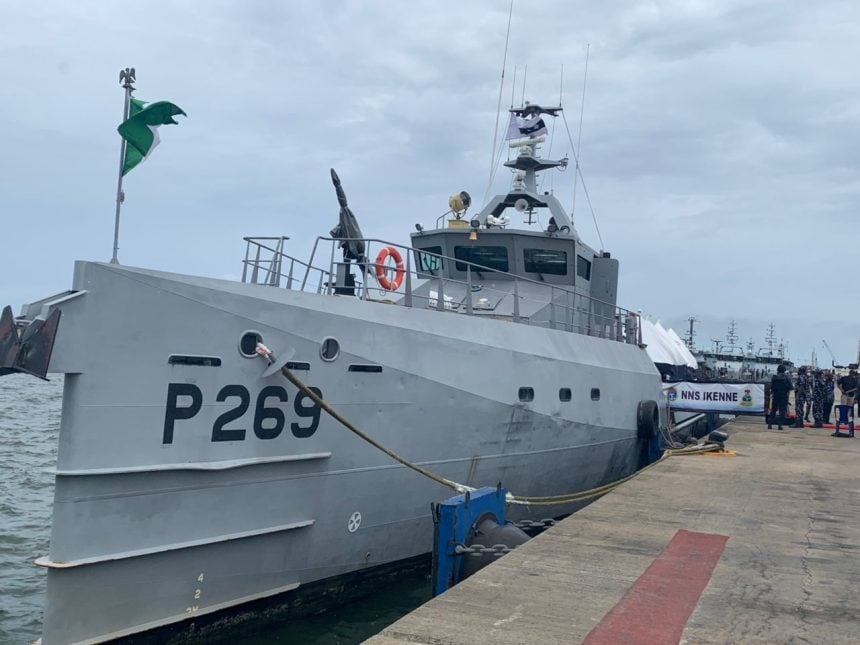
The Nigerian Navy has deployed 10 ships, two helicopters, and other security assets in a major operation aimed at curbing rising maritime crimes in the Gulf of Guinea, including piracy, sea robbery, oil theft, and illegal trafficking.
The operation is part of a multinational exercise known as Exercise Obangame Express 2026, which was formally launched on Sunday aboard the Nigerian Navy Ship KADA in Onne, Rivers State.
The Chief of Naval Staff, Vice Admiral Idi Abbas, who was represented at the event by the Chief of Naval Operations, Rear Admiral P. E. Effah, said the exercise remains a key tool for improving maritime security cooperation among countries in the Gulf of Guinea.
He explained that Obangame Express was first initiated in 2010 by the United States Navy in collaboration with naval forces of Gulf of Guinea countries. Since then, it has grown in size and importance, becoming one of the most significant annual maritime security exercises in West and Central Africa.
According to him, the exercise has evolved into a platform for strengthening joint operations, improving communication among navies, and enhancing the ability of participating countries to respond to sea-based threats.
“It remains a critical instrument for fostering unity of effort, enhancing interoperability, and consolidating our shared resolve to secure our maritime domain against emerging and evolving threats,” Abbas said.
He added that the main objectives of the exercise include strengthening regional maritime cooperation, improving information sharing, increasing awareness of activities at sea, and boosting operational readiness among participating navies.
Other goals include building the capacity of naval forces to combat crimes such as piracy, sea robbery, illegal trafficking, and other unlawful activities on the waters.
Abbas stressed that the importance of the exercise cannot be overstated, especially at a time when maritime security threats are becoming more complex and transnational in nature.
For this year’s operation, he said the Nigerian Navy will deploy a wide range of assets, including 10 ships, two helicopters, maritime surveillance systems, and special forces from the Special Boat Service.
These assets will be used to carry out a series of coordinated training and operational scenarios designed to simulate real-life maritime threats.
The activities include anti-illegal trafficking operations targeting arms and drugs, anti-crude oil theft missions, and enforcement against illegal, unregulated, and unreported fishing activities. Other exercises will involve visit, board, search, and seizure procedures, as well as search and rescue missions and simulated hot pursuit operations.
According to the Navy, these drills are designed to test the readiness of personnel, improve coordination between units, and sharpen the force’s ability to respond quickly to emergencies at sea.
Abbas noted that the success of such a large-scale exercise depends heavily on proper planning, logistics, and the commitment of personnel involved.
He also used the occasion to appreciate President Bola Ahmed Tinubu for his continued support to the Armed Forces and the Nigerian Navy in particular.
He praised senior naval commanders, including Flag Officers Commanding the Eastern and Central Naval Commands, Fleet Commanders, and other units involved in the operation, for their professionalism and dedication to protecting Nigeria’s maritime environment.
“As you proceed to sea alongside your counterparts from partner nations, I urge you to remain professional, disciplined and committed to the objectives of this exercise,” he said.
Earlier in his remarks, the Flag Officer Commanding Eastern Naval Command, Rear Admiral C. D. Okehie, described Obangame Express 2026 as a major multinational exercise conducted annually across West and Central Africa under the sponsorship of the United States Africa Command.
He said the Nigerian Navy must remain fully prepared to support both national and regional security efforts while also contributing to broader international cooperation in maritime safety.
Okehie noted that the Gulf of Guinea remains a strategically important region due to its vast economic resources and its role as a major global shipping route. He said the region is critical not only to African economies but also to international trade.
However, he warned that the same importance also makes the area vulnerable to criminal activities at sea, including piracy, smuggling, and illegal resource exploitation.
“In this regard, it is imperative for Nigeria to continue to build, strengthen and sustain robust maritime security capabilities, while deepening cooperation with neighbouring countries and international partners,” he said.
Nigeria, being a key coastal nation in the region, plays a central role in these efforts. The country’s navy has increased patrols, invested in surveillance technology, and strengthened partnerships with other countries to improve maritime safety.
The current deployment is seen as part of ongoing efforts to sustain these gains and prevent a resurgence of criminal activities on the waters.
Officials say that beyond military training, the exercise also serves as a platform for diplomacy, cooperation, and trust-building among participating nations.