
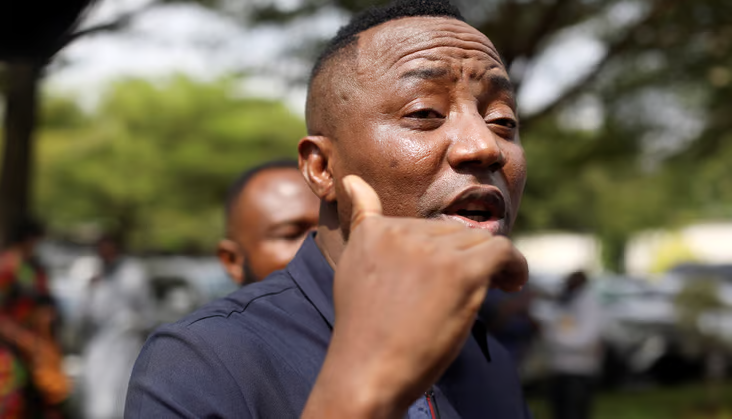
Human rights activist and presidential candidate of the African Action Congress (AAC), Omoyele Sowore, has explained why he refused to attend a recent opposition summit held in Ibadan, Oyo State, saying Nigeria needs a fresh political direction and not what he described as a gathering of recycled leaders.
The summit, which took place at the Oyo State Government House in Ibadan, brought together several prominent opposition figures from across the country. It was attended by former President Olusegun Obasanjo, who chaired the meeting, and Governor Seyi Makinde, who hosted the event. Other attendees included former Vice President Atiku Abubakar, former Kano State Governor Rabiu Kwankwaso, and several other political leaders from different parties.
Organisers of the meeting said the summit was aimed at building stronger cooperation among opposition parties ahead of future elections. The theme of the gathering, “That We May Work Together for a United Opposition to Sustain Our Democracy,” focused on the need for unity in addressing Nigeria’s economic challenges, insecurity, and governance issues.
However, Sowore, a long-time activist and critic of Nigeria’s political system, said he declined the invitation because he does not believe the summit represents genuine change.
In a post shared on X (formerly Twitter) on Sunday, Sowore said he was invited but chose not to attend because, in his view, many of the participants had already been part of Nigeria’s leadership problems in the past.
“I was invited to attend the so-called ‘Opposition Summit’ in Ibadan, but I declined,” he wrote.
According to him, the same set of politicians who have held top positions in the country for decades cannot be trusted to lead a new direction or offer real solutions to Nigeria’s challenges.
“There is no need to pretend that the same men (and a few women) who held Nigeria to ransom for years, presiding over stagnation, corruption, and systemic decay, can suddenly reinvent themselves as champions of progress or defenders of the people. Not all Nigerians are suffering from amnesia,” he said.
Nigeria has faced long-standing challenges including economic hardship, rising inflation, unemployment, and insecurity. Over the years, different political leaders have promised reforms, but many Nigerians still feel the situation has not improved significantly.
Sowore, who contested the 2019 and 2023 presidential elections under the AAC, has consistently called for a complete overhaul of the political system. He is known for his strong criticism of both ruling and opposition parties, which he often describes as part of the same political structure.
He made it clear that his party, the African Action Congress, will not participate in what he described as a political arrangement aimed at recycling failed leaders under a new name.
“For the avoidance of doubt, our revolutionary party, the African Action Congress, will not be part of any charade designed to recycle failed political actors under the guise of ‘opposition,’” he said.
Instead, Sowore said his focus remains on building what he called a people-driven movement that prioritises accountability, transparency, and real change.
“Instead, we are committed to presenting a formidable, people-driven alternative, one rooted in integrity, accountability, and genuine transformation,” he added.
He also criticised major political parties in the country, including the ruling All Progressives Congress (APC) and opposition parties such as the Peoples Democratic Party (PDP), Labour Party, and others. According to him, they all represent the same system that has failed Nigerians.
“We will mobilise Nigerians across the country to rally behind a credible vision that rejects the decadence and deception represented by both the All Progressives Congress and their opportunistic counterparts in ADC, PDP, Labour Party and elsewhere,” he said.
“Nigeria does not need a rearrangement of the same broken pieces, it needs a complete break from the past.”
His comments reflect a growing debate in Nigeria’s political space about whether new alliances among established politicians can truly deliver change or whether a new generation of leaders is needed.
In recent years, opposition figures have made several attempts to form coalitions aimed at challenging the ruling party. Some of these efforts have included discussions about joint candidates, merger talks, and strategic partnerships ahead of elections.
Supporters of such alliances argue that unity is necessary to defeat a strong ruling party and provide a credible alternative. However, critics like Sowore believe these arrangements often involve the same individuals who have been part of Nigeria’s political system for decades.
While Sowore did not attend the Ibadan summit, the meeting itself was seen as an important step by opposition leaders who believe collaboration is key to strengthening democracy and improving governance.