
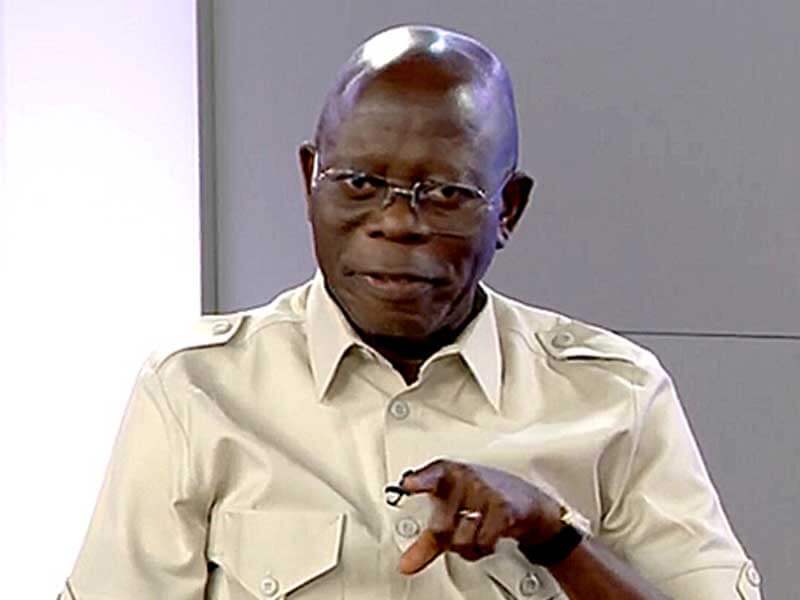
Senator Adams Oshiomhole has called on the Federal Government to take strong action against South African businesses operating in Nigeria following renewed attacks on Nigerians living in South Africa.
Speaking during plenary at the National Assembly on Tuesday, the former governor of Edo State urged the government to respond firmly to what he described as repeated acts of violence and hostility against Nigerian citizens abroad.
Oshiomhole specifically suggested that the Federal Government should consider revoking the operating licences of major South African companies in Nigeria, including MTN Nigeria and MultiChoice, the operator of the popular DSTV service.
According to him, such action would send a strong message that Nigeria will not tolerate the killing and harassment of its citizens.
“I am not going to shed tears. If you hit me, I hit you. I think it is appropriate in diplomacy. It is an economic struggle,” Oshiomhole said during the heated debate.
His comments come amid reports that several Nigerians in South Africa have been attacked in recent days, with some losing their businesses and properties in what has been described as xenophobic violence. Xenophobia refers to fear or hatred of foreigners, often leading to discrimination or attacks.
Over the years, Nigerians living in South Africa have faced periodic waves of such violence. Many of the attacks are often linked to claims by some South Africans that foreign nationals, including Nigerians, are taking jobs and opportunities meant for locals.
Oshiomhole rejected this argument, saying Nigerians have contributed positively to the South African economy and should not be treated as enemies.
He also argued that if South Africans believe Nigerians are taking their jobs, then Nigeria should encourage its citizens to return home and take up opportunities in companies owned by South Africans operating in Nigeria.
“Let Nigerians come back home and take the jobs in MTN and DSTV. Those companies are making huge profits here,” he said.
The senator further stressed that Nigeria must act in a way that commands respect on the international stage. He warned that failure to respond strongly could be seen as weakness and might encourage further attacks.
“When we hit back, the President of South Africa will not only talk but will also go on his knees to recognise that Nigeria cannot be intimidated,” he added.
While expressing concern over the reported killings, Oshiomhole said Nigeria does not oppose the enforcement of law and order in South Africa. However, he insisted that any Nigerian who commits a crime should be arrested and prosecuted according to the law, not attacked or killed by mobs.
“We will not condone any life being lost. If a crime has been committed under South African law, they have the right to bring such a person to justice, but to kill our people as if we are helpless, we will not allow that,” he said.
Relations between Nigeria and South Africa have experienced tension in the past due to similar incidents. Both countries are among the largest economies in Africa and play key roles in regional politics and trade. However, repeated attacks on foreign nationals in South Africa, especially Nigerians, have often led to diplomatic disputes.
In previous years, the Nigerian government has responded by summoning South African envoys, issuing strong statements, and in some cases facilitating the return of affected Nigerians. There have also been calls for stronger protection for Nigerians living abroad.
South African companies have a strong presence in Nigeria, particularly in the telecommunications and entertainment sectors. MTN Nigeria is one of the largest telecom operators in the country, serving millions of subscribers. DSTV, operated by MultiChoice, is also widely used for satellite television services.
Because of their large customer base, any action against these companies could have significant economic implications for both countries. Analysts say such a move could affect jobs, investments, and bilateral trade relations.
However, Oshiomhole believes that economic pressure may be necessary to force a change in attitude and ensure the safety of Nigerians abroad.
For many Nigerians living in South Africa, the latest reports have raised fresh concerns about safety and security. Community leaders have often called for better cooperation between the two governments to address the root causes of the violence.
Back home, Oshiomhole’s remarks have added to growing pressure on the Federal Government to take decisive steps. Some lawmakers and civil society groups have also called for stronger diplomatic engagement, while others support tougher economic measures.
As discussions continue, the Federal Government is expected to weigh its options carefully, balancing the need to protect its citizens with the potential impact on economic relations.
For now, the situation remains tense, with many Nigerians hoping for swift action that will not only address the immediate crisis but also prevent future attacks.