
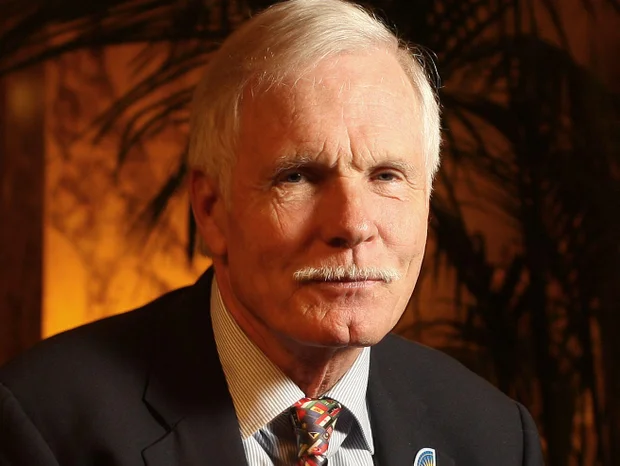
Ted Turner, the American media entrepreneur who changed the face of global television journalism with the creation of the Cable News Network (CNN), has died at the age of 87.
His death was confirmed on Wednesday in a statement released by Turner Enterprises, bringing to an end the life of one of the most influential figures in modern media history.
Turner is best known for founding CNN in 1980, a bold and risky idea at the time. Before then, television news was limited to a few scheduled bulletins each day. Turner broke that pattern by introducing a 24-hour news channel that delivered updates around the clock.
The idea was initially met with doubt, as many believed there would not be enough news to fill an entire day. However, Turner proved critics wrong. CNN grew steadily and went on to become one of the most powerful and widely watched news networks in the world.
According to Turner Enterprises, his vision helped reshape journalism by making news faster, more accessible, and global.
“Turner’s vision changed journalism forever by making news immediate, global, and constant,” the statement said.
Over the years, CNN became known for its live coverage of major world events. From wars and political crises to natural disasters and historic moments, the network brought real-time images and reports into people’s homes across the globe.
Many media experts say Turner’s idea helped create the modern news culture where people expect instant updates through television and, later, digital platforms.
Beyond CNN, Turner built a large media empire that included entertainment and sports. He launched and supported channels such as Cartoon Network, which became popular among young viewers, and Turner Classic Movies, known for showing old and classic films.
His influence also extended into sports. Turner owned the Atlanta Braves baseball team and played a key role in increasing its national visibility through television broadcasts. Under his ownership, the team gained a wider fan base across the United States.
Turner was known not only for his business success but also for his bold personality. He often took risks that others avoided and spoke his mind on issues, sometimes attracting controversy. Despite this, he was widely respected for his vision and determination.
A former CNN executive described him as “a once-in-a-generation media pioneer whose influence touched every corner of modern broadcasting.”
In addition to his work in media, Turner was also a major philanthropist. He was deeply involved in charitable causes, especially those related to global development and the environment.
One of his most notable contributions was the creation of the United Nations Foundation. This followed his historic pledge of $1 billion to support the work of the United Nations. The donation remains one of the largest ever made by an individual to support global humanitarian efforts.
Through the foundation, Turner supported programs aimed at improving health, reducing poverty, and promoting peace around the world.
He was also passionate about environmental conservation. Over the years, he invested in wildlife protection and land preservation. He became one of the largest private landowners in the United States, using much of his land for conservation projects.
Turner also helped raise awareness about environmental issues through popular culture. He played a role in the creation of the animated series “Captain Planet and the Planeteers,” which educated young audiences about environmental protection and sustainability.
His efforts earned him recognition and praise globally. In 1991, Time magazine named him Man of the Year, highlighting his impact on media and public awareness.
The magazine noted that Turner had helped turn viewers into “instant witnesses to history,” a phrase that captured the essence of his contribution to global communication.
Despite his achievements, Turner eventually stepped back from active business leadership. This followed the sale of much of his media empire to Time Warner. However, he remained closely connected to CNN and often described it as his greatest achievement.
Even after leaving day-to-day management, Turner continued to be a respected voice in media and public affairs.
In 2018, Turner revealed that he had been diagnosed with Lewy body dementia, a condition that affects brain function and can lead to memory loss and other health challenges. In the years that followed, reports indicated that his health had been declining.
Those who knew him closely often spoke about his strong will and determination. A longtime associate said Turner was fearless in pursuing his ideas, even when others doubted him.
“He believed in his instincts when few others did,” the associate said.
Turner’s death has sparked tributes from across the world, especially within the media industry. Journalists, broadcasters, and media organisations have acknowledged his role in shaping modern news.
His impact is also felt in countries like Nigeria, where 24-hour news channels have become a key part of the media space. Today, many Nigerian broadcasters and digital platforms follow the model he introduced decades ago, providing continuous updates to audiences.
They note that while technology has changed how news is delivered, the core idea of constant, real-time reporting can be traced back to Turner’s vision.
For many young journalists and media professionals, his story serves as an example of how bold ideas can transform an entire industry.
As the world reflects on his life, Turner is remembered as a man who took risks, challenged the status quo, and changed how people receive information.
His legacy lives on through CNN and the many other media platforms that have followed in its path.
With his passing, the world has lost a pioneer whose influence will continue to shape journalism and communication for generations to come.