
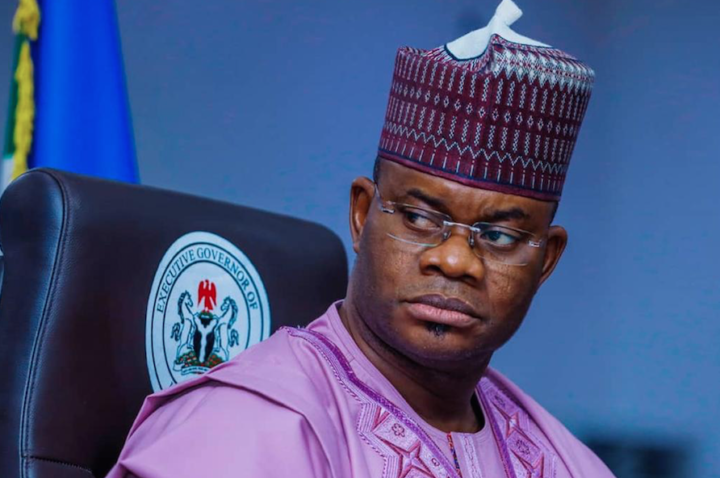
Fresh details emerged on Thursday in the ongoing trial of former Kogi State Governor, Yahaya Bello, as a prosecution witness told the Federal High Court in Abuja how millions of naira were allegedly paid in cash for the construction of a luxury property in Maitama.
The witness, Shehu Bello, who appeared before Justice Emeka Nwite as the 14th prosecution witness, testified that he was aware of several cash payments allegedly made by Ali Bello in connection with the property project.
The Economic and Financial Crimes Commission (EFCC) is prosecuting Yahaya Bello over an alleged N80.2 billion money laundering case.
The anti-graft agency accused the former governor of involvement in financial crimes linked to funds allegedly diverted during his administration as governor of Kogi State.
At Thursday’s proceedings, the witness explained his role in helping to secure a construction company for the Maitama property located at Plot 1891, Dala Hills, Abuja.
According to him, Ali Bello, who is believed to be related to the former governor, approached him for assistance in finding a reliable company to handle the project.
“My friend, Ali Bello, approached me to ask if I knew any good construction company that could build a house for him,” the witness told the court.
“So, I recommended a company, Metro Deck Construction Company Limited. I brought them, and he gave them the job to build the house for him.”
The witness further stated that payments for the project were made both through bank transfers and cash transactions.
“Ali Bello made transfers to them, and on some occasions, he paid them in cash,” he said.
When asked about the specific amounts involved in the cash payments, Shehu Bello said he was aware of three separate payments.
“The ones that I am aware of are N9 million, N8.5 million and N5.8 million,” he told the court.
“These are the only three cash payments I am aware of.”
The witness confirmed that all the payments were made in naira.
Apart from the Maitama property, the witness also testified about another property transaction involving land located at Plot 1058, Cadastral Zone A08, Wuse II, Abuja.
According to him, Ali Bello contacted him for help in locating a commercial property in Wuse II where shops could be developed.
“My friend, Ali Bello, asked me if I could get him a property around Wuse II where he could build shops,” the witness said.
“After we spoke, I went out and got some people and spoke with some colleagues of mine.”
“We got a plot of land in that location, Durban Street, Plot 1058, Cadastral Zone A08, Wuse II, Abuja.”
The witness told the court that the property was purchased from SFC Foods Limited for N650 million through bank transfer.
“It was bought from SFC Foods Limited. The amount paid was N650 million. The payment was made via bank transfer,” he added.
The court proceedings later shifted from witness testimony to legal arguments after the EFCC attempted to tender extra-judicial statements made by the witness during investigation.
The EFCC’s lead counsel, Mr Kemi Pinheiro (SAN), sought to present the witness’s statements as evidence after Shehu Bello confirmed that he made them voluntarily and identified his signatures on the documents.
“Yes, it is my statement. It carries my signatures on all pages,” the witness said.
However, counsel to Yahaya Bello, Mr Adebayo Adedeji (SAN), objected to the move.
The defence lawyer argued that the prosecution could not tender the extra-judicial statement of its own witness as substantive evidence at that stage of the trial.
“My lord, we submit with respect that the statement sought to be tendered this morning by the prosecution, as though it constitutes substantive evidence in support of the prosecution’s case, is a misconception of the law and is inadmissible at this stage,” Adedeji argued.
He maintained that such statements are mainly useful to the defence when attempting to challenge the credibility of a witness.
According to him, the Supreme Court had already settled the legal position on the issue many years ago.
“My lord, this position was not made by me but by the Supreme Court in 1989,” he said.
The defence lawyer further argued that the statement being presented was not confessional and therefore should not be admitted against the defendant.
Responding to the objection, prosecution counsel Olukayode Enitan (SAN) described the defence argument as incorrect and based on a misunderstanding of the law.
“The witness has given his evidence on oath, he has owned the statement, and I urge your lordship to admit it,” Enitan told the court.
He argued that under the Evidence Act, a document becomes admissible once the person who made it appears in court to identify it.
He also said the court had the power to decide the weight to attach to the evidence after admission.
After listening to both sides, Justice Emeka Nwite adjourned the case until June 15 for ruling on whether the statements would be admitted as evidence.
The matter was also adjourned until June 18 for continuation of trial.
Thursday’s testimony came barely one day after another prosecution witness, Baba Bappa, an estate surveyor and facility manager, testified before the same court.
Bappa had told the court under cross-examination that he never handled any property transaction directly involving Yahaya Bello and only knew the former governor as a public figure.
The trial of the former governor has continued to attract national attention because of the large amount involved and the political profile of the defendant.
Yahaya Bello served as governor of Kogi State from 2016 to 2024 under the platform of the All Progressives Congress (APC).
The EFCC has accused him of involvement in large-scale financial crimes, including money laundering and diversion of public funds.
The former governor has denied all allegations against him.
Money laundering cases involving former public officials have become increasingly common in Nigeria as anti-corruption agencies intensify investigations into the management of public funds.
The EFCC has repeatedly stated that tackling corruption and financial crimes remains important for improving governance and public confidence in government institutions.
As proceedings continue, attention is expected to remain focused on witness testimonies, financial documents and property transactions linked to the case.