
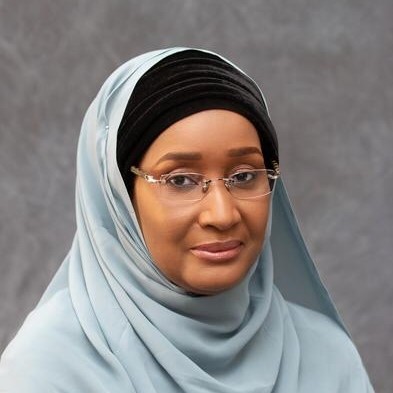
The Economic and Financial Crimes Commission has declared former Minister of Humanitarian Affairs and Social Development, Sadiya Umar Farouq, wanted over allegations of abuse of office and diversion of public funds.
The anti-graft agency made the announcement in a notice published on its official website on Saturday, marking a major development in ongoing investigations linked to activities during her time in office.
According to the notice, Farouq, who is 52 years old and from Zamfara State, is being sought by the commission in connection with alleged financial misconduct.
The EFCC also listed her last known address as EN008, Okpo River, off Agulu Street, Maitama, Abuja, and called on members of the public to provide information that could help security agencies locate and arrest her.
“Anybody with useful information as to her whereabouts should contact EFCC offices,” the notice stated.
The commission included several phone numbers and contact channels through which information could be passed to investigators.
The declaration came weeks after a Federal Capital Territory High Court sitting in Apo, Abuja, reportedly issued an arrest warrant against the former minister on April 16, 2026.
The court order followed legal proceedings connected to allegations of financial crimes and abuse of office linked to her stewardship at the Ministry of Humanitarian Affairs and Social Development.
As of Saturday evening, there was no official public response from Farouq regarding the EFCC’s declaration or the allegations against her.
Farouq served as Minister of Humanitarian Affairs, Disaster Management and Social Development under former President Muhammadu Buhari after her appointment in July 2019.
At the time, she was one of the youngest ministers in Buhari’s cabinet and became widely known for overseeing major federal government intervention programmes targeted at vulnerable Nigerians.
The ministry under her leadership supervised programmes such as conditional cash transfers, school feeding initiatives and humanitarian support schemes designed to assist poor households, internally displaced persons and victims of disasters.
During Buhari’s administration, the ministry became one of the most prominent government agencies because of the scale of funds allocated to social intervention programmes across the country.
However, the ministry also faced repeated scrutiny and allegations of financial irregularities, especially concerning the handling of relief materials, cash transfer programmes and contracts.
Public attention on the ministry increased significantly during and after the COVID-19 pandemic, when billions of naira were released for emergency interventions and welfare support.
Civil society organisations, opposition figures and anti-corruption groups had repeatedly called for transparency and accountability in the management of those funds.
In recent years, the EFCC and other anti-corruption agencies intensified investigations into activities linked to some former government officials accused of mismanaging public resources.
The declaration of a former minister as wanted is considered a major step because such actions usually indicate that investigators have either been unable to secure the individual’s appearance for questioning or require immediate arrest to continue legal proceedings.
The EFCC has in the past declared several politically exposed persons wanted in connection with corruption investigations, including former governors, ministers and senior public officials.
The anti-graft commission, established in 2003, is responsible for investigating and prosecuting cases involving financial crimes, money laundering, advance fee fraud and abuse of office.
Over the years, the agency has secured convictions against a number of public officials, although critics have sometimes accused it of selective prosecution and slow judicial processes.
Supporters of stronger anti-corruption measures argue that public officials entrusted with managing government funds must be held accountable to strengthen public trust in institutions.
The case involving Farouq is expected to attract significant national attention because of the strategic role her ministry played during Buhari’s administration and the large amount of public funds managed by the ministry.
Nigeria has long struggled with corruption allegations involving public office holders, with successive administrations promising reforms and tougher enforcement against misuse of public funds.
Despite these efforts, corruption remains one of the country’s major governance challenges, often affecting public confidence in government institutions and service delivery.
As investigations continue, the EFCC has urged Nigerians with useful information about the former minister’s whereabouts to cooperate with the commission.
The agency said efforts were ongoing to ensure that all those involved in financial crimes are brought before the law.
The latest development now places Farouq among high-profile former government officials currently facing scrutiny from anti-corruption agencies over alleged misuse of public resources.
With the arrest warrant already issued by the court and the EFCC’s public declaration, attention is likely to remain focused on the next steps in the investigation and possible legal proceedings against the former minister.