
President Bola Tinubu has said Nigeria’s economy is gradually recovering from years of financial challenges, noting that state governments are no longer struggling to pay workers’ salaries as they did before his administration’s economic reforms.
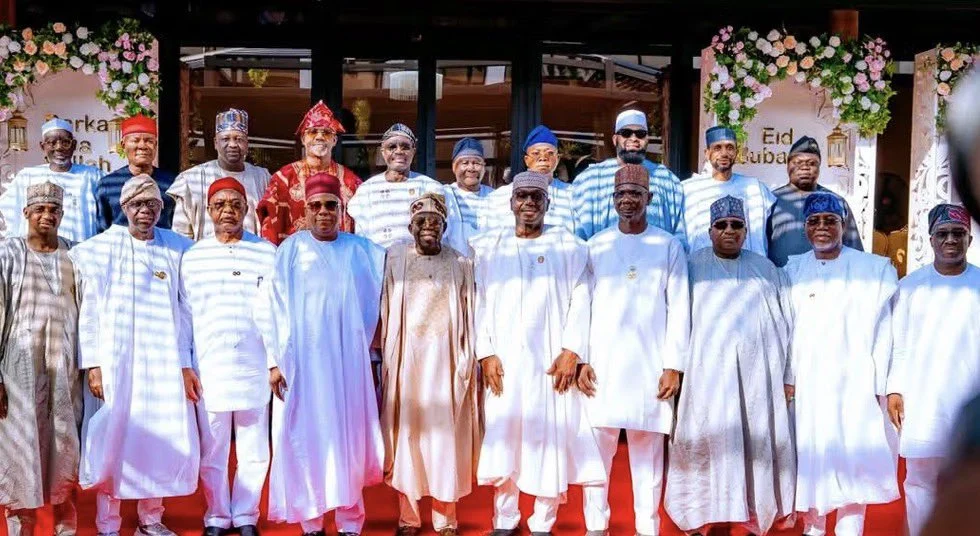
The President made the remarks on Friday while receiving members of the Nigeria Governors’ Forum (NGF), led by Vice President Kashim Shettima, during a Sallah homage at his Lagos residence.
Tinubu used the occasion to reflect on his political journey to the presidency, the challenges his administration faced after taking office, and the impact of the economic reforms introduced over the past three years.
According to the President, Nigeria has moved away from the threat of economic collapse and is now witnessing signs of growth in key sectors of the economy.
He said many state governments that previously depended on support and intervention funds from the Federal Government to meet salary obligations are now in a stronger financial position.
“I am glad that out of the 27 governors borrowing from the federal government and asking for interventions, we are no longer struggling to pay salaries. No more,” Tinubu said.
His comments come amid ongoing debates over the impact of major economic reforms introduced shortly after he assumed office in May 2023. These reforms included the removal of petrol subsidy and the unification of the foreign exchange market, policies that initially triggered sharp increases in fuel prices, transportation costs, food prices and general inflation.
While the reforms attracted criticism from labour unions, opposition parties and many Nigerians who faced rising living costs, the Federal Government has consistently argued that the measures were necessary to prevent a deeper economic crisis and place the country on a path of sustainable growth.
Speaking to the governors, Tinubu acknowledged that the road to the presidency was difficult and filled with political and legal obstacles.
“At the time, I faced the challenge of trying to become the President of the Federal Republic of Nigeria,” he said.
“It was very, very challenging. It was tough, for those who were in the party with me. Some kept faith, and instead of dodging the bullets, I took it. I took the point in the chin. Very hard work.”
The President also praised governors and members of his political party for standing by him throughout the election period and the early years of his administration.
According to him, many of his supporters backed him without knowing the specific policies he would eventually implement after assuming office.
“I didn’t disclose to anybody what I would do. Many of you took the risk and went along because of the party platform and everything. We survived. You faced litigations and accusations, and we survived it,” he said.
Tinubu said the support of governors was critical in maintaining public confidence during the implementation of reforms that he described as painful but necessary.
He noted that state governors helped persuade Nigerians to remain patient while the government worked to stabilise the economy.
“You kept the spirit, you kept the hope, you persuaded our people to be patient, to endure these three years of painful reforms, while we put the economy on reset,” he said.
The President argued that the benefits of those reforms are beginning to emerge, pointing to improvements in economic indicators and ongoing infrastructure projects across the country.
“Today, the benefit is showing. The economy has recovered, macroeconomic indices are doing very well,” he stated.
He added that several abandoned road and infrastructure projects are being revived and completed, while investment in housing development is increasing.
“Construction is ongoing on roads and infrastructure. The ones abandoned are being rehabilitated. The housing industry is coming on very well,” Tinubu said.
The President also expressed optimism about the agricultural sector, which he identified as one of the key drivers of economic growth and national development.
According to him, agriculture is showing encouraging signs of progress and has the potential to guarantee food security if properly supported by federal and state governments.
“Instead of bankruptcy, Nigeria has survived. The economy has recovered. It is growing. Agriculture is humming. Food is here,” he said.
Tinubu urged governors to take greater advantage of agricultural opportunities within their states by making productive use of available land and water resources.
He specifically highlighted the economic potential of projects along the Sokoto–Badagry corridor, describing the area as a major opportunity for irrigation, farming and electricity generation.
“Today I was watching some clips of the Sokoto-Badagry axis. Imagine how many dams on that corridor for irrigation, for farming land, for electricity,” the President said.
The Sokoto–Badagry Super Highway project is one of the flagship infrastructure initiatives of the current administration. Government officials have argued that the project will improve transportation, boost trade, support agriculture and connect economic activities across several states.
Tinubu maintained that with proper planning and investment, Nigeria has enough resources to achieve food sufficiency and reduce dependence on imported food.
He stressed that governors have an important role to play in ensuring that agricultural programmes succeed at the state level.
The President’s remarks come at a time when the Federal Government continues to defend its economic policies against criticism from opposition politicians and civil society groups.
Although inflation and the high cost of living remain major concerns for many Nigerians, government officials have pointed to rising state revenues, increased foreign exchange inflows, growing investor confidence and ongoing infrastructure development as evidence that the economy is gradually stabilising.
For many state governments, increased allocations from the Federation Account following the removal of fuel subsidy have provided additional revenue, helping them meet salary obligations, fund projects and reduce dependence on federal intervention programmes.
As the country moves closer to another election cycle, Tinubu’s comments reflect his administration’s position that the difficult decisions taken since 2023 are beginning to produce positive results and lay the foundation for long-term economic growth.