
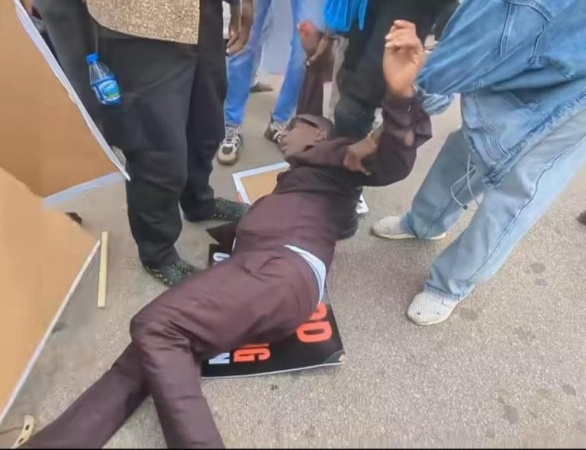
There was panic at the Unity Fountain in Abuja on Friday after activist and former presidential candidate, Omoyele Sowore, reportedly collapsed during a confrontation between police officers and protesters marking Nigeria’s Democracy Day.
The protest, which drew dozens of demonstrators to the popular gathering point in the Federal Capital Territory, was organised to draw attention to growing concerns over insecurity, rising economic hardship and what participants described as poor governance in the country.
Eyewitnesses said the situation turned chaotic when security operatives moved to disperse the crowd. Police officers allegedly fired tear gas canisters at the protesters in an apparent attempt to break up the demonstration, forcing many of those present to flee in different directions.
Amid the confusion, Sowore was said to have collapsed after being exposed to the tear gas. Videos circulating on social media showed the activist being supported by some protesters and sympathisers shortly after the incident. The exact extent of his condition was not immediately clear, but those around him quickly rushed to assist him.
The development created panic among protesters, many of whom condemned the use of force against citizens gathered for what they insisted was a peaceful demonstration.
Sowore, a prominent human rights campaigner and publisher of the online news platform Sahara Reporters, has remained one of the most vocal critics of successive Nigerian governments. He has led and participated in several protests over issues ranging from corruption and insecurity to economic policies and the protection of civil liberties.
The Democracy Day protest in Abuja was part of activities held by different groups across the country to express dissatisfaction with the current state of affairs in Nigeria. Protesters carried placards bearing messages calling on the government to address worsening living conditions and improve security.
Some of the inscriptions on the placards demanded urgent action on rising food prices, unemployment and the continued attacks by armed groups in different parts of the country.
Participants argued that many Nigerians were struggling to survive due to the high cost of living. They said the economic reforms introduced in recent years, including the removal of fuel subsidies and changes in the foreign exchange market, had placed additional pressure on ordinary citizens.
Nigeria has experienced a sharp increase in the prices of food items, transportation and essential goods. Many households have complained that their incomes can no longer meet basic needs, while small businesses have also faced mounting operating costs.
At the same time, concerns over insecurity remain widespread. Communities in several parts of the country continue to battle kidnappings, bandit attacks and other violent crimes. Protesters insisted that government at all levels must do more to protect lives and property.
Although the exact number of protesters at the Abuja gathering could not be confirmed, witnesses said the demonstration started peacefully at the Unity Fountain before the arrival of security personnel.
The Unity Fountain has long served as a symbolic venue for civic engagement and public demonstrations in the nation’s capital. Over the years, activists, labour groups and civil society organisations have used the location to voice concerns on national issues.
Friday’s incident, however, reignited debates over the rights of Nigerians to peaceful assembly and freedom of expression as guaranteed by the Constitution.
Human rights advocates have repeatedly maintained that security agencies should protect peaceful protesters rather than suppress them. They argue that citizens have the legal right to express their grievances without fear of intimidation or violence.
Critics of the police response questioned why force was deployed against demonstrators who were exercising their democratic rights on Democracy Day, a national holiday set aside to celebrate Nigeria’s return to civilian rule.
Democracy Day, observed every June 12, commemorates the annulled June 12, 1993 presidential election widely believed to have been won by the late Chief Moshood Kashimawo Olawale Abiola. The day is regarded as a symbol of the struggle for democratic governance and the sacrifices made by pro-democracy activists.
For many Nigerians, the anniversary provides an opportunity not only to celebrate democratic progress but also to reflect on the country’s challenges and demand better governance.
As of the time of filing this report, the Nigeria Police Force had yet to issue a detailed statement on the circumstances surrounding Sowore’s collapse and the use of tear gas at the protest.
Similarly, there was no official confirmation on whether any arrests were made during the incident.
The dramatic scenes at the Unity Fountain have once again highlighted the growing frustration among many Nigerians over economic difficulties and security concerns, while also raising fresh questions about the protection of civil liberties in the country’s democratic journey.