
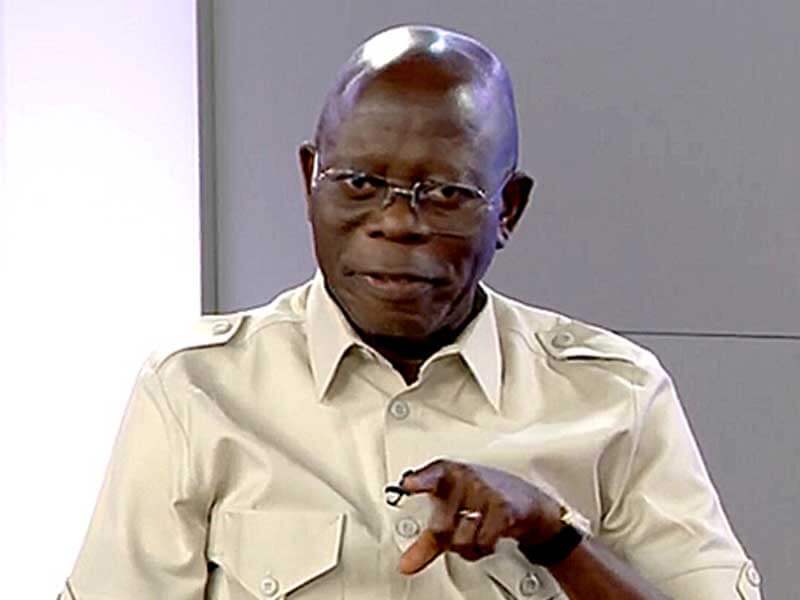
Edo North Senator and former President of the Nigeria Labour Congress (NLC), Adams Oshiomhole, has revealed that the late Chief Moshood Kashimawo Olawale (MKO) Abiola refused to surrender or negotiate away the mandate Nigerians gave him in the historic June 12, 1993 presidential election.
Oshiomhole made the disclosure during a lecture titled “June 12 and Beyond,” held in Akure, the Ondo State capital, where participants reflected on the journey of Nigeria’s democracy and the country’s current security challenges.
The former Edo State governor said he was among labour leaders who met with the late military Head of State, General Sani Abacha, in Abuja after the annulment of the June 12 election, widely regarded as the freest and fairest poll in Nigeria’s history.
According to him, despite pressure from government officials and intermediaries seeking a compromise, Abiola remained resolute and refused to trade the mandate entrusted to him by Nigerians.
Oshiomhole recounted that Abacha had indicated a willingness to accommodate Abiola in many ways but drew the line at Abiola’s insistence that he was the legitimately elected President of Nigeria.
“General Abacha told us he was ready to tolerate anything and do anything for MKO Abiola. The one thing he was not ready to tolerate was the idea that Abiola had proclaimed himself President of Nigeria,” Oshiomhole said.
He explained that labour leaders who engaged Abiola during that difficult period relayed messages from those seeking a settlement. However, Abiola insisted that the presidency was not his personal property to bargain with.
“He told those who sent us that he was elected President of Nigeria and would not sell the mandate entrusted to him by the Nigerian people,” Oshiomhole stated.
The June 12, 1993 election remains a defining moment in Nigeria’s democratic history. Conducted under the military administration of General Ibrahim Babangida, the election was widely believed to have been won by Abiola, the candidate of the Social Democratic Party (SDP).
However, before the final declaration of the results, the military government annulled the election, triggering nationwide protests, political unrest and international condemnation.
Many Nigerians viewed the annulment as a betrayal of the people’s will. The decision plunged the country into one of its most turbulent political periods and intensified demands for a return to democratic rule.
Abiola later declared himself President based on the mandate he believed Nigerians had freely given him. His action brought him into direct confrontation with the military authorities.
Following General Abacha’s takeover of power in November 1993, Abiola was arrested and detained in 1994 on charges related to treason after insisting on reclaiming his mandate.
He remained in detention for four years despite repeated local and international calls for his release. On July 7, 1998, Abiola died in custody under circumstances that remain a subject of public debate and national reflection.
For many Nigerians, his death transformed him from a politician into a symbol of democratic resistance and sacrifice.
Speaking at the lecture, Oshiomhole described Abiola as a courageous leader who placed the interests of Nigerians above his personal safety and comfort.
He said the late businessman and philanthropist understood the enormous sacrifices made by millions of Nigerians who voted for him and therefore refused to betray their trust.
According to the senator, Abiola’s conduct during the June 12 struggle demonstrated patriotism, integrity and uncommon bravery.
He urged younger Nigerians, many of whom were not born during the June 12 crisis, to study the events surrounding the election and draw inspiration from Abiola’s example.
Oshiomhole said the late politician’s victory transcended ethnic, regional and religious divisions, making him a unique symbol of national unity.
Abiola, a Yoruba Muslim from the South-West, secured widespread support across different parts of the country, including areas considered political strongholds outside his region.
The senator noted that preserving democracy requires citizens to defend justice, uphold accountability and actively participate in the democratic process.
He also linked the lessons of June 12 to contemporary governance challenges, especially the need to strengthen Nigeria’s security architecture.
Oshiomhole disclosed that President Bola Ahmed Tinubu is committed to accelerating constitutional reforms aimed at creating state police across the country.
Debates over state policing have intensified in recent years as Nigeria grapples with terrorism, banditry, kidnapping and other forms of insecurity.
Supporters argue that state police would improve response times and allow security agencies to better understand local environments and threats. Opponents, however, fear the system could be abused by state governments for political purposes.
According to Oshiomhole, the President has made his position clear on the matter.
“The President is really committed to moving quickly and getting the state police amendment passed,” he said.
“He has clearly told us to get it done, but he can’t just make it happen on his own.”
He stressed that constitutional amendments require broad support from lawmakers at the National Assembly and endorsement by state Houses of Assembly.
As Nigeria marked another Democracy Day anniversary, Oshiomhole’s reflections served as a reminder of the sacrifices made by individuals who fought for the country’s democratic freedoms.
More than three decades after the annulled June 12 election, the story of MKO Abiola continues to occupy a special place in Nigeria’s history.