
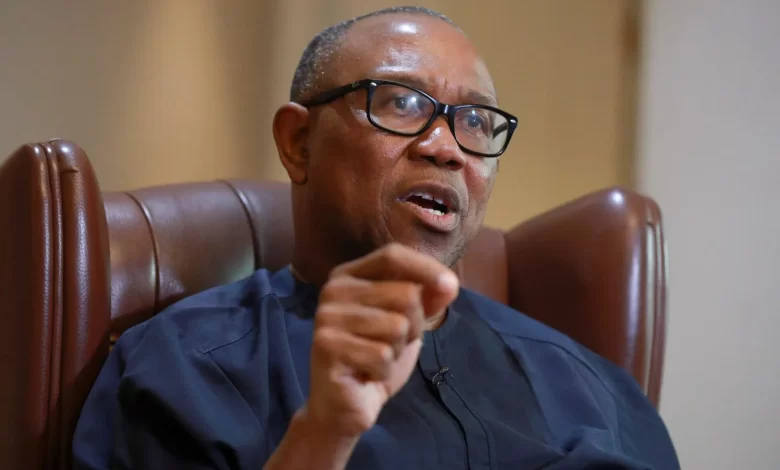
Former Anambra State Governor and presidential candidate of the Nigeria Democratic Congress (NDC), Peter Obi, has said that his desire to lead Nigeria is not driven by personal ambition or a quest for power but by a determination to address the country’s numerous challenges.
Obi stated that he is more interested in seeing Nigeria function effectively for the benefit of its citizens than in occupying the nation’s highest political office.
The former governor made the remarks during an interview on the Nevon HQ podcast hosted by journalist and media personality, Rufai Oseni.
Speaking on his political aspirations, Obi insisted that becoming president was not an end in itself, stressing that his greatest concern was improving the living conditions of Nigerians.
“I am not desperate to be president of Nigeria. I am desperate to see Nigeria work,” he said.
The former presidential candidate said Nigeria possesses enormous potential but has failed to harness its resources and opportunities for the benefit of its people.
According to him, the country can only move forward when leaders place national interest above personal gain and focus on solving the problems confronting ordinary citizens.
Obi expressed concern over the economic hardship being experienced across the country, particularly by young Nigerians who are struggling to secure jobs and build meaningful livelihoods.
He said the rising level of poverty and unemployment should worry every leader and policymaker.
“I am desperate to see young people have a means of livelihood. I am desperate to see people stop stealing public money. I am desperate to see Nigeria work,” he stated.
His comments come at a time when many Nigerians are grappling with high living costs, inflation and declining purchasing power.
In recent years, economic reforms, including the removal of fuel subsidy and exchange rate adjustments, have contributed to rising prices of goods and services, placing additional pressure on households and businesses.
Youth unemployment and underemployment also remain major concerns in Africa’s most populous nation.
Millions of young Nigerians continue to seek opportunities within and outside the country as they struggle to secure stable sources of income.
Obi has consistently argued that addressing unemployment should be a national priority, warning that idle youths could become vulnerable to crime, social unrest and exploitation.
The former governor has built much of his political message around themes of accountability, prudent management of public resources and investment in critical sectors such as education, healthcare and production.
During the 2023 general election, Obi attracted significant support, especially among young voters and urban professionals, many of whom viewed him as a symbol of change and an alternative to the country’s traditional political establishment.
His supporters, popularly known as the “Obidient Movement,” emerged as one of the most visible political groups during the election season, using social media and grassroots mobilisation to campaign across the country.
Although he did not win the presidential election, Obi has remained active in national discourse, frequently commenting on governance, economic management and public accountability.
He has repeatedly criticised what he describes as wasteful spending in government and has urged leaders to embrace transparency and discipline in the management of public funds.
His latest remarks against the theft of public resources reflect growing public frustration over corruption and its impact on development.
Nigeria has consistently ranked among countries battling corruption despite efforts by successive administrations to strengthen anti-graft institutions and improve accountability.
Obi maintained that the country’s problems are not beyond solution if leaders demonstrate sincerity, competence and a commitment to public service.
He stressed that his motivation remains rooted in a desire to see Nigerians enjoy a better quality of life.
As political activities gradually gather momentum ahead of future elections, statements by leading opposition figures are expected to shape debates around governance, economic recovery and national development.
For many Nigerians facing daily economic difficulties, issues such as job creation, rising inflation, insecurity and corruption remain more pressing than political rhetoric.
Obi’s remarks therefore touch on concerns shared by millions of citizens who continue to hope for a country where public resources are used responsibly and opportunities are available to all.
Whether his message translates into broader political support in future contests remains to be seen.