
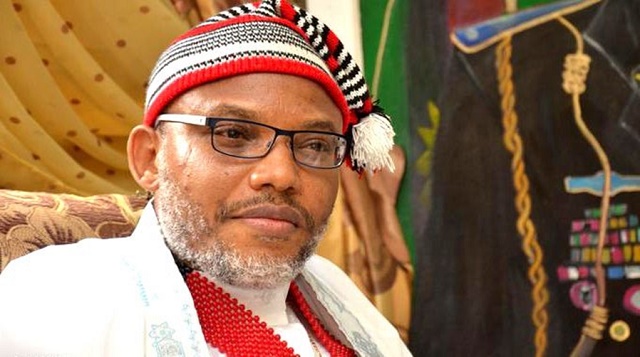
A major leadership crisis has erupted within the proscribed Indigenous People of Biafra (IPOB) following the decision by the group’s Directorate of State (DOS) to suspend the Office of its Leader, held by Nnamdi Kanu, and the position of the Director of Radio Biafra.
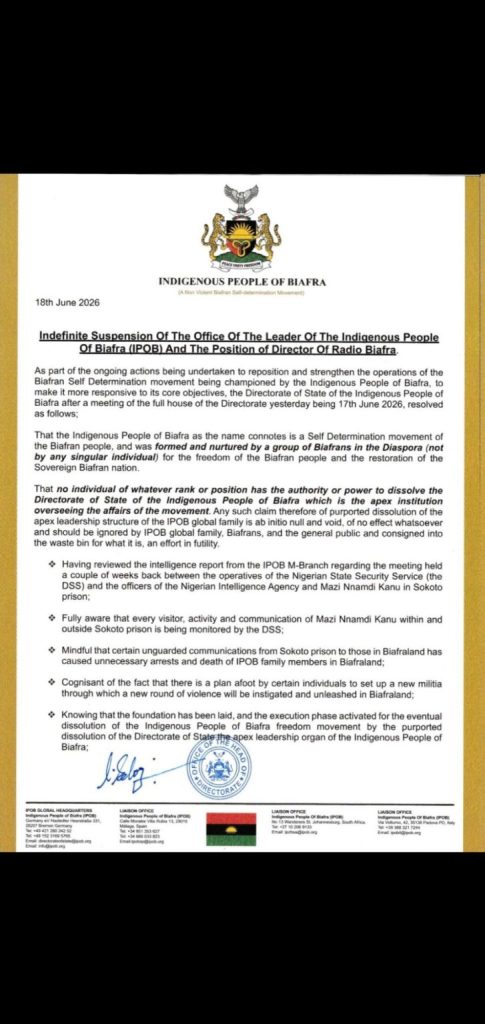
The development marks one of the most significant internal disputes in the history of the separatist organisation and comes amid growing concerns over the direction of the movement while Kanu remains in detention.
In a statement issued on Thursday and signed by Mazi Chikadibia Edoziem, Head of the Directorate of State of IPOB, the leadership said the decision was reached during a full-house meeting of the Directorate held on Wednesday.
According to the statement, members of the leadership body reviewed intelligence reports relating to communications allegedly originating from Kanu while he is being held at the Department of State Services (DSS) facility in Sokoto.
The group said the suspension was necessary to prevent further confusion within the organisation and to safeguard its members from what it described as the consequences of unguarded directives.
The statement announced that the Directorate of State would henceforth assume full responsibility for administering the affairs of the organisation and overseeing the activities of the movement.
According to the leadership, IPOB was founded and nurtured by a collective of Biafrans in the Diaspora and was not created by a single individual.
The group argued that no individual possesses the authority to dissolve the Directorate of State, which it described as the highest leadership organ of the movement.
It said the decision was taken after members became concerned that “certain unguarded communications from Sokoto prison to those in Biafraland” had resulted in unnecessary arrests and the deaths of some IPOB members in the South-East.
The leadership further claimed that Kanu’s visitors and activities in detention are closely monitored by security agencies, raising fears that information transmitted from prison could compromise the safety of members.
It also expressed concern over what it described as plans by certain individuals to establish a new militia group in the region, warning that such actions could trigger another cycle of violence in the South-East.
According to the statement, the suspension is intended to “prevent unchecked actions, reckless assumption of authority and unguarded utterances from resulting in the reckless arrests, torture and needless death of Biafran youths.”
The Directorate added that criminal acts committed by individuals acting in the name of the suspended offices would no longer be attributed to IPOB.
“IPOB shall henceforth not be held accountable for actions of individuals or groups of individuals not holding any active position within IPOB,” the statement added.
The latest development came barely a day after reports emerged that Kanu had dissolved the third administration of the Directorate of State.
According to those reports, Kanu, acting under what was described as his authority as leader of the movement, announced the inauguration of a fourth administration of the Directorate of State.
He was also said to have appointed United States-based Mazi Chris Nwaọgụ as the new Head of the Directorate.
In a separate statement attributed to IPOB spokesperson Emma Powerful, Nwaọgụ was directed to immediately assume responsibility for the administration, coordination and day-to-day management of the organisation’s affairs under Kanu’s direct supervision.
The conflicting announcements have exposed deep divisions within the movement over questions of authority, leadership structure and decision-making.
IPOB was established in 2012 as a separatist movement seeking the restoration of the defunct Republic of Biafra. The movement gained prominence through its campaigns for self-determination and support among some people in the South-East and parts of the South-South.
The Directorate of State was created by Kanu in the same year as the administrative arm of the organisation to oversee its operations and implement decisions.
Over the years, the body has been led by different individuals based in the Diaspora. Dr Justin Akujieze, based in the United States, headed an earlier administration, while Mazi Uchenna Asiegbu in Spain also served in the role.
Chika Edoziem, who signed the latest statement, was appointed to lead the third administration in March 2017 during Kanu’s earlier detention at Kuje Prison.
Kanu has remained a central figure in IPOB since its formation. He was first arrested in 2015 on charges bordering on treasonable felony before being granted bail in 2017. Following his disappearance after a military operation in his hometown in Abia State, he resurfaced abroad.
In June 2021, he was re-arrested and brought back to Nigeria from Kenya under controversial circumstances. Since then, he has remained in DSS custody while legal proceedings relating to terrorism-related charges continue.
His continued detention has fuelled calls by supporters for his release, while the Federal Government insists that the judicial process should be allowed to run its course.
The latest leadership dispute is expected to generate fresh debate over the future of IPOB and the cohesion of the organisation.
For now, it remains unclear whether Kanu’s loyalists and supporters of the Directorate of State will reconcile their differences or whether the divisions will widen in the days ahead.
What is certain, however, is that the internal crisis has opened a new chapter in the history of IPOB, raising fresh questions about leadership, legitimacy and the future direction of the proscribed group.