
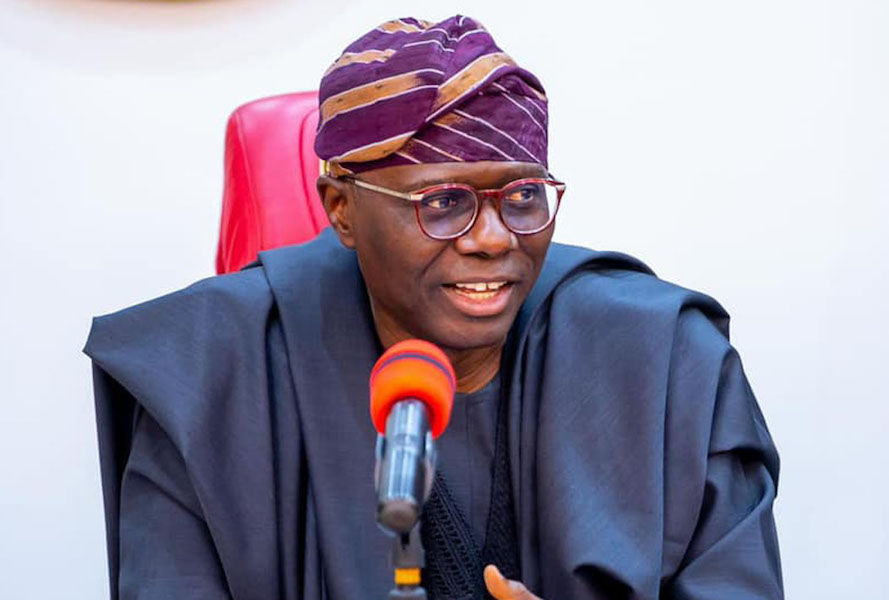
Lagos State Governor, Babajide Sanwo-Olu, has said the Omi Eko Project will significantly reduce travel time for residents, improve movement across the state and boost economic productivity through a modern and efficient water transportation system.
The governor said the project would transform the way Lagosians commute by providing safer, faster and more reliable alternatives to the often-congested road network.
Sanwo-Olu made the remarks while receiving a delegation from the European Investment Bank (EIB), led by its Vice President, Ambroise Fayolle, during a courtesy visit to Lagos House, Marina.
According to a statement issued by the Lagos State Government, the governor praised the European Investment Bank and other development partners for supporting what he described as a major investment in the future of transportation in Africa’s largest city.
He said the Omi Eko Project aligns with his administration’s THEMES+ development agenda, particularly the pillar focused on transportation and traffic management.
The THEMES+ agenda serves as the blueprint for the Sanwo-Olu administration and focuses on areas such as transportation, health, education, the environment, economic growth and social inclusion.
Sanwo-Olu noted that Lagos occupies a unique position as Nigeria’s commercial and economic capital, attracting investments in sectors such as technology, finance, innovation and entrepreneurship.
As the country’s most populous state, Lagos faces enormous transportation challenges caused by rapid population growth and increasing commercial activities.
Millions of residents rely on road transportation daily, resulting in persistent traffic congestion that affects productivity, increases travel costs and reduces the quality of life of commuters.
The governor said his administration was committed to changing this reality through an integrated transport system that combines roads, rail and waterways.
He explained that the Omi Eko Project is a major component of that broader vision.
According to him, the state intends to maximise the use of its waterways, noting that approximately one-third of Lagos is covered by water.
“The Omi Eko Project would provide modern and climate-resilient water transport infrastructure, including upgraded ferry terminals, safer navigation channels and improved commuter services,” Sanwo-Olu said.
He explained that the initiative, whose name translates to “Water of Lagos,” is designed to unlock the vast economic opportunities associated with the state’s waterways while easing pressure on existing transport infrastructure.
The governor said the project would bring major relief to residents who currently spend long hours commuting across the city.
According to him, journeys that now take as much as two hours by road could be reduced to between 40 and 45 minutes once the project becomes fully operational.
Such a reduction in travel time, he said, would improve productivity, reduce stress on commuters and enhance the overall efficiency of the state’s economy.
He described the project as a strategic investment with long-term benefits for both residents and businesses.
Sanwo-Olu thanked the European Investment Bank, the African Development Bank and other development partners for supporting Lagos State’s efforts to build a sustainable and efficient transport network.
He stressed that providing multiple transport options remains critical to addressing the mobility challenges facing Lagos.
According to him, expanding water transportation would reduce the heavy dependence on roads while complementing the state’s growing rail infrastructure.
Beyond transportation, the governor also welcomed the European Investment Bank’s increasing involvement in Nigeria’s small and medium-scale enterprise sector.
He described small and medium-sized enterprises (SMEs) as the backbone of economic growth, job creation and innovation.
Sanwo-Olu referred to the recently concluded Lagos Investment Summit, which attracted both local and foreign investors, saying the state remains committed to ensuring that investment commitments translate into tangible economic gains.
“We are determined to create an environment where investments can thrive and where our people can benefit directly from economic opportunities,” the governor said.
Earlier, EIB Vice President Ambroise Fayolle highlighted the growing partnership between Nigeria and the European Investment Bank.
He disclosed that Nigeria emerged as the bank’s largest country of operations in Africa in 2025, with total lending valued at €550 million.
According to Fayolle, the development reflects increasing confidence in Nigeria’s economy and the strength of the relationship between Nigeria, the European Union and the European Investment Bank.
He also announced that the EIB recently signed a €200 million facility agreement with the Development Bank of Nigeria.
The facility, he said, is aimed at supporting digital and environmentally friendly investments by micro, small and medium-sized enterprises across the country.
Fayolle further revealed that the bank had entered into a financing agreement with Wema Bank to improve access to credit for underserved businesses while promoting sustainable business practices.
Speaking specifically on the Omi Eko Project, the EIB vice president described it as one of the European Union’s flagship projects in Lagos.
He explained that the initiative is being jointly funded by the European Investment Bank, the European Union and the French Development Agency (AFD).
According to him, the project will support the construction of modern ferry terminals and facilitate the deployment of electric boats to improve water transportation services throughout Lagos State.
“The initiative is designed to reduce congestion, improve environmental sustainability and provide Lagos residents with a more efficient means of commuting,” Fayolle said.
He added that the European Investment Bank remains committed to supporting projects that promote economic growth, environmental resilience and improved living standards in Nigeria.
Transportation experts have long argued that Lagos must make better use of its waterways to effectively address its mobility challenges.
With an estimated population of more than 20 million people and increasing urban expansion, pressure on the state’s roads continues to grow despite ongoing investments in road rehabilitation and rail development.
Successive administrations in Lagos have introduced measures aimed at promoting water transport, but stakeholders believe sustained investment in infrastructure, safety standards and modern technology is essential to unlocking the sector’s full potential.
For many Lagos residents, the promise of shorter travel times and more convenient commuting options offers hope of relief from the daily struggle associated with navigating one of Africa’s busiest cities.