
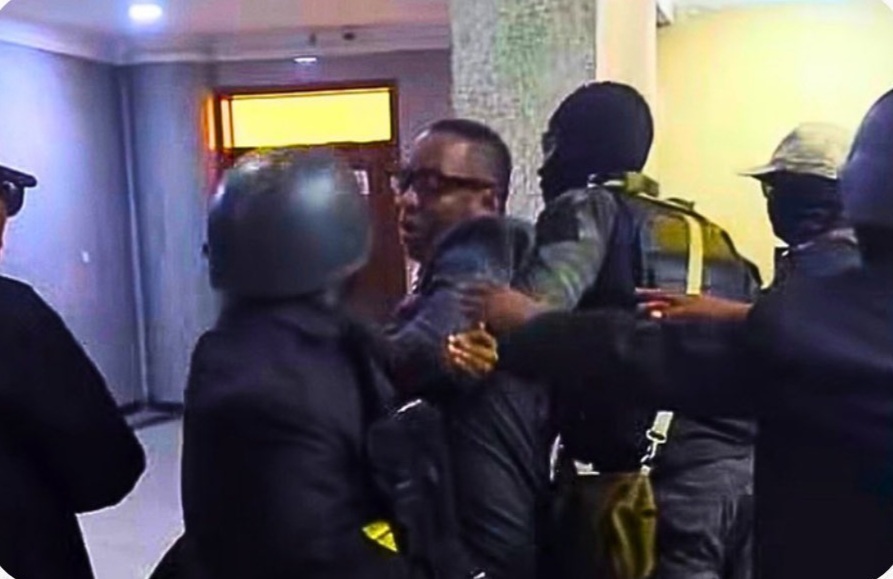
The Department of State Services (DSS) has launched an investigation into the conduct of its operatives following the remand of activist and former presidential candidate, Omoyele Sowore, at the Kuje Correctional Centre in Abuja.
The security agency announced the development on Tuesday amid public reactions to events that occurred at the Federal High Court in Abuja, where Sowore appeared in connection with charges filed against him.
In a statement issued by the Deputy Director of Public Relations and Strategic Communications of the DSS, Favour Dozie, the agency said it was aware of concerns raised by members of the public regarding incidents that took place at the court on Monday.
According to the DSS, the concerns include reports of an altercation involving a correctional officer as well as a reported scuffle involving security personnel during the proceedings that eventually led to Sowore’s remand.
The agency disclosed that its Director-General had ordered an immediate investigation into the actions of all operatives involved in the incident.
The DSS said the review would determine whether its personnel acted in accordance with established rules and professional standards.
“The Director-General has directed that the conduct of the operatives involved be investigated,” the agency stated.
The Service said it remains committed to transparency, professionalism and accountability and would thoroughly examine all circumstances surrounding the incident.
According to the statement, one of the unusual developments under review was the manner in which Sowore was transported after the court proceedings.
The DSS claimed that although arrangements had been made for him to be transported in a vehicle belonging to the Nigerian Correctional Service, Sowore reportedly chose to travel in a DSS vehicle instead.
The agency described the development as unusual and said investigators would examine all related circumstances.
The statement comes amid renewed public attention on Sowore, who has remained one of Nigeria’s most outspoken activists and critics of government policies.
Sowore, publisher of the online news platform Sahara Reporters and former presidential candidate of the African Action Congress (AAC), has frequently been involved in legal and political disputes with government institutions over his activism and public statements.
The DSS explained that the case currently before the court originated from a social media post allegedly made by Sowore on August 25, 2025.
According to the agency, the activist criticised President Bola Tinubu over comments reportedly made during a foreign trip.
The Service alleged that the publication violated provisions of the law and eventually led to legal action.
However, the DSS maintained that it did not immediately arrest Sowore after the publication.
Instead, the agency said it initially sought a non-confrontational resolution.
According to the statement, the Service wrote to Sowore on September 4, 2025, requesting a retraction of the publication within one week.
The agency said this approach was consistent with its preference for resolving disputes through dialogue and legal processes before resorting to enforcement actions.
The DSS argued that its actions in the matter followed a pattern it has adopted in similar cases over the years.
To support its position, the agency cited several previous cases in which it sought legal clarification or requested corrections and apologies before taking further action.
Among the examples mentioned was the court case involving political economist and public affairs commentator, Pat Utomi, whose proposed “Shadow Government” initiative was declared unconstitutional by a Federal High Court.
The DSS said that in such matters it has often preferred judicial interpretation and legal remedies rather than immediate arrests.
The agency also referred to previous defamation-related cases involving allegations made against some of its personnel.
According to the Service, courts ruled in favour of its officers in some of those cases, reinforcing the importance of using legal channels to resolve disputes.
On the legal basis of the current case, the DSS said Sowore was charged under Section 24 of the Cybercrimes (Prohibition, Prevention, etc.) (Amendment) Act, 2024.
The provision deals with certain forms of online communication that may be considered unlawful under Nigerian law.
The agency further disclosed that it did not oppose Sowore’s application for bail.
According to the statement, the activist was granted bail on self-recognition by the court.
The DSS stressed that it neither arrested Sowore in relation to the case nor sought to prevent the court from granting him bail.
It maintained that all actions taken were in compliance with judicial processes and court directives.
“The remand and related proceedings were based strictly on court processes,” the Service stated.
The agency’s clarification comes after criticism from some civil society groups and members of the public who questioned the circumstances surrounding Sowore’s remand and transportation.
Human rights advocates have continued to monitor the case closely because of Sowore’s long history of activism and previous encounters with security agencies.
Over the years, Sowore has emerged as one of Nigeria’s most prominent activists. He gained national attention through his role as publisher of Sahara Reporters, an online news platform known for investigative reports and criticism of public officials.
He later entered partisan politics and contested the 2019 and 2023 presidential elections under the African Action Congress.
His activism has often placed him in direct confrontation with successive governments and security agencies.
One of the most notable incidents occurred in 2019 when he was arrested following the #RevolutionNow protests, a development that generated widespread local and international reactions.
Since then, Sowore has remained an active voice on issues relating to governance, human rights, corruption and accountability.
The latest legal proceedings have once again placed him at the centre of national debate about freedom of expression, national security and the application of cybercrime laws.
Supporters argue that citizens have the right to criticise public officials and government policies, while others insist that freedom of expression must be exercised within the limits prescribed by law.
Against this backdrop, the DSS said it remains committed to balancing national security responsibilities with respect for legal and constitutional rights.
The agency reiterated that professionalism and adherence to the rule of law remain central to its operations.
It added that the ongoing investigation into the conduct of its operatives demonstrates its willingness to review its actions whenever concerns are raised.
As the investigation proceeds, attention will focus on the outcome of the internal review and whether any disciplinary or corrective measures will be taken.
For now, the DSS has assured the public that all allegations surrounding the court incident will be thoroughly examined, while insisting that its actions in the Sowore case were guided by legal procedures and judicial directives.