
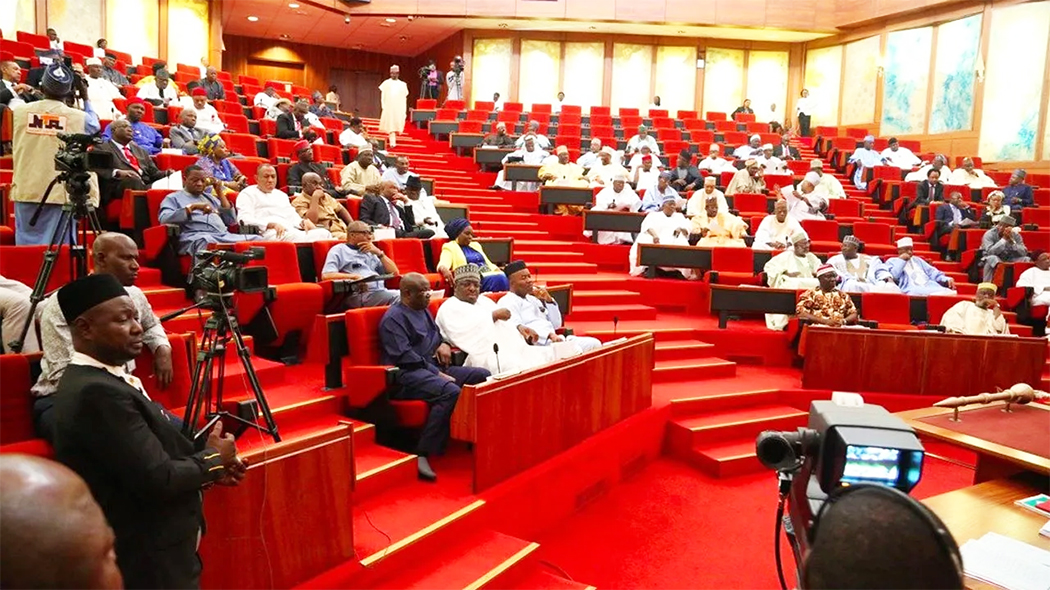
The Senate on Wednesday passed the Constitution Alteration Bill seeking to establish state police across Nigeria, marking a significant step in the country’s long-running effort to reform its security system and tackle growing insecurity.
The landmark legislation was approved after a detailed clause-by-clause consideration by lawmakers and secured the support of more than two-thirds of senators during a manual voting exercise conducted on the floor of the Senate.
The passage of the bill is widely regarded as one of the most important constitutional reforms undertaken by the 10th National Assembly and could fundamentally change the way policing is carried out in Nigeria if it completes the remaining constitutional processes.
Senate President Godswill Akpabio announced the passage of the bill after senators overwhelmingly voted in favour of the proposal during plenary.
The upper chamber approved the legislation after considering the report of the Senate Committee on the Review of the Constitution, which was presented by Deputy Senate President and Chairman of the Committee, Barau Jibrin.
The provisions of the bill were first examined at the Committee of the Whole before lawmakers adopted them and proceeded to the final vote.
Leading debate on the bill, Senate Leader Opeyemi Bamidele urged his colleagues to support what he described as a critical reform designed to strengthen internal security and improve responses to local security challenges across the country.
The proposed constitutional amendment seeks to create a state policing framework that would operate alongside the existing Nigeria Police Force, ending the Federal Government’s exclusive control over policing.
If eventually signed into law and approved through all constitutional requirements, every state would be allowed to establish and manage its own police service while the federal police structure continues to operate nationwide.
One of the major provisions of the bill empowers state governors to appoint Commissioners of Police for their respective states, subject to confirmation by their state Houses of Assembly.
Under Clause 17 of the proposed amendment, the Federal Police Service will continue to be headed by the Inspector-General of Police, while each State Police Service will be led by a Commissioner of Police appointed by the governor and confirmed by the state’s legislature.
The legislation also outlines how governors and state police commands will work together.
According to Section 17(6), a governor may issue lawful written directives of a general policy nature to the Commissioner of Police on matters relating to public safety and public order within the state.
The inclusion of this provision reflects the desire of supporters of state policing to ensure that local authorities have greater influence over security operations within their territories.
For many years, advocates of state police have argued that governors are often described as chief security officers of their states but lack direct control over security agencies operating within their jurisdictions.
Supporters believe that giving states greater authority over policing will allow faster responses to local threats and improve intelligence gathering within communities.
The debate over state police has remained one of Nigeria’s most controversial constitutional issues for decades.
Many security experts, traditional rulers, governors and civil society groups have repeatedly argued that Nigeria’s current centralised policing system is overstretched and unable to effectively respond to the country’s numerous security challenges.
Nigeria currently has a single national police force responsible for policing a population of more than 200 million people spread across 36 states and the Federal Capital Territory.
Advocates of reform say the existing structure has struggled to cope with rising cases of terrorism, banditry, kidnapping, communal conflicts, armed robbery and other crimes.
In recent years, insecurity has become a major concern across different parts of the country. The North-East continues to battle insurgency, while bandit attacks and kidnappings remain common in parts of the North-West and North-Central regions. Other areas have also experienced violent crimes and communal clashes.
Supporters of state police believe local officers who understand the language, culture and terrain of their communities would be better positioned to prevent and respond to crimes.
However, concerns over possible abuse of state police powers have remained one of the biggest obstacles to the proposal.
Critics have long warned that governors could use state-controlled police forces to harass political opponents, suppress dissent, intimidate journalists or influence elections.
To address these fears, lawmakers included safeguards in the bill aimed at protecting civil liberties and democratic rights.
One of the key safeguards is contained in Section 17(7), which provides that a state Commissioner of Police shall not arrest, detain, investigate or deploy force against any individual, political party or group merely for criticising the government, except in accordance with the law.
The provision is intended to ensure that state police formations are not used as political tools and that all actions taken by officers comply with due process and existing legal standards.
The Senate’s approval of the bill came shortly after lawmakers abandoned plans to use an electronic voting system for the consideration of constitutional amendment proposals.
The upper chamber had initially planned to deploy electronic devices for voting, but concerns emerged over technical glitches affecting some of the equipment.
Lawmakers feared that reliance on the electronic system could prevent some senators from participating fully in the historic exercise.
As a result, Bamidele moved a motion calling for the adoption of manual voting, arguing that every senator should have an equal opportunity to participate in the process.
Akpabio supported the proposal, stating that open voting would guarantee transparency and allow Nigerians to know where their representatives stood on important constitutional matters.
Following the decision, senators were called individually to publicly announce their names and declare their positions on the proposed amendments.
Several top government officials witnessed the proceedings, including Kaduna State Governor Uba Sani, Ogun State Governor Dapo Abiodun, Ondo State Governor Lucky Aiyedatiwa and the Chief of Staff to President Bola Tinubu, Femi Gbajabiamila.
Despite Wednesday’s Senate approval, the state police proposal has not yet become law.
Under Nigeria’s constitutional amendment process, the bill must still receive approval from at least two-thirds of the 36 state Houses of Assembly before it can be transmitted for presidential assent.
Political observers say the next stage may be crucial, as state legislatures across the country will have to decide whether to support the far-reaching reform.
If the proposal eventually becomes law, it could represent the most significant restructuring of Nigeria’s policing system since independence and may reshape the country’s security architecture for decades to come.
For now, supporters view the Senate’s decision as a major victory in the campaign for decentralised policing, while critics are expected to continue pushing for stronger safeguards against possible abuse of the new system.