
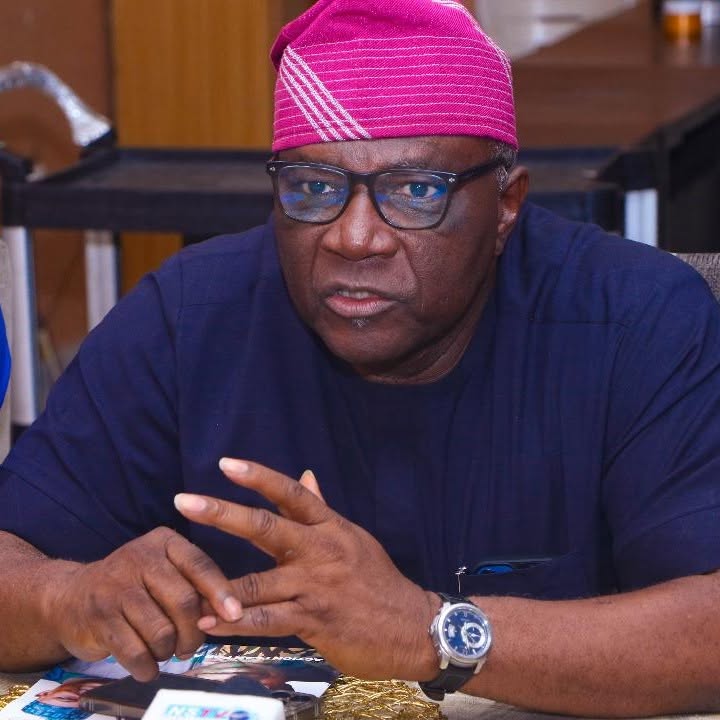
The Special Adviser to the President on Information and Strategy, Bayo Onanuga, has defended the economic policies of President Bola Tinubu, saying he does not personally see the level of hunger and hardship that many Nigerians frequently complain about.
Onanuga made the remarks on Tuesday during an interview on Arise Television, where he argued that several policies and projects introduced by the Tinubu administration are already producing positive results for citizens across the country.
His comments come at a time when many Nigerians continue to express concern over the rising cost of living, inflation, high food prices and declining purchasing power following a series of economic reforms introduced by the Federal Government since President Tinubu assumed office in May 2023.
Speaking during the interview, Onanuga pointed to infrastructure development as one of the major achievements of the administration. He cited his recent experience while travelling from Ibadan to Lagos, saying he was impressed by road projects that have improved transportation in parts of the South-West.
According to him, he was travelling from Ibadan to Lagos when Google Maps alerted him to heavy traffic on the approach to Lagos. To avoid the congestion, he decided to take an alternative route through Sagamu and Ijebu-Ode.
“One day, I was travelling from Ibadan to Lagos, and Google Maps told me that there’s a go-slow in the approach to Lagos, and I decided to take Ijebu-Ode via Shagamu,” he said.
“What struck me most was that I just found myself on a paved road, a concrete road. I said, ‘Wow, when was this one built?’”
The presidential aide said the improved road infrastructure has changed the mood of residents in the area, who previously complained about poor road conditions.
He added that many people in Ijebu and neighbouring communities now appreciate the benefits of the road project because it has improved movement and reduced travel difficulties.
“I found that our people, I mean, our Ijebu people, have stopped complaining. I said, ‘Oh, no wonder they now have a brand-new road that’s not just an asphalt road, a concrete road,’” he stated.
Onanuga also highlighted the ongoing Lagos-Calabar Coastal Highway project, one of the flagship infrastructure projects of the Tinubu administration.
According to him, the project has already improved travel time for many commuters living in parts of Lagos.
Using his personal experience as an example, he explained that the journey from central Lagos to his residence in Ajah now takes significantly less time than it did before.
“I live in Ajah. Anytime I go to Lagos, and I ask Google Maps to tell me how soon I will get home, Google Maps will tell me one hour, seven minutes. Before, it was two hours, 30 minutes, and the reason for that is that we now have a coastal road that has shortened my travel time,” he said.
Questioning criticisms directed at the government, Onanuga argued that such improvements should be recognised as tangible benefits of the administration’s policies.
“Is that not beneficial? What are people talking about, really?” he asked.
Beyond infrastructure, the presidential spokesman pointed to government social intervention programs and financial support initiatives aimed at easing the burden on Nigerians.
He specifically mentioned the Federal Government’s student loan scheme, which was introduced to help students in tertiary institutions access funding for their education without paying interest.
The scheme was launched under the Nigerian Education Loan Fund (NELFUND) and is designed to assist students who may struggle to pay tuition fees and other educational expenses.
According to Onanuga, parents whose children benefit from the program are already enjoying relief from financial pressures.
“If you are a parent and you have four children in university, and they’re able to access federal loans, which are interest-free, are they not benefiting?” he asked.
He also referred to low-interest credit facilities available to civil servants and workers, saying such programs provide affordable access to funds at a time when commercial lending rates remain high.
“If you are a civil servant and you can access the credit card, a very cheap loan at below interest, it is about seven per cent. Now people can access that loan at a single digit. Are they not benefiting as well?” he said.
Onanuga maintained that discussions about the economy often focus heavily on difficulties while ignoring some of the gains being recorded through government programs.
According to him, many people have formed fixed opinions about the administration without considering the broader picture.
“We have been pigeonholed into certain assumptions, certain conclusions,” he said.
The presidential aide also recalled a viral video that circulated shortly after President Tinubu assumed office. The video featured a voice-over in Yoruba saying “Ebi n pawa o,” meaning “we are hungry,” which quickly became a popular phrase on social media and in public conversations about the economy.
Onanuga said the phrase gained traction and has since been repeatedly used to describe the economic situation in the country.
“I think the President went to Lagos, he was coming from the Central Mosque, and somebody now did a voice-over saying ‘Ebi n pawa o,’ and that means we are hungry. Since then, people have been saying that,” he said.
While defending government policies, Onanuga acknowledged that Nigerians are facing economic challenges. However, he insisted that his personal experiences and interactions with people around him do not reflect the level of hunger often portrayed in public discourse.
“I’m a Nigerian. I have people working for me privately. I don’t see the level of hunger people are talking about because I see them, and I keep asking them questions: how are things, how are they adjusting, what are the problems?” he said.
His comments are likely to generate debate, especially as many Nigerians continue to struggle with the effects of economic reforms introduced by the Tinubu administration.
Since the removal of fuel subsidy and the unification of foreign exchange rates in 2023, prices of goods and services have risen sharply. Food inflation has remained one of the biggest concerns for households, while transport costs, electricity tariffs and other living expenses have also increased.
Government officials have repeatedly argued that the reforms were necessary to stabilise the economy, attract investment and reduce long-term economic distortions. They have also maintained that the benefits of the policies will become more visible over time.
However, labour unions, opposition parties and many citizens have continued to call for stronger measures to cushion the impact of the reforms on ordinary Nigerians.
As debate over the state of the economy continues, Onanuga’s remarks have once again highlighted the differing views between government officials who point to ongoing reforms and infrastructure projects, and many Nigerians who say daily economic realities remain difficult.