
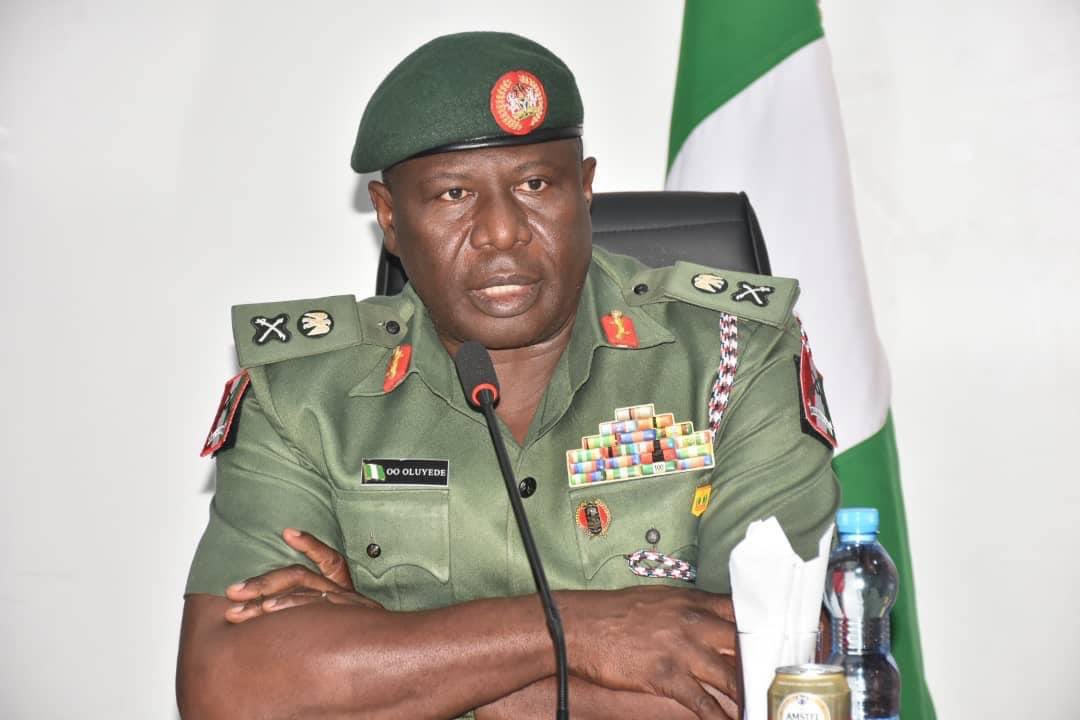
The Chief of Army Staff, Olufemi Oluyede, has blamed the worsening security situation in Nigeria on growing instability in the Lake Chad Basin, the Sahel region and the Gulf of Guinea, warning that conflicts beyond the country’s borders continue to fuel insecurity within Nigeria.
Oluyede said the changing security environment across West and Central Africa has made Nigeria’s security challenges more complex, with criminal and terrorist groups taking advantage of porous borders, weak regional stability and the easy movement of arms and fighters.
The Army Chief made the remarks while delivering a lecture during the 2026 Nigerian Army Day Celebration (NADCEL) in Port Harcourt.
He said Nigeria is currently facing multiple security threats ranging from terrorism and insurgency to banditry, cybercrime, transnational organised crime and conflicts linked to natural resources.
According to him, these threats have become increasingly interconnected, making it necessary for security agencies to adopt new strategies to respond effectively.
Oluyede noted that developments outside Nigeria’s borders continue to have direct consequences for the country’s internal security.
“Beyond Nigeria’s borders, instability within the Lake Chad Basin, the Sahel Region and along the Gulf of Guinea continues to influence and exacerbate the domestic threat environment,” he said.
He explained that armed groups operating in neighbouring countries often exploit Nigeria’s porous borders to move weapons, fighters and other illegal materials into the country.
The Army Chief also pointed to the widespread proliferation of small arms and light weapons as a major factor sustaining criminal activities across different parts of Nigeria.
According to him, ethnic and religious divisions are also being exploited by criminal elements to deepen conflicts and undermine national unity.
Oluyede said these factors have made the country’s security landscape far more complicated than it was in previous years.
He observed that traditional military tactics alone are no longer sufficient to deal with today’s security challenges because criminals and insurgents are increasingly adapting to modern technology.
According to him, the emergence of artificial intelligence, cyber operations, unmanned systems and other advanced technologies has changed the nature of warfare across the world.
He said the Nigerian Army is responding by embracing innovation and investing in modern capabilities to stay ahead of emerging threats.
The Army Chief explained that the military has continued to strengthen cooperation with other security agencies as part of efforts to improve national security.
He said intelligence sharing among security organisations has been expanded, while collaboration with local communities has also been strengthened to improve the gathering of information needed to prevent attacks.
According to him, effective intelligence remains one of the most important tools in disrupting the activities of terrorists, bandits and other criminal groups before they strike.
Oluyede disclosed that the Army has also increased investment in modern equipment and technology to improve operational effectiveness.
He said the military is combining kinetic and non-kinetic strategies in its campaign against insecurity.
While kinetic operations involve direct military action against criminal groups, non-kinetic measures focus on dialogue, community engagement, peace-building and other initiatives aimed at addressing the root causes of conflict.
According to him, this balanced approach has become necessary because military operations alone cannot permanently resolve complex security challenges.
The Army Chief said the Nigerian Army has also placed greater emphasis on protecting civilians during military operations.
He explained that the military remains committed to respecting human rights and ensuring that operations are conducted professionally in accordance with established rules of engagement.
He noted that building public confidence is essential to the success of counter-insurgency and other internal security operations.
Oluyede highlighted several reforms introduced by the Army to strengthen accountability and improve relations with the civilian population.
These include the establishment of Human Rights Desks in military formations, expanded civil-military cooperation programmes and stricter enforcement of operational guidelines designed to safeguard civilians.
He said such measures are helping to strengthen trust between soldiers and the communities where they operate.
The Chief of Army Staff also revealed that the Army is expanding specialised training for its personnel in response to changing security realities.
According to him, officers and soldiers are receiving additional training in counter-insurgency operations, urban warfare and cyber defence to prepare them for modern security challenges.
He added that the Army is also supporting reconstruction efforts, humanitarian activities and peace-building initiatives in communities affected by conflict.
Oluyede said restoring normal life in conflict-affected areas requires more than military victories, stressing that rebuilding infrastructure, supporting displaced persons and promoting peaceful coexistence are equally important.
The Army Chief reaffirmed the commitment of the Nigerian Army to professionalism, innovation and continuous improvement.
He said the service would continue to strengthen partnerships with other security agencies, regional organisations and international allies in addressing common security threats.
According to him, cooperation among countries in the region has become increasingly important because many of today’s security challenges extend beyond national borders.
The Lake Chad Basin has for more than a decade remained one of the major theatres of insurgency in West Africa, with terrorist groups operating across parts of Nigeria, Niger, Chad and Cameroon.
Similarly, the Sahel region has witnessed growing political instability, violent extremism and military coups in recent years, creating conditions that have enabled armed groups to expand their activities across several countries.
The Gulf of Guinea has also remained vulnerable to maritime crimes, including piracy, illegal oil theft, arms trafficking and other transnational criminal activities that affect regional security and economic development.
The Federal Government has continued to work with regional and international partners through platforms such as the Multinational Joint Task Force and other security cooperation arrangements aimed at tackling terrorism, organised crime and cross-border criminal activities.
The Nigerian Army has also intensified operations against insurgents, bandits and other armed groups across different parts of the country while expanding intelligence-led operations and community engagement initiatives.