
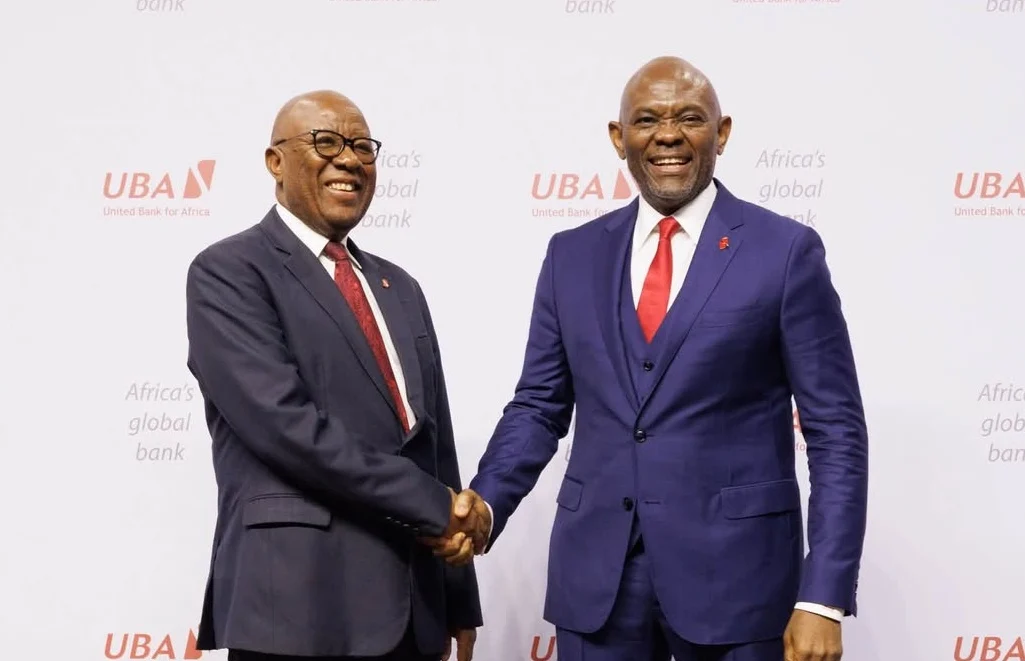
United Bank for Africa (UBA) Plc has announced that its Group Chairman, Tony Elumelu, will retire from the bank’s Board of Directors on August 21, 2026, bringing to an end a 12-year tenure as chairman and decades of service to one of Africa’s largest financial institutions.
The bank also announced that Emmanuel Nnorom, a current non-executive director on the board, has been appointed as the incoming Group Chairman. His appointment will take effect on the same day Elumelu officially steps down.
UBA disclosed the development on Monday after a meeting of its Board of Directors, explaining that Elumelu’s retirement is in line with the corporate governance guidelines issued by the Central Bank of Nigeria (CBN), which set a maximum tenure of 12 years for non-executive directors of commercial banks.
The lender said the transition reflects its commitment to complying with regulatory requirements while ensuring continuity in leadership.
In a statement issued after the board meeting, UBA paid tribute to Elumelu for what it described as his outstanding leadership and contribution to the growth of the bank over the past 12 years.
“The Board places on record its profound appreciation to Elumelu for his visionary leadership and exceptional contribution to the strategic vision and institutional strength of the UBA Group,” the statement said.
According to the bank, UBA recorded significant expansion under Elumelu’s leadership, strengthening its position as one of Africa’s leading financial institutions.
The bank noted that during his tenure as chairman, UBA deepened its pan-African expansion strategy and now operates in 20 African countries, alongside operations in four global financial centres.
It also stated that the bank currently serves more than 50 million customers across Africa and other parts of the world.
UBA explained that Elumelu’s retirement is part of efforts by Nigerian banks to comply with the CBN’s corporate governance code, which was introduced to promote board independence, accountability and sound corporate governance in the banking industry.
The guidelines require non-executive directors, including chairmen of banks, to leave office after serving the maximum period allowed.
The announcement marks the end of another major chapter in Elumelu’s long relationship with UBA, a bank he has been associated with for decades.
Widely regarded as one of Africa’s leading bankers and investors, Elumelu played a key role in transforming UBA from a Nigerian commercial bank into a major pan-African financial institution with operations across the continent and an international presence in Europe, the United States, the United Kingdom and the Middle East.
Reacting to the announcement, Elumelu expressed gratitude for the opportunity to lead the institution, describing his years as chairman as one of the greatest honours of his career.
In a farewell message posted on his Facebook page under the title *”Celebrating an African Institution: My Farewell from UBA,”* he reflected on the vision that guided his leadership.
“I have never been able to look at Africa and see only borders. Where many see fifty-four separate markets, I saw one continent, one destiny — waiting to be transformed, waiting to be believed in,” he wrote.
According to him, Africa’s greatest challenge is not the shortage of talented people but the need for strong institutions that can survive beyond individual leaders.
“Africa does not have a shortage of brilliant women and men. Africa suffers a shortage of institutions that outlast brilliant women and men,” he stated.
Elumelu described his departure as a moment of excitement rather than sadness, saying leadership is about knowing when an organisation is ready for a new phase.
“Leadership is not about holding onto a position, but knowing when an institution is ready for the next chapter,” he said.
He added that he would conclude his tenure as chairman on August 21 with “profound gratitude, immense pride and great optimism for the future.”
Reflecting on the bank’s growth, Elumelu said his vision had always been to build an institution that would connect Africa to itself and to the rest of the world while creating lasting value beyond any individual.
According to him, that vision has now become a reality.
“Today, that vision is reality. UBA Group serves over 50 million customers, operates across 20 African countries and four continents, supports trade and investment, and demonstrates that an African institution can compete globally, while being deeply committed to our continent’s development,” he said.
He also thanked employees, customers, shareholders, regulators, directors and business partners for contributing to the bank’s success.
“This success belongs to generations of dedicated colleagues, exceptional management, visionary directors, loyal customers, supportive regulators, committed shareholders and partners who believed in our shared purpose,” he added.
The appointment of Emmanuel Nnorom as incoming Group Chairman is expected to ensure continuity in the bank’s leadership.
Nnorom has served as a non-executive director on UBA’s board and is expected to assume responsibility for overseeing the bank’s strategic direction and corporate governance after Elumelu’s retirement.
Although the bank did not provide further details about his plans as chairman, industry analysts believe his experience on the board will help maintain stability during the leadership transition.
Founded in 1949, UBA has grown into one of Africa’s largest financial institutions, with operations spanning retail banking, corporate banking, investment services and digital banking.
The bank has continued to expand its presence across the continent, making it one of the few Nigerian financial institutions with a truly pan-African footprint.
Beyond banking, Elumelu has become widely known for promoting entrepreneurship through the Tony Elumelu Foundation, which has provided training, mentorship and funding to thousands of young entrepreneurs across Africa.
His philosophy of “Africapitalism” has also influenced discussions on the role of the private sector in driving economic development across the continent.
The leadership transition at UBA comes at a time when Nigeria’s banking sector is undergoing significant changes following regulatory reforms by the Central Bank, including stricter corporate governance rules and ongoing recapitalisation efforts aimed at strengthening the industry.