
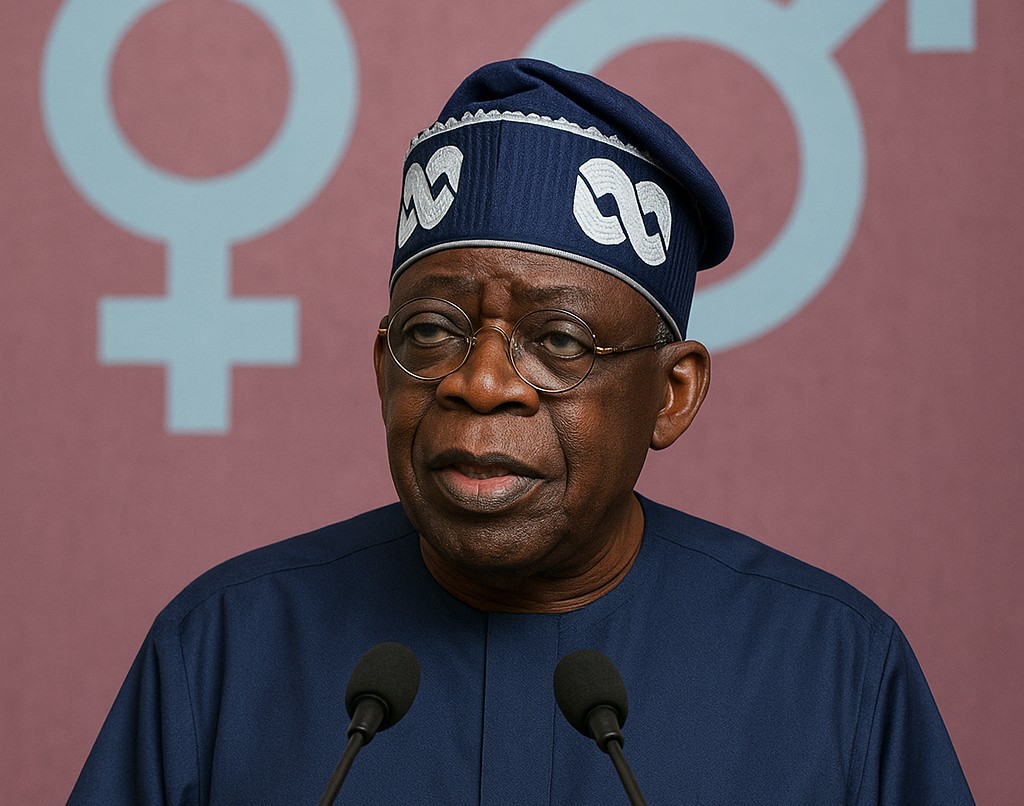
President Bola Tinubu on Monday defended his administration’s decision to remove the Federal Capital Territory Administration (FCTA) from the Treasury Single Account (TSA), saying the move has given the nation’s capital the financial flexibility needed to speed up infrastructure development.
The President said the decision has already produced visible results across Abuja through faster project execution and extensive urban renewal, despite initial criticism from those who opposed the policy.
Tinubu also dismissed claims that his administration was interfering in the affairs of the judiciary by funding infrastructure projects for courts and legal institutions, insisting that providing such facilities is a constitutional responsibility of the executive arm of government.
The President spoke during the inauguration of the new Office Annex of the Body of Benchers and 10 units of four-bedroom staff quarters at the Nigerian Law School in Bwari, Abuja.
He was represented at both events by the Secretary to the Government of the Federation, Dr George Akume.
The Treasury Single Account was introduced by the Federal Government to consolidate revenues from Ministries, Departments and Agencies into a single account maintained by the Central Bank of Nigeria. The policy was designed to improve transparency, reduce leakages and strengthen public financial management.
However, the Tinubu administration decided to exempt the FCTA from the TSA, arguing that the unique responsibilities of managing Nigeria’s capital city require quicker access to funds and greater financial flexibility to execute projects.
Speaking on the decision, Tinubu said the exemption had removed bureaucratic delays that previously slowed the implementation of critical infrastructure projects.
According to him, the policy has allowed the FCT Administration to work more efficiently with financial institutions while delivering projects without unnecessary administrative bottlenecks.
“When we pulled the FCT Administration out of the Treasury Single Account, there were sceptics. There were those who questioned the wisdom of that financial liberation.
“But we did it because we knew that local administration must have the liquidity, the speed and the corporate flexibility to interface with financial institutions and deliver critical projects without bureaucratic strangulation. Today, the results are glaring,” the President said.
Tinubu maintained that the rapid transformation taking place across Abuja has justified the government’s decision.
He credited the Minister of the Federal Capital Territory, Nyesom Wike, with driving the administration’s vision of turning Abuja into a modern and world-class capital city.
According to the President, infrastructure development and urban renewal projects carried out over the past three years have significantly changed the face of the Federal Capital Territory.
“When I appointed Minister Wike, I gave him a clear mandate to transform Abuja into a modern, functional and world-class capital city.
“Over the last three years, the scale of infrastructural development, urban renewal and project delivery in the FCT has been unmatched,” Tinubu said.
The President also praised Wike for resolving a long-standing land documentation challenge involving the Nigerian Law School.
He said the minister facilitated the issuance of the institution’s Certificate of Occupancy after many years without a formal land title, describing the achievement as an important milestone for the school.
Speaking at the inauguration of the Body of Benchers’ Office Annex, Tinubu said the project reflected his administration’s commitment to strengthening democratic institutions, the rule of law and the justice sector.
He rejected suggestions that the executive was attempting to influence the judiciary by constructing facilities for judges and members of the legal profession.
According to him, improving infrastructure for the judiciary does not amount to interference but rather demonstrates government’s responsibility to create an enabling environment for justice delivery.
“Let me be absolutely clear: the provision of infrastructure for the legal community and the judiciary is not an interference in the independence of another arm of government.
“Rather, it is a constitutional and collaborative duty of the executive to ensure that those who interpret and uphold our laws are provided with an environment that fosters operational efficiency and excellence,” he said.
Tinubu stressed that a strong judiciary requires modern facilities to perform its constitutional responsibilities effectively.
He said investments in courts and legal institutions are essential for strengthening democracy and improving access to justice for Nigerians.
At the Nigerian Law School, the President said quality infrastructure is necessary for producing competent legal practitioners capable of serving the country.
He noted that the newly completed staff quarters represent only the first phase of broader investments planned for the institution.
According to him, the Federal Government is currently funding the construction of a new auditorium, additional student hostels and the digitisation of the Law School’s academic and administrative operations.
He explained that the projects are aimed at improving both learning and living conditions for students and staff.
“We cannot build a world-class legal system with dilapidated infrastructure,” Tinubu said.
The President further disclosed that similar projects are being executed across the justice sector.
These include the construction of the Abuja Division of the Court of Appeal, magistrates’ courts and residential quarters for judicial officers.
He said the investments demonstrate the administration’s determination to strengthen institutions that uphold democracy rather than merely constructing physical buildings.
According to him, the government’s objective is to rebuild key national institutions through sustained investment and reforms.
“We promised not just to govern, but to reform. We promised to rebuild the broken structures of our institutional foundations,” Tinubu said.
He added that the projects being commissioned across the country reflect the administration’s commitment to fulfilling its campaign promises through measurable achievements.
The President said institutional development remains central to his government’s agenda, stressing that improving public infrastructure in sectors such as justice, education and governance would contribute to national development.
The inauguration of the Body of Benchers’ Office Annex and the new staff quarters at the Nigerian Law School formed part of a series of projects recently commissioned by the Federal Government in the Federal Capital Territory.
The Body of Benchers is Nigeria’s highest legal institution responsible for the formal admission of qualified lawyers to the Bar as well as maintaining professional standards and discipline within the legal profession.
Similarly, the Nigerian Law School serves as the final stage of legal education for law graduates before they are called to the Nigerian Bar.
The President maintained that the visible infrastructure projects across Abuja and the justice sector demonstrate that his administration remains focused on delivering practical results through policy reforms and strategic investments aimed at strengthening national institutions and improving public service delivery.