
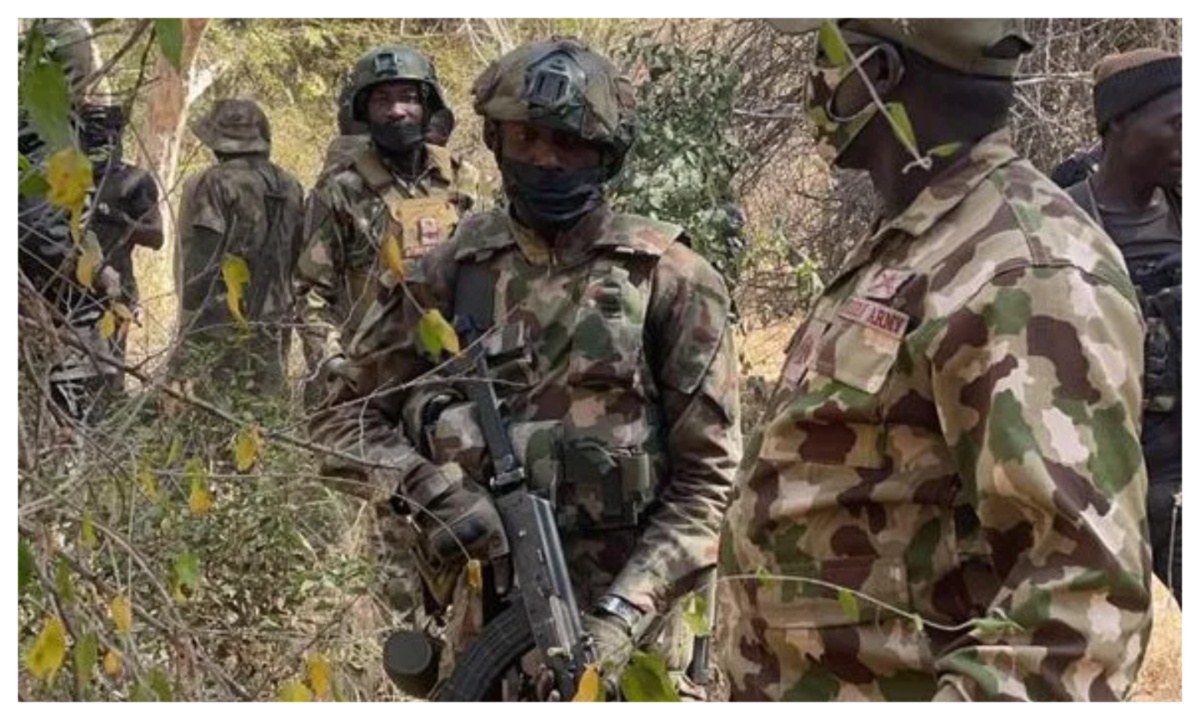
Troops of the Joint Task Force North-West, Operation FANSAN YAMMA, have intensified their offensive against terrorist groups operating in the North-West, killing a notorious terrorist commander, foiling planned attacks on communities and recovering weapons during separate operations in Zamfara and Katsina states.
The military said the successful operations were carried out through coordinated ground and air offensives backed by intelligence gathering and support from local security volunteers.
The development was disclosed in a statement issued on Monday by the Media Information Officer of Operation FANSAN YAMMA, Lieutenant Colonel Aliyu Danja.
According to the statement, the operations formed part of the military’s ongoing efforts to dismantle terrorist networks, protect farming communities and restore peace across the troubled North-West.
The statement said troops of Sector 2, acting on credible intelligence, intercepted armed terrorists who were preparing coordinated attacks on communities in Kaura Namoda Local Government Area of Zamfara State.
The troops, working closely with local security volunteers, moved swiftly to block the terrorists before they could strike.
A fierce gun battle followed, forcing the attackers to retreat into nearby forests after suffering casualties.
The military did not disclose the exact number of terrorists killed or injured during the encounter but described the operation as successful.
The statement added that troops later responded to another attack targeting farmers around Dogon Kade in the same local government area.
During the operation, soldiers engaged the attackers and neutralised a notorious terrorist commander identified as Alhaji Tukur.
According to the military, Tukur was the younger brother of a wanted terrorist kingpin, Alhaji Shehu Bagiwaye, who has been linked to several violent attacks in parts of Zamfara State.
Security officials believe the death of the commander could weaken the operations of the criminal group operating in the area.
The military described Alhaji Tukur as a key figure within the terrorist network and said his elimination represents another major breakthrough in ongoing counter-terrorism operations.
In a separate operation within Kaura Namoda, troops responded to intelligence reports about suspicious movements around Sabon Gari.
On sighting the advancing soldiers, the suspected terrorists reportedly abandoned their planned operation and attempted to escape.
The troops pursued the fleeing suspects, killing one suspected terrorist during the operation.
A motorcycle believed to have been used by the fleeing attackers was also recovered.
The military said the recovery could provide useful intelligence for future operations against the criminal group.
In neighbouring Katsina State, troops on a fighting patrol encountered suspected terrorists along the Danmusa-Yantumaki road in Danmusa Local Government Area.
The soldiers engaged the armed men in another gun battle, forcing them to flee from the area.
Although no casualty figures were released, the military said several weapons and other items were recovered from the fleeing suspects.
Items recovered during the operation included two AK-47 rifles, two magazines loaded with 25 rounds of ammunition and a motorcycle.
Military authorities said the recovered weapons would be subjected to further investigation as part of efforts to track criminal networks operating across the region.
The operations were not limited to ground forces.
According to the statement, the Air Component of Operation FANSAN YAMMA also carried out a successful aerial mission in Zamfara State after receiving intelligence on the movement of a large group of terrorists.
The military said surveillance aircraft detected about 300 terrorists travelling on motorcycles between the Sunke-Kumbo axis and the Bayazaki riverine area in Gummi Local Government Area.
The group was reportedly moving towards communities believed to have been selected as targets for attack.
The statement explained that the terrorists attempted to take cover after noticing the approaching aircraft.
However, military pilots launched what the army described as precision airstrikes on the group, disrupting the planned attack.
Although the military did not disclose the number of casualties resulting from the air operation, it said the strike prevented what could have been a major assault on civilians.
Operation FANSAN YAMMA said the latest operations demonstrate the effectiveness of intelligence-led military campaigns being conducted across the North-West.
The military assured residents that security forces remain committed to sustaining pressure on terrorist groups and other criminal elements.
“The Joint Task Force North West Operation FANSAN YAMMA remains resolute in sustaining offensive operations against terrorist and criminal elements across the theatre and reassures residents of its unwavering commitment to denying terrorists freedom of action, protecting lives and livelihoods, and restoring lasting peace and security across the North-West,” the statement said.
The North-West has remained one of Nigeria’s most troubled regions in recent years, with armed groups carrying out attacks on villages, highways and farming communities.
States such as Zamfara, Katsina, Sokoto, Kebbi and parts of Kaduna have experienced repeated incidents of banditry, kidnapping for ransom, cattle rustling and attacks on security personnel.
Thousands of people have been displaced, while many farming communities have struggled to cultivate their land because of insecurity.
To address the situation, the Nigerian military has continued to launch coordinated operations involving ground troops, air support and intelligence units.
Operation FANSAN YAMMA is one of the major security operations established to combat terrorism, banditry and other violent crimes across the North-West.
In recent months, troops have intensified clearance operations targeting known terrorist camps, logistics routes and hideouts in forest areas across Zamfara, Katsina, Sokoto and neighbouring states.
Military authorities say improved cooperation with local communities and volunteer security groups has also strengthened intelligence gathering and enabled faster responses to planned attacks.
Despite these gains, security experts have repeatedly stressed the need for sustained military pressure, improved intelligence sharing and stronger collaboration among security agencies to prevent terrorist groups from regrouping.
They also argue that addressing poverty, unemployment and poor access to education in affected communities remains important for achieving lasting peace.
The latest operations are expected to boost public confidence in the military’s campaign against terrorism, especially in communities that have suffered repeated attacks.
Residents across the North-West have continued to call for sustained security operations to enable displaced families to return home and farmers to safely resume agricultural activities.
With the rainy season underway and farming activities increasing, security agencies have placed greater emphasis on protecting rural communities from attacks that could threaten food production and livelihoods.