
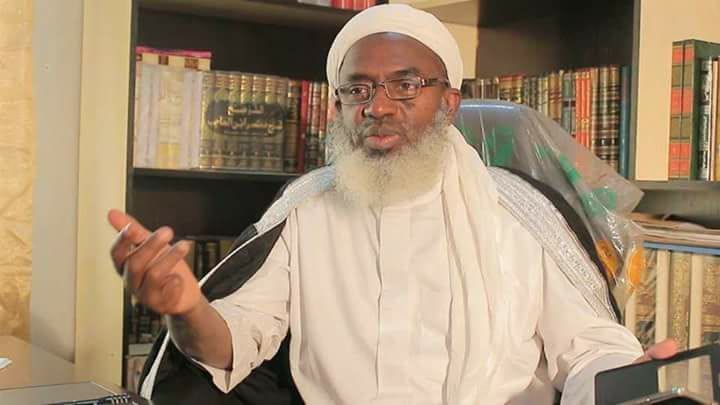
Islamic cleric Sheikh Ahmad Gumi has described the people of Northern Nigeria, commonly referred to as the Arewa, as “civilised,” saying groups such as the Indigenous People of Biafra (IPOB) and the Oodua People’s Congress (OPC) should learn from them.
Gumi made the remark in a Facebook post on Sunday, although he did not provide further details about what prompted the statement.
In the post, the cleric wrote: “Arewa is civilised, IPOB and OPC if they still exist should take a lesson.”
His comments have attracted attention on social media, coming amid ongoing national discussions on unity, ethnic relations and peaceful coexistence among Nigeria’s diverse communities.
While Gumi did not explain the basis of his comparison, his statement followed comments by the Eze Ndigbo in Kano State, Boniface Ndukwe, who spoke about the long-standing relationship between the Igbo community and the people of Kano.
In a video that has been widely shared on social media, Ndukwe said the Igbo community has lived peacefully in Kano for many years and has become an important part of the state’s economic and social life.
According to him, many Igbo businessmen have established successful enterprises in Kano and made the state their permanent home.
“We’re no more Igbos in Kano State but Igbos of Kano State because a lot of our Igbo brothers are big-time billionaires and our investment in Kano State is over trillions of naira,” Ndukwe said in the video.
His remarks highlighted the deep commercial and social ties between the South-East and Northern Nigeria, particularly Kano, which has for decades served as one of the country’s major commercial centres.
Thousands of traders from the South-East have lived and operated businesses in Kano for generations, contributing significantly to the state’s economy through investments in trade, manufacturing, transport and other sectors.
Despite periods of tension in different parts of the country, many community leaders have continued to emphasise the importance of peaceful coexistence among Nigerians regardless of ethnic or religious background.
Gumi’s comments appear to align with the broader conversation on inter-ethnic relations, although he specifically mentioned IPOB and OPC in his post.
IPOB is a separatist group that campaigns for the creation of an independent state of Biafra in Nigeria’s South-East. The group has been at the centre of security concerns in the region, with its activities leading to repeated confrontations with security agencies.
The Federal Government has designated IPOB as a terrorist organisation, a decision the group has consistently rejected.
The Oodua People’s Congress, popularly known as OPC, was formed in the 1990s to promote the interests of the Yoruba people. While the organisation has remained active in different forms over the years, its activities have evolved to include community security and cultural advocacy in parts of the South-West.
Gumi’s reference to OPC “if they still exist” suggested uncertainty about the group’s current level of activity, though he did not elaborate.
The cleric has remained one of Nigeria’s most outspoken religious figures, frequently commenting on national security, governance, ethnic relations and efforts to restore peace in areas affected by violence.
His views have often generated public debate, particularly because of his past involvement in dialogue initiatives aimed at addressing insecurity in the North-West.
Over the years, Gumi has called for peaceful engagement, reconciliation and dialogue as part of efforts to reduce violence and improve security in the country.
His latest statement is expected to generate mixed reactions, especially given the sensitive nature of discussions involving ethnic and regional groups.
Nigeria remains a multi-ethnic nation with more than 250 ethnic groups, making peaceful coexistence and mutual respect essential to national stability and development.
Community leaders, religious organisations and civil society groups have consistently urged Nigerians to embrace tolerance and dialogue while rejecting violence and hate speech.
The comments by Ndukwe, which preceded Gumi’s post, have been widely interpreted as highlighting the long history of cooperation between the Igbo community and the people of Kano..
As reactions continue to trail Gumi’s statement, attention is likely to remain on the broader conversation about national integration, inter-ethnic harmony and the role of community leaders in promoting peaceful relationships across Nigeria.
Neither IPOB nor OPC had publicly responded to Gumi’s remarks as of the time of filing this report.