
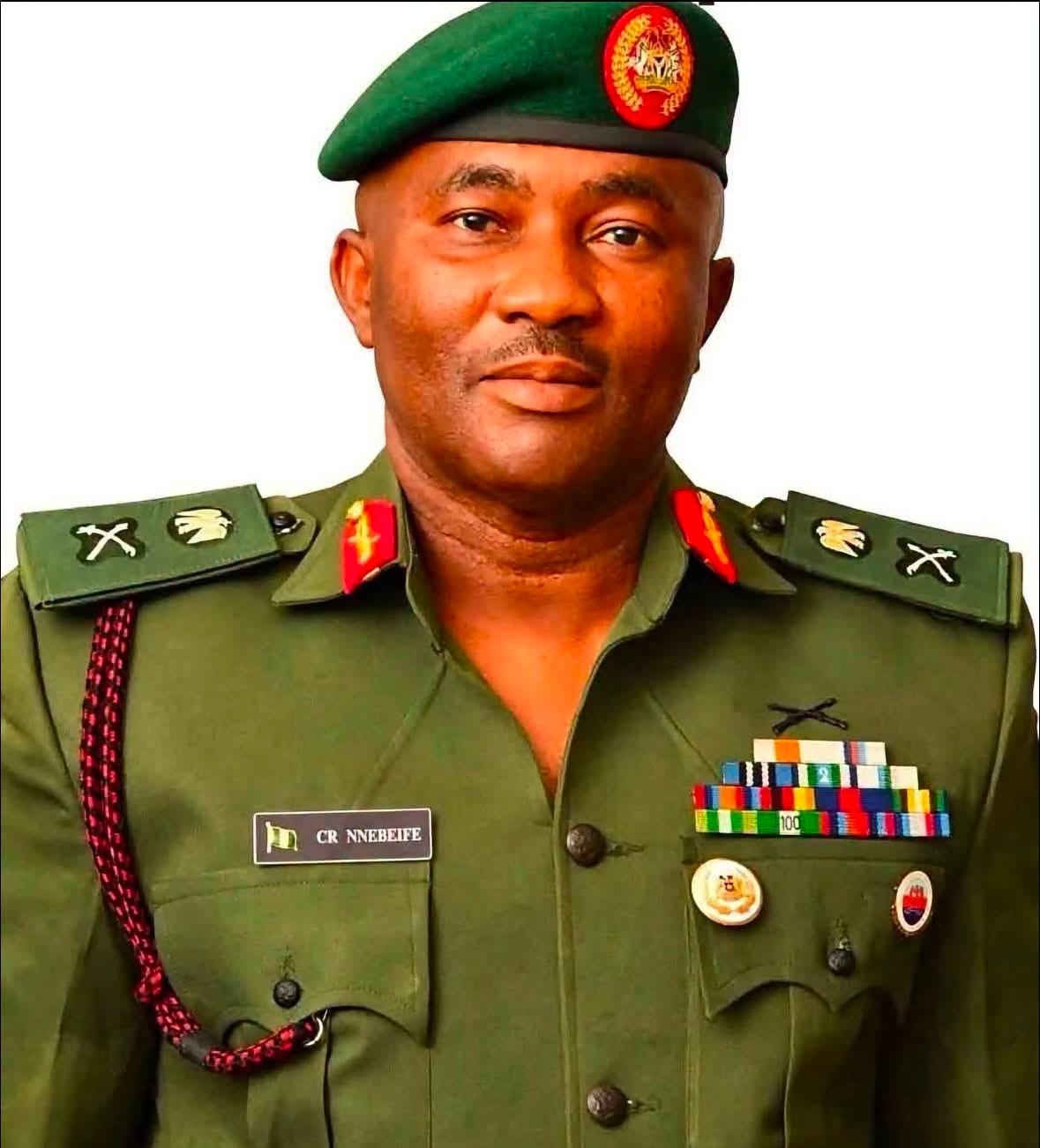
The General Officer Commanding (GOC) 2 Division of the Nigerian Army, Major General Chinedu Nnebeife, has revealed that the Nigerian Air Force and military drone teams were unable to locate the terrorists holding 44 abducted pupils and teachers in Oyo State because the thick forest canopy of the Old Oyo National Park blocked aerial surveillance.
The Army commander said the failure of air reconnaissance forced security forces to launch a dangerous ground operation deep into the forest, a mission that claimed the lives of a military officer and a soldier while several others sustained injuries.
Nnebeife made the disclosure on Monday during a press conference where he gave details of the military operation that eventually secured the release of the victims after they spent 56 days in captivity.
The pupils and teachers were abducted on May 15, 2026, when armed men attacked Community High School, Ahoro-Esiele, and schools in Yawota and Alawusa communities in Oriire Local Government Area of Oyo State.
The kidnapping sparked widespread concern across Nigeria and triggered a massive security operation involving the military, police, intelligence agencies and local security groups.
Explaining the challenges encountered during the rescue mission, Nnebeife said the dense vegetation in the Old Oyo National Park made it impossible for aircraft and surveillance drones to detect the kidnappers’ hideouts.
“Because of how thick the forest is, we brought in drone teams and the Nigerian Air Force to follow up, but in some of those areas, you can’t even see the sun’s rays from under the canopy,” he said.
“The Air Force flew over and couldn’t see anything; the drone team also flew and got nothing. That was how we assisted with the ground operation.”
According to him, with aerial surveillance proving ineffective, troops had no option but to enter the forest on foot to track down the kidnappers.
“It had to be a ground effort, going deep into the forest, and it was during one of these operations that we lost an officer and a soldier that day, with some others wounded, one of them seriously, with a broken arm from a gunshot wound,” he said.
The commander disclosed that the loss of personnel prompted him to assume direct control of the operation from the garrison commander to ensure better coordination of the rescue mission.
“I took over the whole operation completely from the garrison commander because we needed to bring in troops and forces from different places, providing intelligence, and I had to coordinate all these teams together,” he explained.
Nnebeife said the operation became one of the most coordinated security missions in recent times, bringing together personnel from several military formations and intelligence agencies.
He listed the participating units as the special team from the Office of the National Security Adviser (ONSA), the National Counter Terrorism Centre tactical team and the Defence Headquarters Special Forces.
According to him, the Special Forces included personnel drawn from the Nigerian Army, Navy, Air Force, Police, Department of State Services (DSS), Nigeria Security and Civil Defence Corps (NSCDC) and the National Intelligence Agency (NIA).
He added that the Nigerian Police also deployed its own tactical teams independently, while the DSS in Oyo State supported intelligence gathering.
The Nigerian Air Force deployed its Tactical Operations Group from Kainji, backed by fighter aircraft, while troops from Operation Savannah Shield based in Gwara were positioned to block possible escape routes along the northern boundary of Oyo State.
The Army commander also revealed that the first attempt to rescue the victims, carried out shortly after the abduction with the assistance of local hunters and vigilantes, was unsuccessful.
“We went in with some hunters and local vigilantes, but nothing positive happened that day,” he said.
He added that some of the hunters lost their lives during the wider operation, highlighting the dangers faced by all those involved in the rescue effort.
Despite the setbacks, security forces continued the operation for several weeks until they finally located the kidnappers.
“By the grace of God, on the 10th of July, we successfully rescued 44 of them,” Nnebeife said.
He stressed that the military never considered yielding to the demands of the kidnappers despite the difficult circumstances.
According to him, the abductors demanded the release of a detained Boko Haram commander in exchange for the victims and also held two teachers who later died while in captivity.
“I have always said we will never yield to terrorists’ demands. We will not, and we never will,” he declared.
Nnebeife explained that the breakthrough came after security forces cut off the kidnappers’ main supply route through a town identified as Ashamu.
The move, he said, placed enormous pressure on the criminals and eventually forced them to offer the unconditional release of the captives.
“But we were not giving up on them. We said no, this isn’t just about a release; we must see to the end of terrorism in that region, and indeed in the whole country,” he added.
Earlier, the Special Adviser to the President on Information and Strategy, Bayo Onanuga, confirmed that the rescue operation led to the arrest of eight suspected kidnappers.
According to him, the suspects have been handed over to the Department of State Services for further investigation.
He also disclosed that several other members of the kidnapping gang were killed during the operation.
Onanuga said the Federal Government secured the release of the victims without giving in to any of the kidnappers’ demands.
The Army also confirmed that the operation came at a heavy cost.
Among those killed was Lieutenant Felix Isaac, a 28-year-old officer who led troops during the final stages of the operation.
He died on July 10 while leading the assault against the kidnappers.
The young officer was buried with full military honours at the 23rd Armoured Brigade Cemetery in Yola, Adamawa State, on the same day the rescued pupils and teachers were formally handed over to the Oyo State Government.
The successful rescue has been widely praised by government officials and residents, although it has also highlighted the dangers security personnel face in combating kidnapping and terrorism.
The operation further underscored the challenges posed by Nigeria’s vast forests, which have increasingly become hideouts for kidnappers, terrorists and other criminal groups operating across several states.
Major General Nnebeife, who assumed command of the 2 Division at the Adekunle Fajuyi Cantonment in Ibadan on August 19, 2025, previously led another successful rescue mission in Kwara State’s Babasango Forest, where two kidnap victims were freed.