
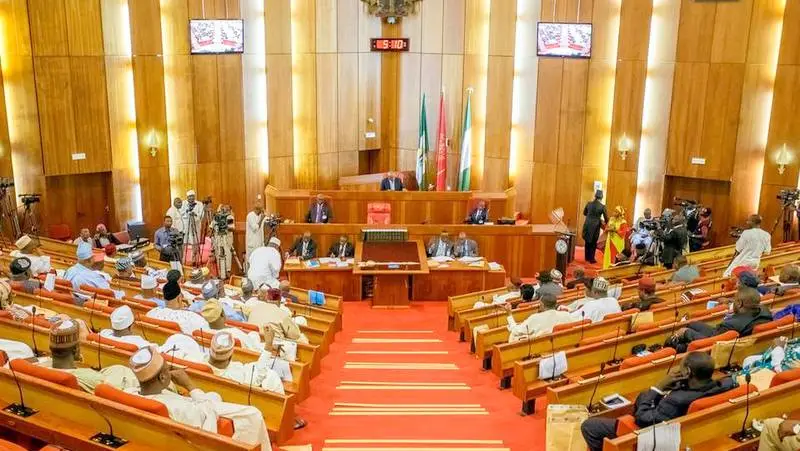
The Senate has passed the Federal Road Safety Corps (FRSC) Amendment Bill, 2026, proposing a ₦50,000 fine for anyone convicted of hawking, trading or preaching inside commercial vehicles as part of broader efforts to improve road safety and reduce distractions during travel.
The bill, which was passed on Thursday, is awaiting President Bola Tinubu’s assent before it can become law.
If signed into law, the amended legislation will introduce stiffer penalties for several traffic offences, including speeding, reckless driving, driving under the influence of alcohol or drugs, disobeying traffic signals and refusing to cooperate with road safety officials during roadside breath tests.
Under the proposed law, anyone found hawking, trading or preaching inside a commercial vehicle commits an offence and, upon conviction, will be liable to a ₦50,000 fine.
Lawmakers said the provision was introduced to reduce distractions inside buses and other commercial vehicles, thereby improving the safety of passengers and drivers.
In many parts of Nigeria, especially in major cities such as Lagos, Abuja, Port Harcourt and Kano, commercial buses are often used by traders selling goods ranging from snacks and drinks to household items. Religious preachers also frequently board buses to share sermons and solicit offerings from passengers during journeys.
While some commuters welcome these activities, others have expressed concerns that they can distract drivers, delay trips and create unnecessary noise inside vehicles.
The Senate believes regulating such activities will contribute to safer road transport and reduce avoidable distractions that may lead to accidents.
The proposed amendment also introduces tougher sanctions for motorists caught driving under the influence of alcohol or intoxicating drugs.
Under the existing law, offenders face a fine of ₦5,000. However, the amendment raises the penalty to ₦100,000. Convicted offenders could also face up to two years’ imprisonment or both the fine and imprisonment.
Similarly, motorists who refuse to cooperate with Federal Road Safety Corps officials during preliminary roadside breath tests carried out on reasonable suspicion would face a ₦50,000 fine, six months’ imprisonment, or both.
The Senate said the provision is intended to strengthen the ability of the FRSC to detect and discourage drunk driving, which remains a major cause of road crashes worldwide.
Another major change in the bill is the increase in penalties for disobeying traffic lights, road signs, pavement markings and other traffic control devices.
If the amendment becomes law, motorists who violate these traffic rules will pay a ₦100,000 fine, a sharp increase from existing penalties.
The bill also significantly raises the punishment for speeding.
Under the current law, speed limit violations attract a ₦5,000 fine. The amendment increases the penalty to ₦100,000, reflecting the Senate’s determination to discourage excessive speeding on Nigerian roads.
Reckless driving will also attract a ₦100,000 fine, with offenders facing up to two years in prison or both imprisonment and the fine upon conviction.
According to the Senate, the revised schedule of offences now lists 52 different traffic violations and their corresponding penalties.
Lawmakers said the review is aimed at strengthening the enforcement powers of the Federal Road Safety Corps while encouraging greater compliance with traffic regulations across the country.
The FRSC is the federal agency responsible for road safety administration, traffic law enforcement, public education and rescue operations on Nigerian highways.
Since its establishment in 1988, the Corps has introduced several initiatives aimed at reducing road crashes, including stricter driver licensing procedures, speed limit enforcement, vehicle inspections and public awareness campaigns.
Despite these efforts, road accidents remain a major public safety concern in Nigeria.
According to the FRSC, excessive speed, dangerous driving, driving under the influence of alcohol, driver fatigue, wrongful overtaking and poor compliance with traffic regulations remain among the leading causes of road crashes across the country.
Every year, thousands of people are injured or killed in road accidents, resulting in significant social and economic losses.
Road safety experts have consistently argued that stronger penalties can help deter dangerous driving behaviour if they are backed by effective enforcement.
However, they also stress that stricter laws alone may not solve the problem unless they are supported by improved road infrastructure, better driver education and fair enforcement.
The proposed amendment is part of ongoing efforts by the National Assembly to update Nigeria’s road safety laws to reflect present-day realities and strengthen public safety.
If President Tinubu signs the bill into law, the Federal Road Safety Corps will have expanded legal powers to enforce the new penalties and improve compliance with traffic regulations nationwide.
The proposed ban on hawking, trading and preaching inside commercial vehicles is expected to generate public debate, particularly among religious groups, traders and regular commuters who have long considered such activities a common feature of public transportation in Nigeria.
While supporters argue that the measure will reduce distractions and make journeys safer, critics may question its impact on freedom of expression and the livelihoods of roadside traders who depend on public transport to reach customers.
For now, the bill remains subject to presidential assent before its provisions can take effect. If signed into law, it will mark one of the most significant reviews of Nigeria’s road traffic penalties in recent years, with the aim of promoting safer roads and reducing preventable crashes across the country.