
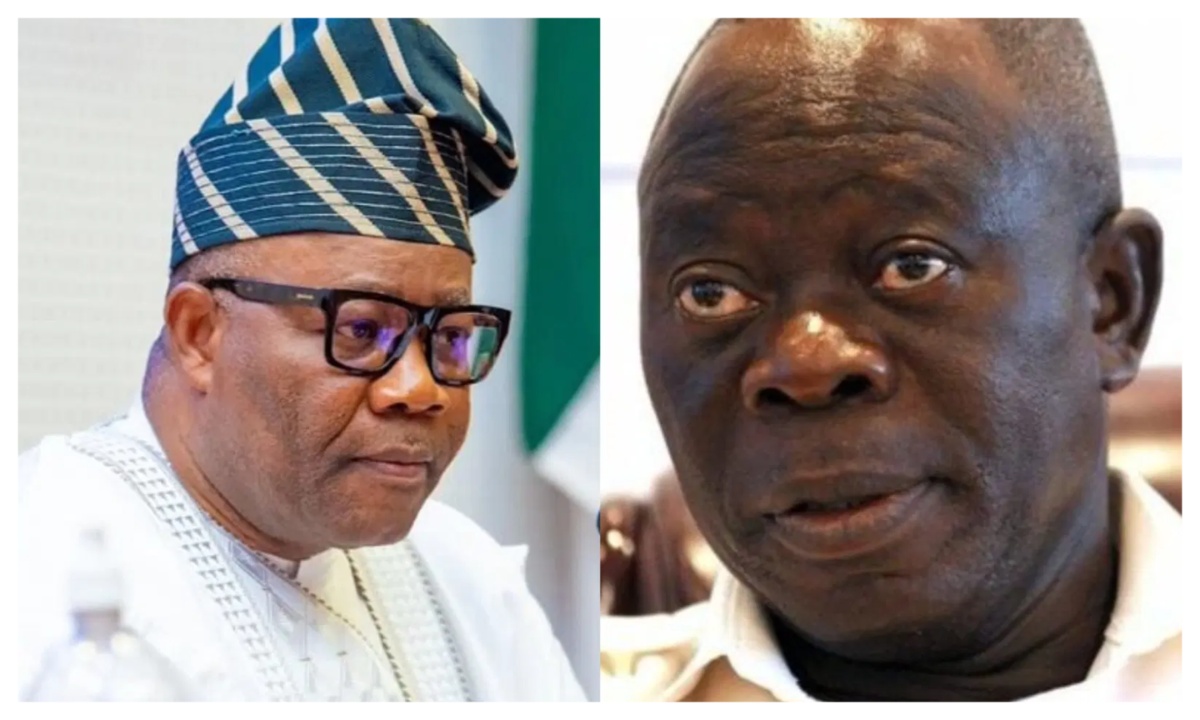
There was mild drama in the Senate on Thursday as Senate President Godswill Akpabio and former Edo State Governor, Senator Adams Oshiomhole, disagreed over the confirmation of Professor Abayomi Fasina as a non-career ambassadorial nominee despite allegations of sexual harassment against him.
The disagreement came during plenary while senators were considering the report of the Senate Committee on Foreign Affairs on the screening of ambassadorial nominees submitted by President Bola Tinubu.
Oshiomhole argued that confirming a nominee who is facing allegations of sexual harassment would send the wrong signal to Nigerians, particularly women, even though the allegations are yet to be determined by the courts.
According to the former president of the Nigeria Labour Congress, the Senate should exercise caution and allow the legal process to run its course before approving the nomination.
“Nigerian women have brought to the attention of this Senate that the professor in question has been accused by two women, not just orally, and these issues are pending before different courts,” Oshiomhole said during the debate.
He acknowledged the constitutional principle that every accused person is presumed innocent until proven guilty but insisted that public perception and the need to protect the integrity of public institutions should also be taken into account.
“I think the general view is that nobody says he is guilty; he is presumed to be innocent until proven guilty. But, as a matter of sensitivity, for the Senate to endorse a man who faces cases like that would amount to being insensitive to the feelings of women because it’s not just one woman; there are two women making different allegations.
“So, I thought that in matters like this, it would be more prudent to wait and ask the man to clear himself before the court,” he added.
However, Senate President Akpabio disagreed with Oshiomhole’s position, maintaining that the Senate could not deny a nominee confirmation based on allegations that had not been proven in court.
Akpabio reminded lawmakers that under the Nigerian legal system, every person is entitled to the presumption of innocence until found guilty by a competent court.
He stressed that the Senate must be guided by the Constitution and the law rather than public opinion or unproven claims.
Following the exchange, the Senate proceeded with the consideration of the report of the Senate Committee on Foreign Affairs and eventually confirmed Fasina as a non-career ambassadorial designate.
The committee’s report was presented by Senator Simon Lalong (APC, Plateau South) on behalf of the committee’s chairman, Senator Sani Bello (APC, Niger North).
Fasina’s confirmation came shortly before the end of his tenure as Vice-Chancellor of the Federal University Oye-Ekiti (FUOYE).
The ambassadorial confirmation is part of President Tinubu’s ongoing effort to fill vacant diplomatic positions following the recall of Nigerian ambassadors in 2023. Since then, many of the country’s foreign missions have been headed by chargés d’affaires while the government worked on appointing new envoys.
The nomination of Fasina has attracted public attention because of allegations of sexual harassment made against him by two women. The allegations have generated public debate and are reportedly the subject of legal proceedings.
Fasina has denied any wrongdoing, and no court has found him guilty of the allegations.
The disagreement between Akpabio and Oshiomhole reflected the wider debate over how public institutions should handle appointments involving individuals facing unresolved allegations.
While some observers argue that public office holders should not be appointed until such allegations are resolved, others insist that denying appointments based solely on accusations would violate the constitutional right to fair hearing.
The issue has also renewed conversations about accountability in public service and the need to balance respect for the rule of law with public confidence in government appointments.
Despite the disagreement on the Senate floor, lawmakers approved Fasina’s nomination alongside other ambassadorial nominees after adopting the committee’s recommendations.
The confirmation clears the way for the Federal Government to complete the process of appointing the new non-career ambassadors, who are expected to represent Nigeria in various countries once they receive their letters of credence and are posted to their respective missions.