
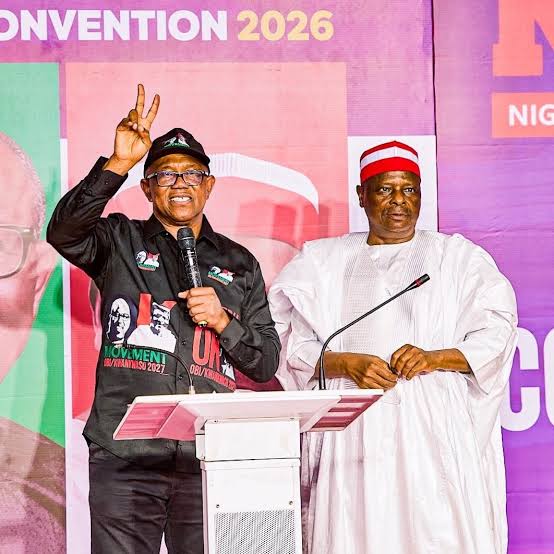
The vice-presidential candidate of the Nigeria Democratic Congress (NDC), Rabiu Kwankwaso, has confirmed that he and the party’s presidential candidate, Peter Obi, signed a written agreement committing Obi to serving only one four-year term if elected president in the 2027 general election.
Kwankwaso said the agreement provides that power would return to Northern Nigeria after a single four-year administration between 2027 and 2031, describing the arrangement as part of the party’s strategy to promote national unity and political stability.
He made the disclosure during an interview aired on Channels Television on Monday, where he spoke on the party’s zoning arrangement, his decision to accept the vice-presidential ticket and the NDC’s plans for the 2027 elections.
The former Kano State governor said he had absolute confidence that Obi would honour the agreement and had no reason to believe the former Anambra State governor would renege on his promise.
Asked whether Obi’s commitment to serving only one term was non-negotiable, Kwankwaso said he trusted his running mate’s integrity.
“Oh yes, I personally believe him and… I don’t think, based on what I now know about him… he will change his mind when the time comes, and we are all gentlemen, even though we have accepted to put it on paper,” he said.
When pressed on whether the agreement had been documented, Kwankwaso confirmed that it was formally signed.
According to him, there are two separate agreements covering the arrangement.
“We have done one for the party, and we have done another one between the two of us,” he said.
Explaining the contents of the agreement, Kwankwaso said both leaders had agreed to work together to ensure that after a single four-year tenure under Obi, the presidency would rotate back to the North.
“The agreement is what you said, that after four years… we will work together, team together as a group, as a party, as friends, brothers and so on… so that after his term, or our term, of four years, 2027 to 2031, then it comes back to the North, and that is the general agreement,” he stated.
According to Kwankwaso, the arrangement reflects the party’s belief that power sharing between the North and the South remains important for Nigeria’s unity and political stability.
He said the decision was reached after consultations within the party and was based on what members considered to be the current political realities in the country.
The former governor explained that although he had previously sought the presidency, he accepted the vice-presidential position because he believed a southern presidency for one term would promote fairness and strengthen national cohesion.
“Together we felt that the presidency should go to the South for four years; thereafter it will come back to the North. We believe that should be the consensus of everybody in this country so that we can move together as a family, both North and South,” he said.
Kwankwaso dismissed suggestions that accepting the vice-presidential ticket meant abandoning his own presidential ambition.
Asked whether he intended to contest the presidency in 2031, he declined to give a direct answer but indicated that the party was already considering both immediate and long-term political plans.
“We have a short-term plan which we are executing now and, of course, we also have our medium and long-term plans for the country, and that is what we are working on now,” he said.
The comments are the clearest confirmation yet that the NDC leadership has adopted a formal power-sharing arrangement ahead of the 2027 presidential election.
The issue of zoning and rotation of the presidency has remained one of the most sensitive topics in Nigerian politics since the return to democratic rule in 1999.
Although the Nigerian Constitution does not require the presidency to rotate between the North and the South, the principle has been widely adopted by major political parties as an informal arrangement aimed at promoting national inclusion and reducing political tensions.
The debate became more pronounced ahead of the 2023 elections following the decision of the then-ruling All Progressives Congress (APC) to zone its presidential ticket to the South, leading to the emergence of Bola Tinubu as the party’s candidate and eventual winner of the election.
The People’s Democratic Party (PDP), however, faced internal disagreements after it fielded former Vice President Atiku Abubakar, a northerner, despite calls from some members for the ticket to be zoned to the South.
Peter Obi had earlier announced his intention to serve only one term if elected president.
Speaking in May, Obi said he would willingly leave office after four years, insisting that his administration would focus on laying a solid foundation for national development rather than remaining in power.
“I want to be a one-term president because of stability. I would not stay a day, with a gun to my head, longer than four years,” Obi had said.
His declaration generated widespread debate, with supporters describing it as a demonstration of commitment to national unity, while critics questioned whether any future president could legally bind himself to such a promise before assuming office.
Kwankwaso’s latest disclosure suggests that Obi’s public promise was backed by a written political agreement between the two leaders and their party.
Neither Obi nor the leadership of the NDC has publicly released details of the documents signed by both men.
However, Kwankwaso maintained that the agreement reflects a shared commitment to fairness, mutual trust and political cooperation.
Supporters of the NDC argue that the agreement demonstrates the party’s commitment to inclusiveness and national balance, while opponents are expected to question whether such political agreements can bind an elected president under Nigeria’s Constitution.