
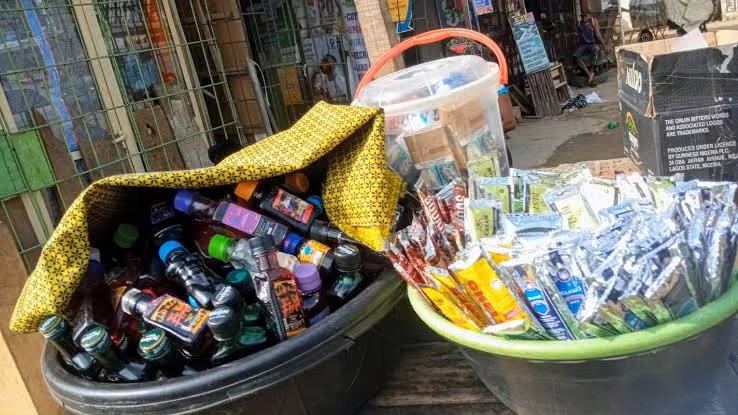
The National Agency for Food and Drug Administration and Control (NAFDAC) has launched a nationwide enforcement operation to remove alcoholic beverages packaged in sachets and small polyethylene terephthalate (PET) bottles from markets and other distribution channels across the country.
The agency said the operation is aimed at enforcing the Federal Government’s ban on the production, importation, distribution, sale and use of alcoholic drinks packaged in sachets and PET bottles smaller than 200 millilitres.
NAFDAC announced the development in a statement shared on its official X account on Wednesday, saying the exercise is taking place simultaneously across the six geopolitical zones of the country.
According to the agency, the enforcement exercise follows the closure of manufacturing facilities that failed to comply with the government’s directive and forms part of broader efforts to protect public health and reduce alcohol abuse.
The agency said its enforcement teams have been deployed to various locations, including markets, motor parks, retail shops, bars and other distribution outlets, where they are identifying, confiscating and removing banned products from circulation.
“NAFDAC enforcement teams are conducting coordinated operations in markets, motor parks, retail outlets, bars and other distribution channels to identify, seize and remove banned products from circulation,” the agency stated.
NAFDAC warned that every person or business involved in the production or sale of the prohibited products must immediately surrender any remaining stock.
The warning applies to manufacturers, importers, distributors, wholesalers, retailers, transporters and every other stakeholder in the supply chain.
The agency stressed that anyone found storing, distributing or selling the banned alcoholic beverages would face legal consequences.
It said continued possession or sale of the affected products amounts to a violation of existing regulations and could lead to confiscation of the products, regulatory sanctions and possible prosecution.
According to NAFDAC, the nationwide operation is not only about enforcing the law but also about protecting Nigerians from the dangers associated with harmful alcohol consumption.
The agency explained that one of the major objectives of the policy is to reduce underage drinking and substance abuse, especially among children, teenagers and young adults.
NAFDAC believes that removing these products from the market will help reduce their availability and discourage excessive alcohol consumption.
The agency also appealed to members of the public to cooperate with its officials by refusing to buy the banned products and reporting anyone involved in their production or sale.
It urged Nigerians to provide useful information to the nearest NAFDAC office or through the agency’s dedicated hotline whenever they encounter individuals or businesses violating the directive.
The current enforcement exercise marks another phase in the implementation of the Federal Government’s policy on alcohol packaging.
The ban was introduced after years of discussions involving government regulators, public health experts and manufacturers over concerns about rising alcohol abuse among young people.
Authorities have argued that alcohol sold in sachets and very small plastic bottles is often cheaper and easier to purchase, making it attractive to underage consumers and increasing the risk of abuse.
Industry stakeholders were initially given time to adjust to the new policy before full enforcement began.
NAFDAC had earlier granted manufacturers and distributors a transition period to clear existing stock and redesign their packaging in line with the new regulations.
During that period, the agency held several meetings with industry operators and repeatedly reminded them of the deadline for compliance.
With the transition period now over, NAFDAC says there will be no further extension and enforcement will continue across the country.
The agency noted that manufacturing facilities that failed to comply with the directive have already been shut down, while enforcement teams are now focusing on removing the remaining products from the market.
They also say alcohol abuse contributes to poor academic performance, family problems, crime and other social challenges, particularly among young people.
However, some traders and distributors are expected to be affected by the enforcement exercise, especially those still holding large quantities of the prohibited products.
NAFDAC has therefore advised affected businesses to cooperate fully with enforcement officers by surrendering any remaining stock rather than risking prosecution.
The agency reaffirmed its commitment to ensuring that all regulated products sold in Nigeria meet approved safety and public health standards.
It also assured Nigerians that the nationwide operation would continue until the banned alcoholic beverages are completely removed from circulation.
As enforcement teams intensify inspections across markets and other sales points, the agency has called on citizens to play an active role by complying with the directive and reporting offenders.
NAFDAC said the success of the exercise depends not only on government enforcement but also on public cooperation in preventing the sale and consumption of products that have been declared illegal.
The agency maintained that the nationwide mop-up is part of its broader responsibility to safeguard public health, strengthen regulatory compliance and reduce the harmful effects of alcohol abuse in Nigeria.