
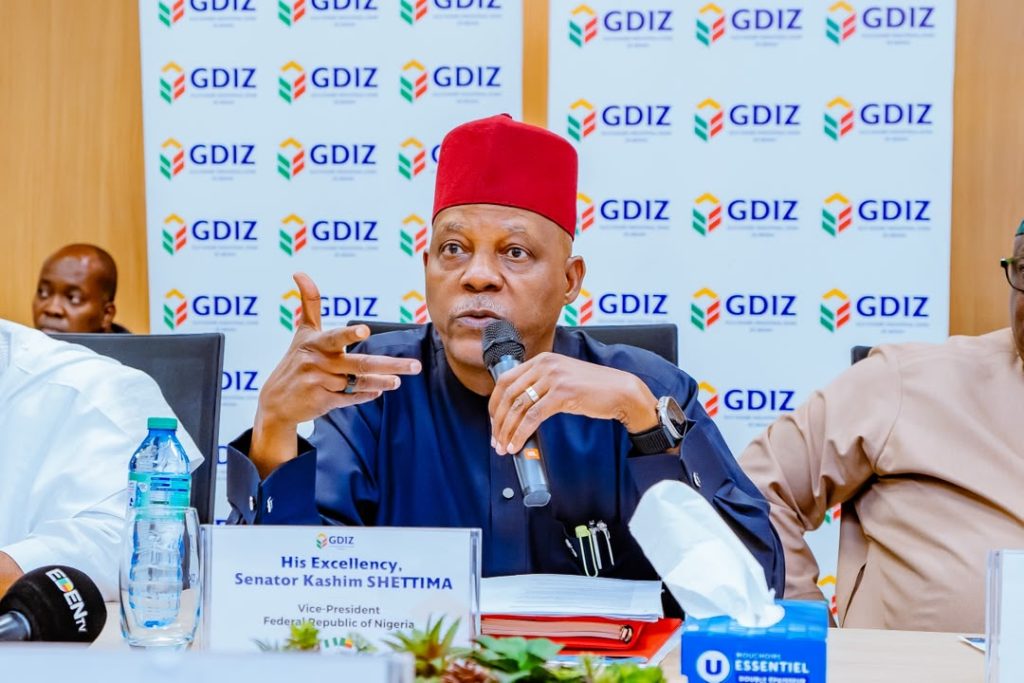
Vice President Kashim Shettima has called on African countries to stop exporting raw materials without processing them, saying the continent must take control of its natural resources by building industries that add value before products are sold to the global market.
Shettima made the call on Friday during a visit to the Glo-Djigbé Industrial Zone (GDIZ) in Cotonou, Republic of Benin, where he led a Nigerian delegation on a study tour aimed at learning from Benin’s industrial development model.
The Vice President said Africa could no longer afford to remain a supplier of raw materials while other parts of the world earned huge profits from processing and manufacturing finished products.
According to him, the future of the continent lies in developing industries that transform locally produced agricultural and mineral resources into high-value products capable of competing in international markets.
He said President Bola Tinubu’s administration was committed to industrialising Nigeria through the Renewed Hope Agenda and would ensure that every part of the country benefited from the drive.
Shettima explained that the Federal Government was working closely with state governments to establish industries that would create jobs, increase exports and reduce the country’s dependence on crude oil earnings.
“We are here essentially at the behest of President Tinubu, in the spirit of his Renewed Hope Agenda, to see and peer-review global best practices,” the Vice President said.
He described the Glo-Djigbé Industrial Zone as an example of how African countries could successfully build industries around their natural resources instead of exporting them in their raw form.
According to him, the industrial zone has demonstrated that value addition in agriculture can generate employment, attract investment and increase national income.
Shettima expressed admiration for Benin Republic’s efforts to build an integrated industrial system that processes cotton, cashew nuts and soya beans into finished products for both local and international markets.
He noted that Africa currently receives only about one per cent of the global cotton industry, despite being one of the world’s major producers of the crop.
The global cotton industry is estimated to be worth about $370 billion.
He described the situation as unacceptable and said African countries must begin to benefit more from their natural resources by investing in processing and manufacturing.
According to the Vice President, reviving Nigeria’s textile industry alone could create millions of jobs, expand non-oil exports and stimulate economic activities across the country.
He stressed that rebuilding the textile value chain would not only strengthen the economy but also improve the livelihoods of cotton farmers, factory workers and other businesses linked to the industry.
During the visit, Shettima inspected several production facilities within the industrial zone, including factories processing cotton into yarn, fabric and finished garments.
He also toured plants involved in the processing of cashew nuts, soya bean oil and other agricultural products destined for domestic use and export.
The Vice President said the Nigerian delegation had learnt valuable lessons from Benin’s industrialisation efforts and would adapt many of the ideas to suit Nigeria’s economic needs.
“We are setting up eight agro-industrial zones in eight states in our country,” he said.
He added that the Glo-Djigbé Industrial Zone represented “an African success story where there is a whole chain of value addition in cotton, cashew and soya bean value chains.”
“Be rest assured that we have learnt a lot of lessons through this visit, and we are going to replicate a lot of that in Nigeria,” he said.
Shettima reaffirmed the Federal Government’s commitment to transforming Nigeria into one of the world’s leading industrialised economies through policies that encourage local production, manufacturing and private sector investment.
He said the Tinubu administration believes industrialisation remains one of the most effective ways to tackle unemployment, reduce poverty and strengthen the country’s economy.
The Vice President was later briefed by Benin’s Minister of Tourism and Foreign Trade on the structure, production capacity and investment opportunities available at the industrial zone.
The briefing highlighted how Benin has successfully linked agriculture with manufacturing by ensuring that raw materials produced by local farmers are processed within the country before being exported.
Officials explained that the industrial zone has attracted investors by providing modern infrastructure, reliable power supply and business-friendly policies that encourage manufacturing.
The Nigerian delegation observed how locally produced cotton is converted into finished clothing instead of being exported as raw fibre. They also saw how agricultural products such as cashew nuts and soya beans are processed into products with greater market value.
The visit forms part of Nigeria’s broader effort to study successful industrial models across Africa and identify practical strategies that can support the country’s economic diversification programme.
For decades, Nigeria has depended heavily on crude oil exports, while many agricultural commodities have continued to leave the country in their raw state. Experts have repeatedly argued that this practice limits job creation and reduces the country’s earnings because the real profits are made where raw materials are processed into finished goods.
Successive governments have introduced policies aimed at encouraging local manufacturing and reducing imports, but challenges such as inadequate infrastructure, unreliable electricity supply, limited access to finance and insecurity have slowed industrial growth.
The Tinubu administration has identified industrialisation, agriculture and economic diversification as major priorities under its Renewed Hope Agenda. The government has announced plans to establish special agro-industrial processing zones in different parts of the country to support farmers, improve food processing and increase exports.
Shettima’s visit to Benin is therefore seen as part of the Federal Government’s effort to learn from successful African examples and apply practical solutions that can strengthen Nigeria’s industrial base.
The Vice President was accompanied on the tour by the governors of Kwara, Imo, Katsina, Plateau, Zamfara and Jigawa states, reflecting the Federal Government’s plan to work closely with state governments in driving industrial development and expanding value-added production across the country.