
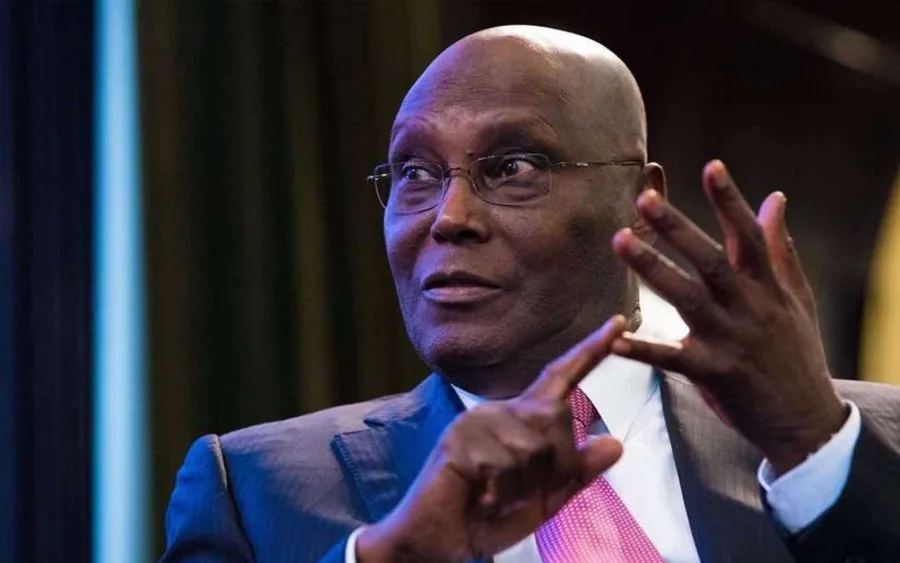
Former Vice President Atiku Abubakar has claimed that President Bola Tinubu’s administration has finally adopted the electricity reform model he proposed more than two decades ago, saying the Federal Government’s new direction on power generation reflects ideas he championed while serving in government.
Atiku, who was the presidential candidate of the African Democratic Congress (ADC), made the claim in a statement issued on Sunday by his spokesman, Phrank Shaibu.
The former vice president said recent comments by the Minister of Power, Joseph Tegbe, showed that the Tinubu administration had accepted the need to decentralise electricity generation, a policy he said he had consistently advocated for over the past 21 years.
According to Atiku, the government’s latest position is a clear acknowledgment that Nigeria can no longer depend mainly on large, centrally managed power plants to solve the country’s long-running electricity crisis.
He argued that the policy shift was long overdue and should have been implemented years ago instead of waiting until after electricity tariffs had already been increased.
“It should not take a government three years in office to discover what was obvious more than two decades ago,” Atiku said.
He criticised the Tinubu administration for increasing electricity tariffs before carrying out the reforms needed to improve power supply.
“A government that thinks before it acts would have fixed the system before asking citizens to pay more. Unfortunately, this administration has done the exact opposite—raising tariffs first and only now beginning to think about the reforms required to justify those increases,” he said.
Atiku maintained that while serving as vice president under former President Olusegun Obasanjo between 1999 and 2007, he repeatedly pushed for a decentralised electricity system that would allow different parts of the country to generate power using the energy resources available to them.
According to him, Nigeria has abundant energy sources that should be fully utilised instead of relying almost entirely on the national grid and a few large power plants.
He said his proposal focused on expanding electricity generation through hydroelectric dams, natural gas, solar energy and other viable energy sources across the country.
“This has been my position for over two decades,” he stated.
The former vice president argued that decentralising electricity generation would improve access to power, reduce pressure on the national grid and encourage greater investment by states and private companies.
Nigeria has struggled with inadequate electricity supply for decades despite several reforms, huge public investments and the privatisation of the power sector in 2013.
Millions of households and businesses continue to rely heavily on petrol and diesel generators because of frequent power outages and unstable electricity supply.
The country’s power sector has also been affected by weak transmission infrastructure, inadequate gas supply, ageing facilities, poor revenue collection and mounting debts owed to electricity generation and distribution companies.
In recent years, the Federal Government has introduced several reforms aimed at improving electricity generation, transmission and distribution.
One of the most significant changes came with the Electricity Act, which allows state governments, private investors and other qualified operators to generate, transmit and distribute electricity within their jurisdictions after obtaining the necessary approvals.
Supporters of the policy believe it will encourage competition, attract fresh investment and reduce dependence on the national electricity grid.
The Minister of Power recently acknowledged that Nigeria could no longer rely solely on large, centralised power plants and stressed the need to develop smaller and more diversified electricity generation systems to meet the country’s growing energy demand.
Although Atiku did not directly quote the minister, he argued that the statement effectively endorsed the decentralised power model he had promoted since his time in office.
The latest remarks add another chapter to the ongoing exchange between the opposition and the Tinubu administration over the handling of Nigeria’s economy and infrastructure.
Since leaving office, Atiku has repeatedly criticised successive governments over what he describes as delays in implementing key economic and structural reforms.
Power supply has remained one of the major challenges facing Nigeria’s economy, with manufacturers, small businesses and households spending billions of naira annually on alternative energy sources.
Many have also called for greater investment in renewable energy, improved transmission networks and increased participation by state governments and the private sector.
The Tinubu administration has maintained that it is committed to transforming the power sector through policy reforms, infrastructure development and increased investment.
However, the opposition insists that the pace of reforms remains slow and that Nigerians have yet to experience significant improvements in electricity supply despite higher tariffs and repeated government assurances.