
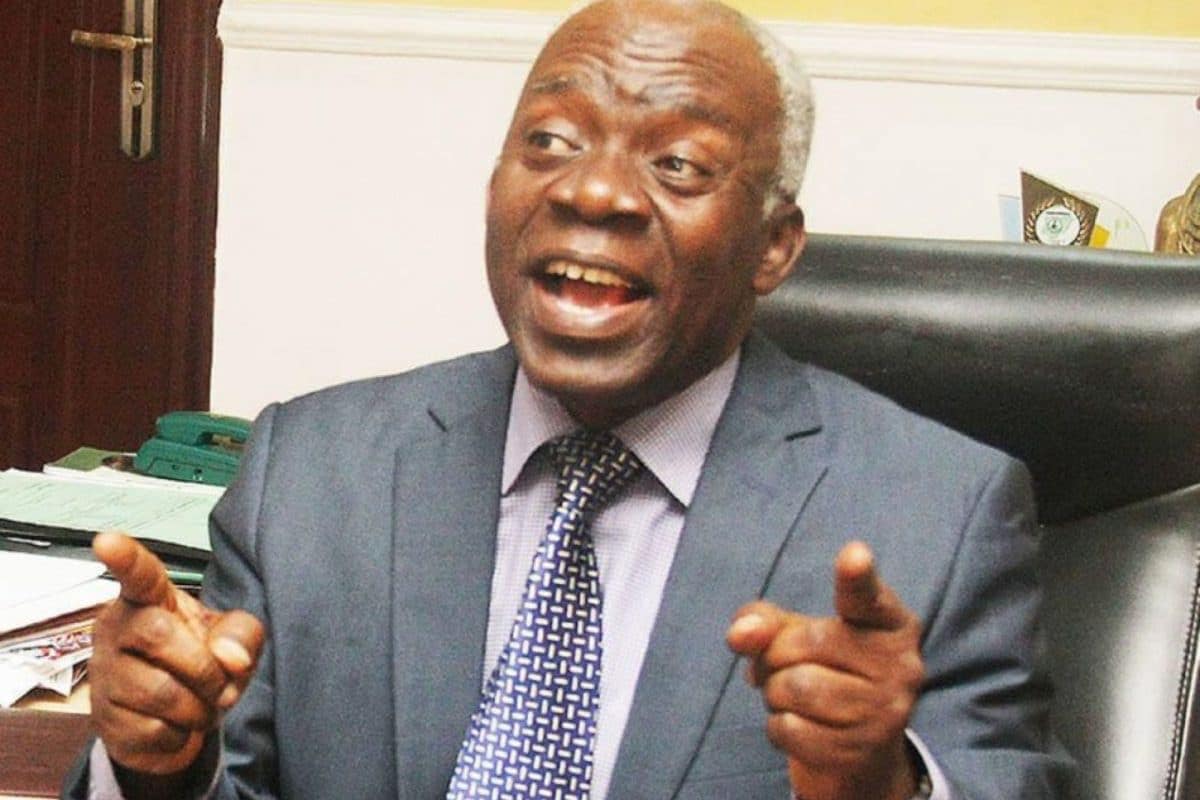
Human rights lawyer and Senior Advocate of Nigeria (SAN), Femi Falana, has called on the Federal Government to impose economic sanctions on South African companies operating in Nigeria in response to the recurring xenophobic attacks on Nigerians and the destruction of their businesses in South Africa.
Falana said Nigeria should move beyond diplomatic protests and adopt stronger economic measures that would compel the South African government to take more decisive action against attacks targeting Nigerians living and doing business in the country.
The senior lawyer made the call while speaking with journalists in Ilawe-Ekiti, Ekiti State. He argued that international diplomacy is guided by the principle of reciprocity and that Nigeria must respond firmly if its citizens continue to face violence, intimidation and discrimination in South Africa.
According to him, although the Federal Government could lodge a formal complaint with the African Union (AU), such a move alone would have little practical effect because of South Africa’s influence within the continental body.
Falana said any complaint brought before the African Union could end with the adoption of resolutions without concrete enforcement, leaving victims of xenophobic attacks without justice or meaningful protection.
He insisted that Nigeria has a responsibility to defend its citizens wherever they are and should not remain passive while Nigerians are allegedly chased out of South Africa and their businesses destroyed.
“The Federal Government will have to employ diplomatic action, but beyond that, it should also adopt economic measures against South African companies operating in Nigeria,” Falana said.
“International diplomacy is about reciprocity. If they chase out Nigerians and destroy their businesses, Nigeria has a duty to act. South African companies should be sanctioned where there are alternatives.”
As part of the measures he proposed, Falana urged Nigerians to patronise alternatives to South African-owned businesses, including telecommunications company MTN.
According to him, encouraging consumers to move to other service providers where alternatives exist would send a clear message that Nigeria is prepared to protect its citizens and hold South Africa accountable.
“Where there are alternatives, Nigerians should be encouraged to migrate from MTN because there are alternatives. That is one way South Africa will know that Nigeria is serious,” he said.
Falana also called on the Federal Government to consider revoking mining licences granted to South African companies operating in Nigeria. He argued that stronger economic actions would demonstrate Nigeria’s commitment to defending the rights and interests of its citizens abroad.
Drawing from history, the senior advocate recalled Nigeria’s role during the struggle against apartheid in South Africa.
He noted that in the 1970s, Nigeria took strong economic measures against British interests because of Britain’s relationship with the apartheid regime.
“In the 1970s, because of apartheid in South Africa, Nigeria nationalised British Petroleum. It should also be possible today to nationalise some South African investments in Nigeria if necessary,” he stated.
Falana, however, also criticised the Nigerian government for what he described as its failure to provide adequate legal protection for Nigerians facing harassment and human rights abuses across the African continent.
He said Nigeria has denied its citizens an important legal avenue by failing to recognise the jurisdiction of the African Court on Human and Peoples’ Rights for individual petitions.
According to him, the court, located in Arusha, Tanzania, was established by the African Union to hear cases involving human rights violations committed by member states.
He explained that although the court exists, Nigerians cannot directly approach it because Nigeria has not deposited the declaration required under the court’s protocol to allow individuals and non-governmental organisations to file cases.
“There is the African Court on Human and Peoples’ Rights in Arusha, Tanzania, established by the African Union to address human rights abuses in member states. Nigeria has refused to allow its nationals access to that court by failing to deposit the necessary instruments,” he said.
Falana argued that if Nigeria had accepted the court’s jurisdiction for individual petitions, victims of xenophobic attacks could have taken legal action directly against South Africa.
“If Nigerians could approach the African Court in the same way citizens can approach the ECOWAS Court in Abuja, South Africa would have been dragged before the court by victims of xenophobic attacks,” he added.
He challenged the Federal Government to immediately take the necessary legal steps that would allow Nigerians to access the continental court.
“I challenge the government of Nigeria to allow citizens access to the African Court without any further delay. Victims of gross human rights violations in African countries should have the opportunity to seek justice before the continental court, just as they can at the ECOWAS Court.”
Falana’s comments come against the backdrop of repeated xenophobic attacks in South Africa over the past two decades.
Several incidents have resulted in the deaths of foreign nationals, including Nigerians, while many shops and businesses owned by migrants have been looted or destroyed.
The attacks have often sparked diplomatic tensions between Nigeria and South Africa, two of Africa’s biggest economies with strong political and commercial ties.
South African companies have significant investments in Nigeria across sectors such as telecommunications, retail, financial services, entertainment and mining. At the same time, many Nigerians live and work in South Africa, where they own businesses and contribute to different sectors of the economy.
Past outbreaks of xenophobic violence have triggered widespread condemnation from the Nigerian government, civil society organisations and the international community. Nigerian authorities have repeatedly summoned South African diplomats to explain the attacks and have called on Pretoria to ensure the safety of Nigerians living in the country.
In 2019, a wave of attacks on foreign nationals led to diplomatic exchanges between both countries, while the Nigerian government evacuated hundreds of its citizens who chose to return home following the violence.
Despite several bilateral meetings and commitments by both governments to strengthen relations and protect citizens, reports of harassment, intimidation and attacks on foreign nationals have continued to surface periodically.
Falana believes the time has come for Nigeria to move beyond verbal condemnations and diplomatic protests by adopting economic measures that would demonstrate the country’s resolve to defend its citizens.