
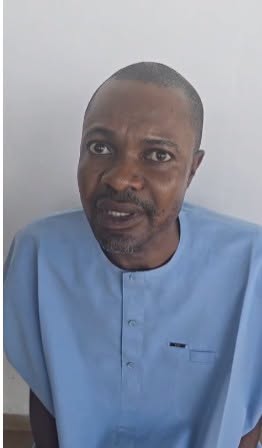
The detained self-acclaimed Director-General of the controversial Presidential Foreign Investment Promotion Council (PFIPC), Prince Adeniyi Adeyemi, has denied allegations that he single-handedly created the disputed agency, insisting that several ministries, departments and agencies (MDAs) of the Federal Government officially recognised, processed and interacted with the council over the years.
Adeyemi, who is currently in police custody, made the claims in a statement issued on Sunday through his legal defence team led by Festus Akhigbe. The statement also demanded that the House of Representatives ad hoc committee investigating the council allow him to appear in person to defend himself.
His lawyers argued that denying him the opportunity to testify before the committee would violate his constitutional right to a fair hearing and could undermine the credibility of the panel’s final report.
The ad hoc committee, chaired by Rep. Yusuf Gagdi, was set up by the House of Representatives following revelations that the PFIPC allegedly operated for years despite questions over its legal status and government recognition.
In the statement, Adeyemi’s lawyers formally requested that the committee secure the necessary administrative approval to enable him to appear before lawmakers despite being in police detention.
“We formally request that the panel issue the necessary administrative clearance to allow our client, Prince Adeniyi Adeyemi Matthew, to appear in person and testify.
“Any investigative outcome or final legislative report produced without affording our client a direct hearing would be fundamentally flawed, incomplete, and a breach of the constitutional right to a fair hearing,” the statement said.
The legal team strongly rejected attempts to portray Adeyemi as the sole architect of what has become one of the Federal Government’s most controversial administrative scandals.
According to the lawyers, the council did not operate in isolation but dealt with several government institutions that processed its documents, approved requests and carried out official transactions on its behalf.
The statement specifically mentioned the Office of the Secretary to the Government of the Federation (OSGF), alleging that it acknowledged documents relating to the council and facilitated the allocation of office space for the organisation within the Federal Secretariat.
The lawyers further claimed that the Office of the Accountant-General of the Federation and the Central Bank of Nigeria acted on official documents presented by the council by assigning administrative budget codes, granting it self-accounting status, posting federal civil servants to the organisation and opening official operational bank accounts.
According to the defence team, the Office of the Head of the Civil Service of the Federation also approved the council’s organisational structure and granted waivers that allowed it to recruit about 314 personnel.
“The Office of the Accountant-General of the Federation and Central Bank of Nigeria acted on official documentation to issue administrative budget codes, grant self-accounting status, post federal civil service staff to the council, and officially open operational accounts.
“The Office of the Head of the Civil Service of the Federation formally approved the establishment structure and granted recruitment waivers that enabled the onboarding of 314 personnel,” the statement added.
The lawyers also alleged that the council enjoyed recognition from other government institutions, including security agencies.
According to them, heads of some security agencies attended programmes organised by the PFIPC, while the Economic and Financial Crimes Commission (EFCC) allegedly allocated a property to the council, requested a processing fee and later presented a plaque of recognition to its leadership.
Based on these claims, the defence questioned how one individual could be accused of deceiving virtually every arm of government without the involvement or approval of officials within the system.
“If the SGF, the Accountant-General, the Central Bank of Nigeria, the Head of Service, the Budget Office, the EFCC, the National Assembly, and the heads of Nigeria’s primary security architecture all verified, processed, funded, and officially interacted with this agency over an extended period, how can a single citizen, Prince Adeniyi Adeyemi, be held uniquely responsible for failing to detect what the entire apparatus of the State validated?” the statement asked.
“It is an administrative impossibility for an unassisted individual to mislead every arm of the Federal Government simultaneously without official, high-level institutional sanction.”
The defence maintained that Adeyemi was being unfairly targeted while the actions of public institutions that allegedly dealt with the council were being ignored.
According to the lawyers, their client was being turned into “a scapegoat” to shield wider institutional failures, administrative lapses and questionable approvals granted within government.
They argued that justice would only be served if investigators examined the roles played by all government institutions connected with the council rather than focusing solely on its head.
The legal team therefore called for an expanded investigation involving civil society organisations, legal professionals and independent observers to review all documents and approvals linked to the PFIPC across government institutions.
“While we note the ongoing proceedings by the House of Representatives ad hoc committee and investigating bodies, justice cannot be served by prosecuting the mouthpiece while ignoring the state machinery that built, budgeted, and bureaucratically birthed the entity,” the lawyers stated.
They added that a broader panel should be constituted to audit what they described as the complete paper trail involving all ministries, departments and agencies that dealt with the council.
The latest development comes as investigations into the PFIPC continue to uncover questions about how the council allegedly operated within the Federal Government’s administrative system.
The controversy began after lawmakers launched a probe into the agency following reports that it functioned as a government body despite concerns that it lacked the legal foundation required for such status. The scandal has raised concerns about weaknesses in government oversight, document verification and administrative procedures.
Earlier investigations by the House committee reportedly heard evidence from several government agencies regarding their interactions with the council. The case has also attracted the attention of law enforcement agencies, leading to Adeyemi’s arrest and ongoing police investigation.
The House committee is expected to continue its hearings as it seeks to determine how the council was created, whether government officials aided its operations and whether public funds or government resources were improperly allocated.
With Adeyemi now insisting that he did not act alone and naming several federal institutions that allegedly recognised the council, the investigation is expected to widen as lawmakers examine the roles played by different agencies in one of the most controversial administrative scandals in recent years.
The Federal Government and the agencies mentioned in Adeyemi’s statement are yet to publicly respond to the latest allegations. The outcome of the House investigation and the ongoing police probe is expected to determine whether the controversy was the result of individual misconduct, institutional failure or a combination of both.