
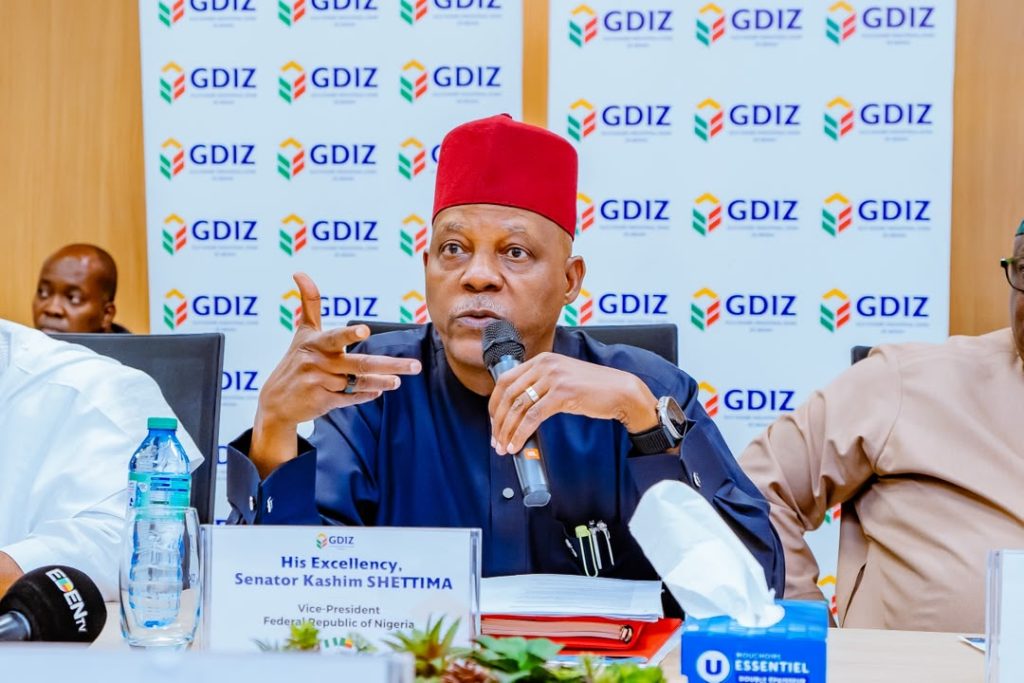
Vice President Kashim Shettima has urged both local and foreign investors to take advantage of Nigeria’s improving economic outlook, saying the country is becoming a more attractive destination for business and that the current period offers the best opportunity to invest before the cost of entry rises.
Shettima made the call on Monday while declaring open the Delta State Economic and Investment Summit 2026 in Asaba, where government officials, business leaders, investors and development partners gathered to explore investment opportunities in Delta State and across Nigeria.
The Vice President said the economic reforms introduced by President Bola Tinubu’s administration had begun to restore investor confidence, improve macroeconomic stability and create a stronger foundation for sustainable economic growth.
According to a statement issued by the Chief Press Secretary to the Delta State Governor, Festus Ahon, Shettima said Nigeria’s states must compete positively by creating environments that attract investments, generate jobs and improve the standard of living of their people.
He noted that every state has unique natural and economic advantages that can be developed to drive growth.
“Every state possesses immense promise with its unique history, geography, people and comparative advantage. This is the race we must welcome, a race in which states compete to create employment, prosperity and human dignity,” the Vice President said.
Shettima said recent fiscal reforms by the Federal Government had increased allocations to state governments, giving them more resources to undertake major infrastructure and development projects capable of attracting investors.
He also pointed to recent upgrades of Nigeria’s credit outlook by international rating agencies, including Fitch Ratings, S&P Global Ratings and Moody’s, as evidence that confidence in the Nigerian economy is gradually returning.
According to him, these positive assessments show that Nigeria is rebuilding its credibility in the global investment community.
“These are proof that Nigeria is regaining credibility, and the best time to invest is now before the opportunity becomes expensive,” he said.
The Vice President described Delta State as one of Nigeria’s leading investment destinations, saying the state’s economic potential goes far beyond its rich oil resources.
He said Delta’s strategic location along the coastline, its seaports, vast natural gas reserves, refining facilities, agricultural land, blue economy opportunities and abundant solid minerals provide strong foundations for industrial and commercial expansion.
Shettima praised Governor Sheriff Oborevwori for organising the summit, saying the initiative demonstrates the state’s commitment to attracting both domestic and foreign investments.
He assured investors that the Federal Government would continue working closely with state governments to remove obstacles affecting businesses and provide an enabling environment for investment.
“We are co-travellers on the road from promise to production, from allocation to transformation, and from potential to prosperity,” he added.
Earlier, Governor Oborevwori announced a major financial commitment aimed at encouraging private sector participation in key sectors of the state’s economy.
He disclosed that the Delta State Government had set aside 100 million dollars as Viability Gap Funding to reduce investment risks for private investors undertaking strategic projects.
According to the governor, the initiative is designed to move beyond investment discussions and convert business proposals into bankable projects capable of driving industrialisation, economic diversification and large-scale job creation.
Oborevwori explained that the summit was part of the state’s broader investment strategy following investment promotion missions to China and Brazil in 2025, where officials engaged potential international partners.
He said Delta currently has an estimated economy valued at about ₦17 trillion, making it one of Nigeria’s strongest sub-national economies.
The governor attributed the state’s attractiveness to its abundant natural resources, improving infrastructure, prudent financial management and investor-friendly policies.
He announced that the government had introduced several incentives to attract businesses, including waivers on tenement rates, levies and other charges for up to five years.
He also said the state established an Ease of Doing Business Council to simplify approval processes, remove unnecessary bureaucracy and improve the investment climate.
Oborevwori revealed that more than 12,000 hectares of land have already been designated for commercial agriculture, while the state’s 163-kilometre coastline provides enormous opportunities for investments in fisheries, maritime transport, tourism and other blue economy activities.
He further highlighted opportunities in gas-fired power plants, renewable energy, solar farms and mini-grid projects designed to improve electricity supply across the state.
The governor assured investors that Delta remains financially stable, secure and debt-free.
He added that the Federal Ministry of Petroleum Resources recognised Delta as Nigeria’s safest state for oil and gas investments in 2024, a development he said should further strengthen investor confidence.
Delivering the keynote address, Director-General of the World Trade Organisation, Dr. Ngozi Okonjo-Iweala, urged Delta State to take advantage of global changes in manufacturing and trade to position itself as Nigeria’s next industrial growth centre.
She described herself as “a Delta State optimist” and said the state’s natural advantages, including its gas reserves, seaports, rail connections, fertile agricultural land, skilled workforce and sound fiscal management, place it in a strong position to compete with established commercial centres.
Okonjo-Iweala encouraged the state government to focus on developing the Delta Special Economic Zone, agro-processing industries, the blue economy, oil and gas value addition, marine logistics, digital infrastructure and artificial intelligence.
Also speaking at the summit, Anambra State Governor, Prof. Chukwuma Soludo, said Nigeria’s macroeconomic environment has improved significantly compared to the situation in 2023.
According to him, the country has moved from a period of capital flight and economic uncertainty to a more stable exchange rate environment that provides greater predictability for investors.
Soludo called for stronger economic cooperation between Delta and Anambra states and urged governments to make investment promotion a continuous exercise rather than a one-time event.
Pan-African scholar, Prof. Patrick Lumumba, challenged African governments, businesses and investors to demonstrate greater confidence in the continent’s economic potential by investing more resources within Africa instead of relying heavily on foreign markets.
Also addressing participants, Minister of Finance, Dr. Taiwo Oyedele, said the Federal Government’s economic reforms, including the removal of fuel subsidy and liberalisation of the foreign exchange market, have significantly increased revenues available to states and local governments.
He said the additional resources have strengthened the capacity of sub-national governments to invest in infrastructure and economic development.
Oyedele described Delta as a natural leader in Nigeria’s blue economy and urged investors to view both the state and the country as prime investment destinations in Sub-Saharan Africa.
Chairman of Transcorp Power Holdings, Tony Elumelu, pledged the company’s readiness to partner with the Delta State Government to improve electricity supply for industries, businesses and households.
He said reliable electricity remains one of the most important requirements for economic growth and industrial development.
The summit also highlighted Delta’s growing energy sector.
Chief Executive Officer of Mosra Energy, Ramos Olukayode, disclosed that Delta has more than 200 million tonnes of coal deposits located in Obomkpa, Ukunzu and neighbouring communities, presenting another opportunity for industrial investment.
Similarly, Chief Executive Officer of UTM Gas Limited, Julius Rone, revealed that Delta State’s ₦42 billion investment in his company in 2022 for an eight per cent equity stake has appreciated significantly and is now valued at about ₦200 billion.
Rone also announced that UTM Gas would establish its corporate headquarters in Warri when its operations become fully operational in 2030, a move expected to strengthen Delta’s position as one of Nigeria’s leading energy investment destinations.