
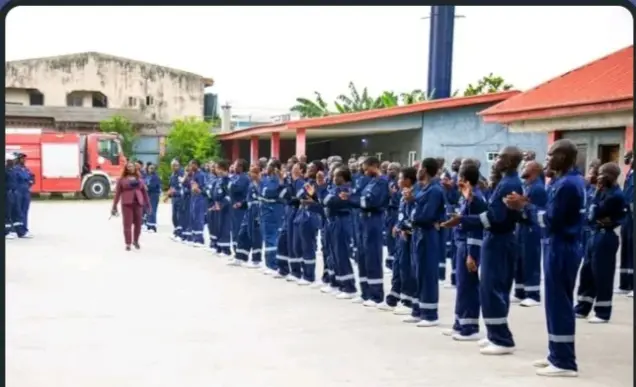
The Federal Fire Service has launched a nationwide mandatory fire warden training and certification programme aimed at improving fire safety and emergency response in workplaces, schools, businesses and other public facilities across Nigeria.
Under the new programme, organisations are required to nominate and train at least one fire warden for every 50 staff members, occupants, students, worshippers, customers or average daily users of their facilities.
The initiative is being implemented by the Federal Fire Service in collaboration with Pilgrims Integrated Management Consult Ltd., PIMC, as part of efforts to reduce deaths and property losses caused by fire outbreaks.
The service announced the programme on Friday in a statement jointly signed by the Commandant of the National Fire Academy, ACF Umetali Peter, and the Managing Director/Principal Consultant of PIMC, Ukpola Okereke Chinedu.
The statement described the initiative as a major step towards strengthening fire safety and emergency preparedness across the country.
According to the FFS, the programme is designed to transform fire safety practices by ensuring that organisations have trained personnel who can respond immediately when a fire breaks out.
The service said fire wardens would serve as first responders within their respective facilities before professional firefighters arrive at the scene.
“Fire outbreaks remain one of the leading causes of preventable loss of lives and property in Nigeria,” the statement said.
The FFS said investigations into fire incidents had shown that many facilities did not have trained emergency responders who could take immediate action when a fire started.
It said the absence of trained personnel often led to delays in raising alarms, poor evacuation procedures, avoidable injuries and greater damage to buildings and property.
Under the new arrangement, organisations covered by the programme are expected to identify the required number of personnel based on the number of people who regularly use their facilities.
A facility with up to 50 staff members or regular occupants, for example, would be expected to nominate at least one person for the training.
Larger facilities would be required to nominate additional wardens based on the same ratio.
The nominated personnel must undergo the prescribed training and obtain certification from the Federal Fire Service before they can serve as designated fire wardens.
The program is expected to cover a wide range of facilities, including offices, schools, worship centres, business premises and other public places where large numbers of people gather.
The service said registration for the programme had already commenced, while the first phase of the training would begin on August 31, 2026.
The initial training will take place at designated centres, starting with Lagos.
The FFS warned that facilities that fail to comply with the requirements could face sanctions under the Federal Fire Service Act.
Such sanctions, according to the service, may include legal penalties and the possible sealing of facilities considered unsafe for public use.
The warning places responsibility on owners and managers of facilities to ensure that they meet the required fire safety standards and have trained personnel available to respond to emergencies.
The Federal Fire Service said the programme was necessary because the first few minutes after a fire starts are often critical in determining whether the incident can be contained or develops into a major disaster.
In many fire incidents, professional firefighters may need time to receive information about the outbreak, mobilise personnel and reach the affected location.
A trained fire warden within the facility can therefore raise an alarm, guide people to safety, use appropriate fire-fighting equipment where it is safe to do so and provide vital information to firefighters when they arrive.
The service stressed that the programme was not intended to replace the work of professional firefighters but to ensure that facilities have trained people who can act immediately during an emergency.
“Fire safety is a shared responsibility,” the statement said, stressing the need for organisations to take preventive measures rather than wait until a fire occurs.
The initiative comes against the background of repeated fire outbreaks across Nigeria, many of which have resulted in deaths, injuries and the destruction of homes, markets, offices, factories and other properties.
Fire incidents are often linked to factors such as electrical faults, cooking accidents, fuel-related incidents, poor storage of combustible materials and unsafe practices.
In densely populated areas and crowded facilities, the consequences can be particularly severe because fire can spread quickly and people may struggle to escape if there are no clear evacuation routes.
The FFS said having trained fire wardens within facilities would help improve preparedness and reduce confusion during emergencies.
The wardens are expected to understand basic fire prevention, emergency response, evacuation procedures and the safe use of fire-fighting equipment.
The program is also expected to encourage organisations to take fire safety more seriously by making emergency preparedness part of their daily operations.
The service said the certification requirement would help ensure that nominated fire wardens receive standard training and possess the basic knowledge needed to perform their duties.
The initiative also puts emphasis on prevention. Organisations are expected to identify fire risks within their premises and take steps to reduce them before an incident occurs.
This could include ensuring that fire extinguishers are available and properly maintained, keeping emergency exits clear, making evacuation routes known to occupants and ensuring that electrical installations are safe.
The FFS said the success of the programme would depend on the cooperation of organisations and facility managers across the country.
It urged them to begin the registration and nomination process rather than wait until enforcement measures are introduced.
The service said the programme represented an important shift towards a stronger fire safety culture in Nigeria, where members of the public and organisations would play a more active role in preventing and responding to emergencies.
The FFS also emphasised that every workplace, institution, business premises and public facility needed trained in-house emergency responders.
It said a prompt response in the first few minutes of a fire could make the difference between a small incident that is brought under control and a major disaster involving loss of lives and property.
With the first phase of the training scheduled to begin in Lagos on August 31, 2026, organisations in the state and other participating locations are expected to prepare their nominated personnel for certification.
The Federal Fire Service said the nationwide programme would ultimately help improve emergency preparedness, protect lives and reduce avoidable property losses caused by fire outbreaks.
The service maintained that fire safety should not be left entirely to emergency agencies, insisting that organisations and individuals must also take responsibility for protecting lives and property within their facilities.