
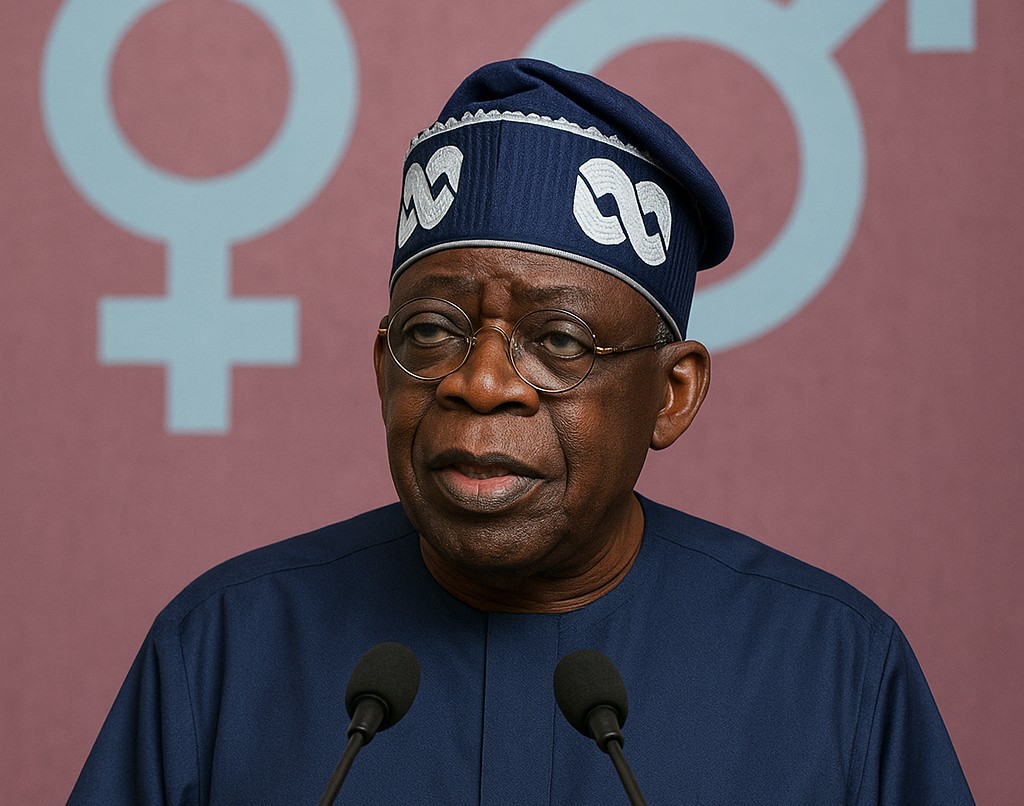
President Bola Tinubu has urged Nigerians to preserve the unity of the country despite their religious, ethnic and other differences, stressing that dialogue remains essential to keeping Nigeria together.
Tinubu, represented by the Deputy President of the Senate, Barau Jibrin, made the call on Tuesday at the International Conference on Security and National Unity organised by Jama’atu Izalatil Bid’ah Wa Iqamatus Sunnah (JIBWIS) in collaboration with the Muslim World League.
The conference brought together government officials, religious leaders, traditional rulers and other stakeholders to discuss security, peaceful coexistence and ways of preventing religious and communal tensions from turning into violence.
The President said the Federal Government remained committed to addressing Nigeria’s security challenges while working with other countries and international organisations to promote peace.
He said Nigerians must be willing to discuss their differences and seek peaceful solutions rather than allow disagreements to threaten the unity of the country.
“Not only that, the government is determined to make sure that we remain united as a country, despite our differences, whatever the differences may be. We should talk and remain in this country, and allow this country to remain a united nation, a united country,” he said.
Tinubu described the conference as timely, given the security challenges facing Nigeria and other parts of the world.
He expressed confidence that discussions at the event would contribute to efforts to achieve lasting peace in Nigeria, West Africa and the wider world.
The President also commended the Muslim World League for partnering JIBWIS to organise the conference and for choosing Nigeria as the first country to host the event.
He said the participation of local and international religious leaders demonstrated the importance of cooperation in tackling issues that affect peace and security.
The conference took place against the background of continuing security concerns in Nigeria, including terrorism, banditry, kidnapping, communal violence and other forms of criminality.
Over the years, religious and ethnic differences have sometimes been exploited by violent groups and criminal elements, increasing tension in communities and making efforts to maintain peace more difficult.
The Executive Secretary of the Nigerian Inter-Religious Council, Prof Cornelius Omonokhua, also called on Christians and Muslims to promote mercy, compassion, love and respect for human dignity.
Omonokhua said Nigerians should focus on their shared humanity rather than allow religious differences to divide them.
“No one is created a Christian, and no one is created a Muslim. We are created as human beings; hence what binds us together is humanity,” he said.
The NIREC executive secretary warned against the use of religion to justify violence, saying both Christianity and Islam uphold the sanctity of human life.
He urged Nigerians to reject attempts to use religion, ethnicity and poverty as tools for creating conflict.
“We should never allow anybody to weaponise religion or ethnicity or poverty to turn us against each other. May God give us security and may we continue to live in peace and harmony,” he said.
Omonokhua said NIREC had continued to promote human dignity, the common good and the welfare of Nigerians through cooperation between Christians and Muslims.
NIREC, which brings together leaders of Nigeria’s two largest religious communities, has played a role in promoting dialogue and peaceful relations between Christians and Muslims.
The council has often called on religious leaders to use their influence to reduce tension and discourage their followers from making statements or taking actions that could trigger conflict.
Also speaking at the conference, the Sultan of Sokoto and Co-Chairman of NIREC, Muhammadu Sa’ad Abubakar III, said Nigeria did not lack solutions to its many challenges but needed to improve its ability to implement agreements and decisions.
The Sultan said conferences and meetings would have little impact if decisions reached at such gatherings were not put into action.
“We don’t lack solutions to our problems. What we lack is implementation. How to implement whatever we agree to do,” he said.
He therefore urged government officials, religious leaders and other stakeholders to ensure that recommendations reached at conferences were translated into practical measures.
The Sultan also appealed to Christians and Muslims to stop insulting one another, saying mutual respect was necessary for peaceful coexistence.
“Christians should stop insulting Muslims. Muslims should stop insulting Christians, and that’s how we live in peace,” he said.
The appeal comes amid recent controversies over religious comments and political issues in the country.
The Sultan had previously urged Nigerians to avoid religious superiority and respect people of other faiths, stressing that no religious group should see itself as better than another.
His latest comments reinforced the message of the conference that religious differences should not be allowed to become a source of conflict.
The event was also attended by the Secretary-General of the Muslim World League, Sheikh Mohammad Al-Issa, who witnessed the signing of the Abuja Declaration.
The declaration seeks to establish a new alliance between Muslim and Christian leaders and create a peace-building mechanism to help Nigeria and West Africa prevent religious tensions from escalating into violence.
The initiative is expected to strengthen cooperation between religious leaders and provide a platform for early intervention when religious or communal tensions begin to emerge.
Al-Issa is widely known for promoting moderate Islam and interfaith dialogue.
His visit to Nigeria and participation in the conference were seen as part of wider efforts to strengthen cooperation between Muslim and Christian leaders.
He has also played a prominent role in promoting dialogue between Muslims and followers of other religions internationally. He was the most senior Islamic figure to visit the Auschwitz concentration camp and has supported interfaith initiatives involving major Christian institutions.
The presence of the Muslim World League leadership at the conference added an international dimension to discussions on Nigeria’s security and national unity.
The conference also provided an opportunity for Nigerian religious leaders to highlight the importance of addressing the social and economic factors that can increase insecurity.
Poverty, unemployment, inequality and lack of opportunities among young people have often been identified as conditions that can make communities vulnerable to criminal and extremist groups.
Participants stressed the need for cooperation between government, religious institutions, traditional rulers and communities to address such problems.
The gathering was attended by ministers, governors, religious leaders, traditional rulers and other dignitaries.
The broad participation reflected growing concern over the need for stronger cooperation in dealing with insecurity and preserving Nigeria’s unity.
Tinubu’s message was that differences among Nigerians should not become reasons for division.
He called for continued dialogue and cooperation, saying Nigerians must remain committed to building one country despite their different religious and ethnic identities.
The President’s call was echoed by Omonokhua and the Sultan, who both stressed the need for Nigerians to respect one another and turn agreements on peace and security into concrete action.
As Nigeria continues to face security challenges, the conference underscored the importance of preventing religious disagreements from escalating into violence.
The Abuja Declaration is expected to provide a framework for stronger cooperation between Christian and Muslim leaders, while the Federal Government has pledged to continue working with national and international partners to address insecurity.
For the speakers at the conference, the central message remained that Nigeria’s unity would require dialogue, mutual respect and practical action rather than confrontation.
They urged Nigerians to reject religious hatred and work together to build a peaceful country where citizens can live and worship freely regardless of their faith or ethnic background.