
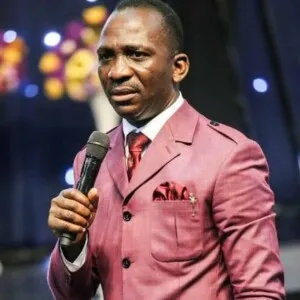
The Senior Pastor of Dunamis International Gospel Centre, DIGC, Dr Paul Eneche, has challenged the Federal Government to conduct a credible population census that would help determine the religious composition of Nigeria.
Enenche made the call on Sunday while reacting to recent remarks by Islamic cleric, Sheikh Yahya Jingir, who claimed that Muslims outnumber Christians in Nigeria.
The pastor questioned the basis of such claims, arguing that only a credible and properly conducted census could provide reliable figures on the population and religious composition of the country.
Speaking during a sermon at the headquarters of the Dunamis church in Abuja, Enenche asked why those who claimed that Muslims were the majority had not supported the conduct of a census that could establish the facts.
“If you think you are superior, why didn’t you people allow for the census all these while?” he asked.
Enenche urged the Federal Government to conduct what he described as a credible census in which Nigerians would be able to state their religious beliefs.
“Credible census, let everybody tell you what they believe in then you will be shocked that where you think you come from, there are Christians almost dominating in that place,” he said.
The pastor’s comments came amid renewed debate over the religious composition of Nigeria following statements by some Muslim clerics and reactions from Christian leaders.
Nigeria is a religiously diverse country, with Islam and Christianity being the two largest religions. Traditional African religious beliefs are also practised in different parts of the country.
However, there has been no recent official census that provides a detailed and reliable breakdown of the population by religion.
The absence of current official figures has often led to competing claims by religious groups about which faith has the larger population.
The controversy has become more sensitive because religion remains an important factor in Nigeria’s social and political life.
Enenche said the Federal Government should provide an opportunity for Nigerians to state their religious affiliations through a credible census rather than allowing individuals or groups to make claims without reliable data.
He also warned against what he described as attempts to take Christians and the church for granted in Nigeria.
“Nobody should take Christian in this country for granted. Don’t take the church in Nigeria for granted. This is a warning to all of you who think that the church can be taken for granted,” he said.
The pastor further criticised those he accused of contributing to violence and destruction in the country.
“They are not tired of bloodshed, they are not tired of destroying the nation. Ask yourself, what have you contributed to the development of this nation? Shame on you and everything you represent,” he said.
Although Enenche did not identify specific individuals in the latter part of his remarks, his comments were made in the context of the ongoing debate over religious identity, violence and national development.
His statement is likely to generate further reactions, particularly because religious population figures have remained a sensitive subject in Nigeria.
The country’s last full population census was conducted in 2006, when Nigeria’s population was put at about 140 million. Subsequent attempts to conduct another census have faced delays and other challenges.
A new national census has been discussed for years, with the Federal Government and the National Population Commission working towards conducting a modern population count.
A credible census is important not only for determining population size but also for planning public services, infrastructure, healthcare, education and other development programmes.
Population data can help governments determine where schools, hospitals, roads and other facilities are most needed.
However, religion is not generally treated as a standard category in Nigeria’s population census. This has contributed to the difficulty of obtaining official data on the religious composition of the country.
As a result, estimates about the number of Muslims and Christians are often based on surveys, studies and projections rather than a national headcount in which every citizen states a religious affiliation.
The latest controversy therefore highlights the wider need for reliable population data and responsible public discussion on religious matters.
Enenche’s demand also comes against the background of continuing tensions between religious communities in parts of Nigeria.
The country has experienced deadly attacks, communal conflicts and other forms of violence in which religion has sometimes been a factor, although many conflicts also have political, ethnic, economic, land and security dimensions.
Religious leaders have repeatedly been urged to avoid statements capable of increasing tension between Christians and Muslims.
Nigeria’s Christian and Muslim leaders have also at various times called for peaceful coexistence and greater understanding among citizens.
The Federal Government has maintained that citizens have the right to practise their religions freely, as guaranteed by the Constitution.
The Constitution also provides for freedom of religion and prohibits the adoption of any religion as a state religion.
Against this background, the debate over which religion has the larger population has implications beyond numbers.
Claims about religious majority can influence political discussions and perceptions of power and representation.
Enenche’s call for a credible census appears aimed at settling the debate through data rather than assertions.
He argued that Nigerians should be allowed to identify their religious beliefs and that the resulting figures could challenge assumptions about the religious composition of different parts of the country.
The pastor’s comments also reflect the growing concern among religious leaders over statements that they believe could deepen divisions between the two major faith communities.
While the debate over population figures continues, the larger challenge for Nigeria remains the need to promote peaceful coexistence and national unity among citizens of different religious backgrounds.
The Federal Government is expected to continue efforts to improve population data as part of its planning and development responsibilities.
For Enenche, however, the immediate priority is to establish the facts about Nigeria’s religious population through a credible process.
His message was that neither Christians nor Muslims should rely on unverified claims to establish superiority and that reliable data would provide a better basis for discussions about the country’s religious composition.