
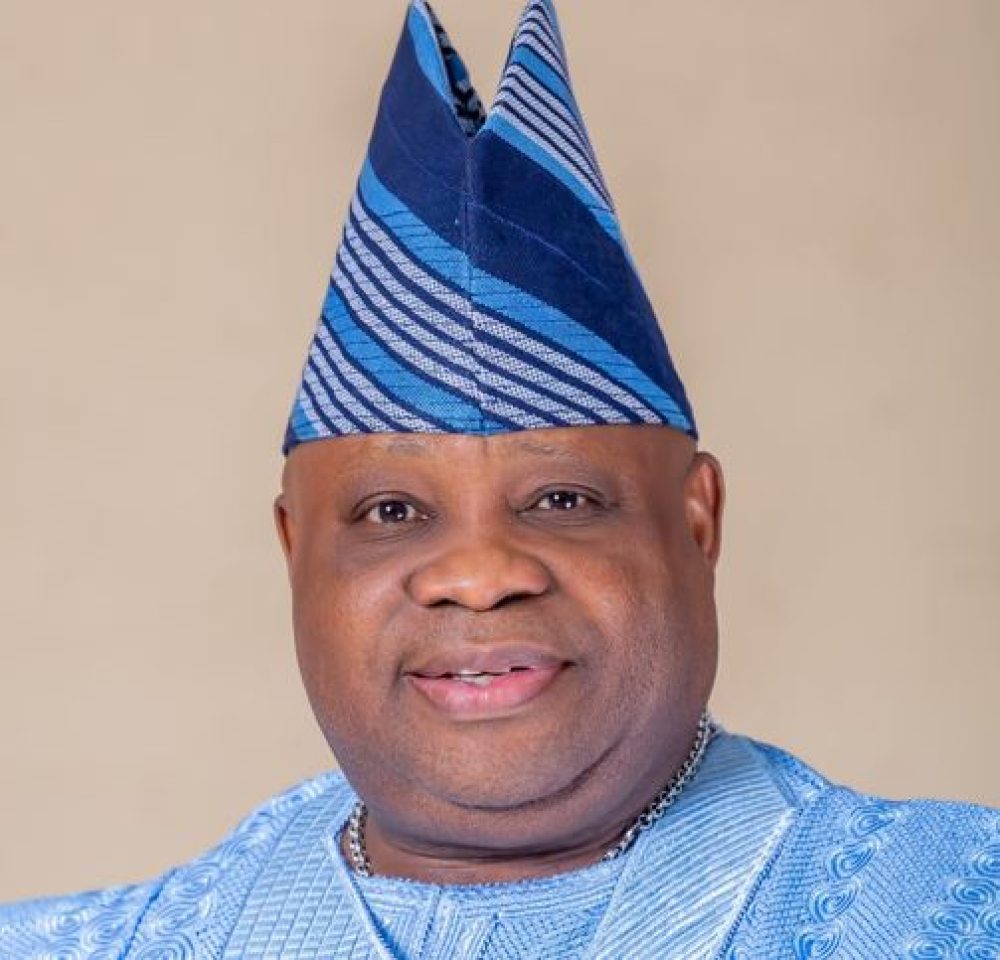
The Imole Campaign Council of Osun State Governor, Ademola Adeleke, has denied claims that the governor’s endorsement of President Bola Tinubu for the 2027 presidential election was based on a political agreement between the two politicians.
The council said Adeleke’s support for Tinubu was based on what it described as the President’s performance and reforms, rather than any pre-arranged political deal.
The council’s spokesperson, Pelumi Olajengbesi, made the clarification in a post on his X handle on Sunday, following a statement by the Minister of Aviation and Aerospace Development, Festus Keyamo.
Keyamo had congratulated Adeleke on his re-election and thanked him for publicly endorsing Tinubu for a second term in 2027.
The minister described Adeleke as a man of integrity and honour before adding, “Agreement is agreement.”
The comment generated reactions on social media, with some users interpreting it as an indication that the governor and the President had reached a political agreement before the Osun governorship election.
However, Olajengbesi rejected the suggestion, saying there was no political agreement behind Adeleke’s decision to support the President.
Quoting Keyamo’s post, the campaign council spokesman said the minister’s remark should not be allowed to undermine the decision of Osun voters who gave Adeleke a second term.
“Do not undermine the resilience of Osun people. There is no agreement,” Olajengbesi said.
He added that Adeleke’s support for Tinubu was based on the President’s performance and reforms.
“Our support for President Bola Ahmed Tinubu, @officialABAT, is based on his performance and reforms that have strengthened states economically,” he said.
Olajengbesi also maintained that Adeleke’s victory in the August 15 governorship election was the result of the decision of Osun voters.
He argued that the President’s role was simply to ensure that the democratic process was allowed to run its course.
“Osun people voted @AAdeleke_01. President Tinubu simply ensured democratic rules were respected,” he said.
The clarification comes against the background of growing political alignments ahead of the 2027 general elections, with politicians across the country already making moves to secure support and build alliances.
Adeleke’s decision to endorse Tinubu has attracted particular attention because the governor has moved across political platforms in recent years and his latest election was contested under the Accord Party.
The governor had earlier reaffirmed his support for Tinubu shortly after being declared winner of the Osun governorship election.
Speaking after his victory, Adeleke described Tinubu as a son of Osun State and thanked him for what he called his support for a free, fair and credible election.
Adeleke said he was reaffirming his earlier endorsement of the President for a second term in office.
The statement immediately drew political attention because Tinubu is a member of the ruling All Progressives Congress, while Adeleke is not a member of the APC.
Keyamo’s subsequent comment about an “agreement” added to the speculation that the endorsement could have been linked to a political arrangement between the two politicians.
The Imole Campaign Council, however, insisted that no such arrangement existed.
The council said its support was linked to the effect of Tinubu’s economic policies and reforms on state governments.
Olajengbesi did not provide details of the specific reforms he was referring to, but his statement appeared aimed at separating Adeleke’s political position from any suggestion of a private bargain with the President.
The controversy also comes after a highly contested Osun governorship election that attracted national attention.
The Independent National Electoral Commission declared Adeleke the winner after he secured 511,067 votes across 19 of the state’s 30 local government areas.
His closest challenger, Bola Oyebamiji of the APC, polled 444,815 votes and won in 11 local government areas.
Adeleke therefore secured a margin of 66,252 votes over Oyebamiji and won a second term in office. ([Leadership][1])
The result was significant because of the political importance of Osun and the wider struggle between opposition forces and the APC ahead of the 2027 elections.
Adeleke had originally won the Osun governorship election in 2022 on the platform of the Peoples Democratic Party before later leaving the party and securing the Accord Party ticket for the 2026 election.
His latest victory under the Accord platform has further increased attention on his political influence and his relationship with the Federal Government.
The governor’s endorsement of Tinubu also comes at a time when political parties are beginning to prepare for the 2027 presidential contest.
Tinubu is expected to seek a second term, while opposition politicians and parties are working on strategies to challenge the APC.
The issue of political alliances is therefore expected to become more prominent as the election draws closer.
For Adeleke, the endorsement places him in an unusual political position, given that he has just secured re-election on the platform of an opposition party while openly supporting the President of the ruling party.
The governor’s camp appears determined to present the support as a decision based on governance and national interest rather than a political bargain.
Olajengbesi also sought to ensure that the focus remained on the voters who participated in the Osun election.
He said the people of the state should receive full credit for Adeleke’s victory and rejected any suggestion that the outcome was the result of an agreement between the governor and the President.
His statement also praised Tinubu for respecting the electoral process, arguing that the President’s role was to allow the wishes of voters to prevail.
The issue is likely to remain part of political discussions in Osun and beyond as the country moves towards the 2027 general elections.
Political agreements and alliances are common in Nigerian politics, particularly ahead of major elections, and public declarations of support often lead to questions about possible political arrangements.
In this case, however, Adeleke’s campaign council has made its position clear: there was no pre-election deal with Tinubu behind the governor’s endorsement.
The council maintained that Adeleke’s support for the President was based on his assessment of Tinubu’s performance and reforms.
It also insisted that the governor’s re-election was secured through the votes of Osun residents.
For now, Adeleke’s team says his support for Tinubu should be seen as an independent political choice rather than evidence of a hidden agreement.