
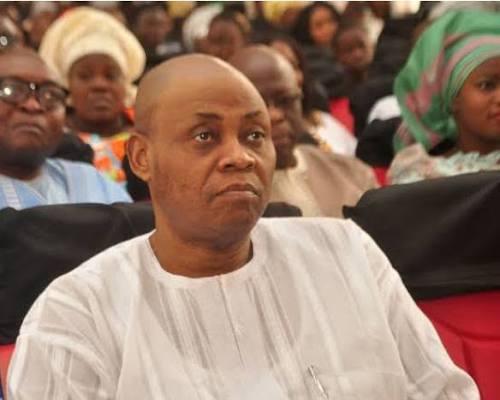
Businessman and father of Afrobeats singer Davido, Deji Adeleke, has alleged that the All Progressives Congress spent about N60 billion to influence voters during the Osun State governorship election.
Adeleke, who is the elder brother of Governor Ademola Adeleke, also alleged that the party offered as much as N50,000 for a single vote in some areas during the election.
He made the allegations while speaking in Osogbo, the Osun State capital, where he said he prayed for voters to collect the money allegedly offered by the opposition party but still cast their ballots for his brother.
According to him, the reports he received about the amount of money being spent on vote-buying during the election prompted him to seek divine intervention.
“On the day of the election, when I heard about the kind of money they were spending, I went back to my little corner in my room and I knelt down and I prayed to God Almighty,” he said.
Adeleke said he prayed that voters would accept the money but vote according to their conscience.
“I said, ‘God Almighty, let people collect their money but still vote for Ademola Adeleke,’” he added.
He claimed that about N60 billion was spent by the APC during the election, while some voters were allegedly offered N50,000 for a single vote.
“They spent N60 billion as we heard. Some places they bought votes for as high as 50,000, for one single vote,” he said.
The allegation could not be independently verified from the information available in the statement, and the APC was not quoted as responding to the claim.
Governor Ademola Adeleke, candidate of the Accord Party, was declared winner of the election after securing 511,067 votes.
His APC challenger, Bola Oyebamiji, polled 444,815 votes.
The result gave Adeleke a margin of 66,252 votes over Oyebamiji.
The election was closely watched because of the political importance of Osun and the high level of competition between the AP and APC.
The contest also attracted significant attention because the governor was seeking another term in office and faced a strong challenge from the APC.
Vote-buying has remained a major concern in Nigerian elections, with political parties and candidates frequently accused of attempting to influence voters through cash, gifts or other material incentives.
Electoral authorities and civil society organisations have repeatedly warned against the practice, saying it undermines the credibility of elections and weakens the ability of voters to freely choose their preferred candidates.
The use of money during elections can also place candidates with access to greater financial resources at an advantage over others, while encouraging voters to see elections as an opportunity to receive immediate financial benefits.
In previous elections, reports of vote-buying have emerged from different parts of the country, particularly during governorship and legislative elections.
The issue has remained difficult to tackle despite legal provisions and efforts by the Independent National Electoral Commission and security agencies to prevent electoral malpractice.
The Electoral Act provides penalties for several forms of electoral offences, including attempts to induce voters.
Political parties have also regularly traded accusations of vote-buying during election campaigns, with rival parties often blaming each other for allegedly using money to influence voters.
In the case of the Osun election, the campaign was marked by intense political activity and strong competition between the ruling AP in the state and the APC.
Both parties mobilised supporters across the state ahead of polling day, while political leaders urged voters to support their candidates.
The election also took place amid heightened security arrangements, with security agencies deploying personnel across the state to maintain law and order and prevent violence.
The result showed a strong performance by the incumbent governor, who secured more than half a million votes.
Adeleke’s victory also extended the PDP’s hold on the Osun governorship, after he defeated former governor Gboyega Oyetola of the APC in the 2022 governorship election.
The latest election therefore represented another major test of the governor’s political standing in the state.
Deji Adeleke’s allegation comes as attention shifts to the conduct of the election and the factors that influenced the outcome.
His claim that voters collected money but still voted for his brother suggests that financial inducements, even where they occur, do not necessarily guarantee victory for the candidate or party offering the money.
However, allegations of vote-buying remain serious because they raise questions about the integrity of the electoral process and the ability of voters to make independent choices.
For electoral observers, the key concern is not only whether money changed hands but also whether political actors are being held accountable when credible evidence of electoral offences emerges.
The Independent National Electoral Commission has repeatedly stressed the importance of voters making their choices freely and without inducement.
Security agencies are also expected to investigate credible allegations of electoral malpractice and ensure that offenders are prosecuted where evidence supports such action.
The latest allegation by Deji Adeleke is therefore likely to add to the debate over the role of money in Nigerian elections and the measures required to curb vote-buying.
While the businessman celebrated his brother’s victory, his comments also highlighted the growing concern over the amount of money allegedly deployed during elections.
For now, Governor Adeleke has secured another term based on the official result, while the allegations of large-scale vote-buying remain claims that would require evidence and appropriate investigation before they can be established as fact.