
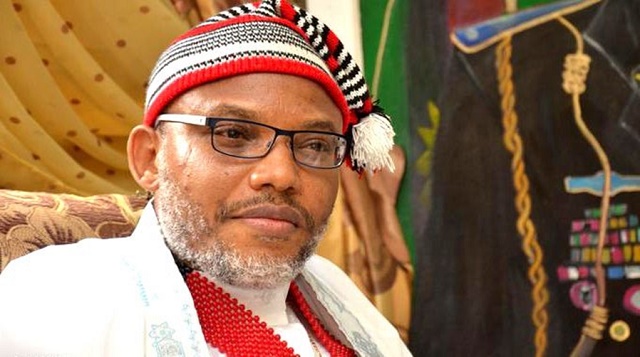
The family of the convicted leader of the Indigenous People of Biafra, Mazi Nnamdi Kanu, has disclosed that he has written to the Chief Justice of Nigeria and the President of the Court of Appeal, demanding the immediate listing and hearing of his pending cases.
The Okwu-Kanu Family, in a statement issued on Tuesday, said Kanu took the step because of what it described as the failure of the Federal Government to file substantive responses in two separate proceedings despite the passage of several months.
The family said Kanu was seeking a prompt determination of the cases and was not asking the judiciary to give him special treatment.
According to the statement, Kanu commenced proceedings at the Supreme Court on November 7, 2025, challenging the legality of the apex court’s December 15, 2023, remittal judgment.
The family said the Federal Government was duly served with the case but had, based on records available to it, failed to file a substantive response or ensure that the matter was listed for hearing more than nine months after the proceedings began.
It also disclosed that Kanu has a separate appeal before the Court of Appeal challenging his conviction and life sentence handed down on November 20, 2025.
The family said the delay in the two matters had raised questions about the speed at which Kanu’s legal challenges were being handled, particularly when compared with previous actions taken by the government to prevent his release.
It recalled the events of 2022, when the Court of Appeal delivered a judgment discharging Kanu and quashing the criminal charges against him.
The Court of Appeal had, on October 13, 2022, discharged Kanu and quashed the charges against him. However, according to his family, the Federal Government subsequently obtained a civil stay of execution from a differently constituted panel of the same court on October 28, 2022.
The family described the 14-day period between the discharge judgment and the stay of execution as evidence of the speed with which the judiciary acted when the government sought to keep Kanu in detention.
It argued that the criminal appeal had already been finally determined and that the Court of Appeal was therefore functus officio, meaning that it had completed its judicial role in the matter.
The family further argued that civil procedure could not lawfully be used to sustain Kanu’s detention after the criminal charges against him had been quashed.
It described the use of the civil stay in the circumstances as an unprecedented “hybridisation” of civil and criminal procedure.
According to the family, a civil stay was neither a criminal charge nor a remand order and could not be used to revive criminal counts that had already been quashed.
The statement said, “Fourteen days. In fourteen days, the machinery of the Court of Appeal moved from an acquittal-equivalent discharge to a civil stay that kept Mazi Nnamdi Kanu in detention.”
The family said it was not asking the courts to favour Kanu but wanted the same level of urgency applied to his present cases.
It said the central demand was for the pending matters to be listed and heard without further delay.
The family’s position comes against the background of Kanu’s long-running legal battle with the Federal Government over his prosecution and detention.
Kanu, a British-Nigerian, has been at the centre of the agitation for the self-determination of the South-East through IPOB, an organisation the Federal Government has proscribed as a terrorist group.
He was first arrested in Nigeria in 2015 and faced charges relating to terrorism and other offences. He was later granted bail but left the country in 2017 following a military operation at his residence in Abia State.
Kanu was rearrested in Kenya in 2021 and brought back to Nigeria by the Federal Government. His return generated widespread controversy, with his lawyers and family questioning the manner in which he was brought back into the country.
His legal team subsequently challenged his detention, prosecution and the circumstances surrounding his return.
The Court of Appeal’s 2022 judgment discharging him and quashing the charges represented a major legal victory for Kanu at the time. However, the Federal Government challenged aspects of the decision and obtained a stay, allowing his detention and prosecution to continue.
Kanu was eventually convicted in November 2025 and sentenced to life imprisonment, according to the family’s statement.
His conviction has kept his case at the centre of legal and political discussions, particularly in the South-East, where some groups and supporters have continued to demand his release.
The family has now indicated that it intends to broaden international attention on the case.
It said the United States Congress, Israeli Knesset and International Bar Association would be formally notified of the issues it had raised concerning Kanu’s legal proceedings.
The family did not state what specific action it expected from the international bodies but said they would be informed of what it described as concerns surrounding the handling of the cases.
The latest development is also likely to renew debate over the pace of criminal appeals involving persons held in detention.
For Kanu, the issue is particularly important because he remains in custody following his conviction and life sentence and is challenging the outcome through the legal process.
The family said the judicial system should provide a clear and timely route for such challenges, particularly where an accused person is already serving a sentence.
It maintained that Kanu’s demand was simply for his cases to be listed and heard, stressing that he was entitled to pursue available legal remedies.
The Okwu-Kanu Family therefore urged the heads of the judiciary to intervene within their constitutional and administrative powers to ensure that the pending matters were brought before the appropriate courts.
It said the family remained committed to pursuing the matter through lawful and judicial channels.
The latest move by Kanu is expected to place renewed attention on his legal battle with the Federal Government, which has continued for more than a decade and has generated strong political reactions across the country.
While Kanu’s supporters have repeatedly demanded his release, the Federal Government has maintained its position in the prosecution and defence of the charges against him.