
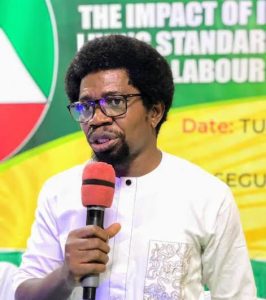
A new leadership era has begun at the Petroleum and Natural Gas Senior Staff Association of Nigeria, PENGASSAN, with Bosun Olabiyi-Agoro emerging as the new president of the association.
Olabiyi-Agoro took over from Festus Osifo, who led the association for six years, promising to make the fight against prolonged contract staffing and casualisation in Nigeria’s oil and gas industry one of the major priorities of his administration.
He was unveiled alongside nine other national officers at the end of PENGASSAN’s Quadrennial National Delegates Conference held at the International Conference Centre, Abuja.
The conference followed the Petroleum and Energy Advancement and Leadership Summit 2026, which brought together stakeholders in the oil and gas industry.
Olabiyi-Agoro comes into office with considerable experience in the oil and gas sector and trade union movement. He previously worked with Baker Hughes and EA Temile and Sons, where he held technical and operational leadership positions.
Before his election as president, he held several positions within the labour movement and PENGASSAN. He served as Chairman of the Trade Union Congress, Oyo State Council, and was National Financial Secretary of PENGASSAN between 2022 and 2023.
He was also National Auditor from 2020 to 2022 and Chairman of the Baker Hughes PENGASSAN Branch between 2016 and 2020.
His election marks the beginning of a new chapter for the association, which represents more than 30,000 senior staff workers across Nigeria’s oil and gas industry.
At the conference, most of the national positions were not contested. The only contested position was that of National Auditor I, where Rex Orji of Indorama Petrochemical Company defeated Ese Okusi by 254 votes to 84.
Other members of the new leadership include George Nwoko, Deputy President; Dominic Abang, National Industrial Relations Officer; Amaoge Chukwudi, National Treasurer; Tijani Oyabure, National Financial Secretary; and Lavin Aghaunor, National Public Relations Officer.
Ada Maryam Mbanaso emerged National Chairperson of the PENGASSAN Women Commission, while Chidinma Anyanwu became National Secretary of the commission. Muhammad Sani Ismail was elected National Auditor II.
In his acceptance speech, Olabiyi-Agoro paid tribute to Osifo, praising the outgoing president for strengthening PENGASSAN and expanding its influence in the oil and gas sector.
Osifo is also the President of the Trade Union Congress.
Olabiyi-Agoro described his predecessor as a leader, builder and fighter who defended the interests of workers during a period of major changes in the industry.
“I must pay tribute to the man whose shoes I am privileged to step into, Comrade Festus Osifo, leader, builder, and fighter. Under your tenure, PENGASSAN became stronger, more respected, and more feared by those who seek to exploit our members,” he said.
He also credited Osifo with defending workers’ jobs during divestments, fighting for a new collective bargaining agreement and ensuring that PENGASSAN had a stronger voice in government.
“Comrade, on behalf of over 30,000 PENGASSAN members, I say thank you. Your legacy is our foundation, and we will carefully and consciously build upon it,” he added.
However, the new president quickly turned attention to the challenges ahead.
The oil and gas industry is currently undergoing major changes, including the sale of some assets by international oil companies, restructuring by operators, increased use of technology and automation, and the global shift towards cleaner sources of energy.
These developments have raised concerns among workers and unions about job security and the future of employment in the sector.
Olabiyi-Agoro said his administration would not allow workers to be left behind as companies adjust to the changing business environment.
“In this era of divestments, business reorganisation, automation, and energy transition, no PENGASSAN member will be left behind,” he said.
He promised that the union would negotiate agreements covering retraining and redeployment of workers affected by changes in the industry.
According to him, workers must be prepared for new roles as technology changes the nature of work, while companies must take responsibility for ensuring that their employees are not unfairly pushed out of their jobs.
The new PENGASSAN president also promised to defend existing collective bargaining agreements between workers and employers.
He warned employers against signing agreements with workers and unions without implementing them.
“Agreements signed must be agreements kept,” he said.
Olabiyi-Agoro said PENGASSAN would work with employers where there was fairness but would resist practices that violated workers’ rights.
“We will work with management not as enemies, but as partners with different roles. Where there is fairness, we will collaborate. Where there is injustice, we will resist, peacefully, lawfully, and powerfully,” he said.
One of the strongest positions in his speech was his rejection of prolonged contract staffing.
Contract staffing is common in Nigeria’s oil and gas industry, with some workers engaged through third-party companies even when they perform functions that are central to the operations of their employers.
Unions have long raised concerns that such arrangements can leave workers with lower pay, fewer benefits and weaker job security compared with permanent employees.
Olabiyi-Agoro said the practice could no longer be justified where a worker had spent many years performing what was clearly a permanent job.
“A job that someone has been doing for over two years, five years, 10 years, even 20 years or more cannot be categorised as a temporary position anymore,” he said.
He warned that the period when employers could use contract staffing to reduce costs at the expense of workers was coming to an end.
“The time management uses contract staffing strategy to molest workers, to cause marginalisation and save cost is effectively over,” he declared.
The new president also raised concerns about the possible health and safety implications of the practice.
He said workers employed under such arrangements could face uncertainty and other challenges that could affect their welfare and safety at work.
“This is becoming a health and safety matter in our various locations and offices, and we will interrogate this matter with every resource available to us,” he said.
The issue of casualisation is particularly important in the oil and gas industry because of the sector’s strategic role in Nigeria’s economy. Oil remains a major source of government revenue and foreign exchange, while the sector supports thousands of direct and indirect jobs.
PENGASSAN’s new leadership is therefore expected to balance its demand for better working conditions with the need to support investment and productivity in the industry.
Olabiyi-Agoro said the union was ready for such cooperation.
He said PENGASSAN was not against business or investment, stressing that the union wanted higher production, increased investment and stronger Nigerian participation in the industry.
“We are not anti-business. We are pro-Nigeria. We want production up, investment in, and Nigerian content protected. But that can only happen when workers are respected and treated fairly,” he said.
Beyond job security and contract staffing, the new leadership also promised to invest in digital skills, leadership development, women’s empowerment and workers’ welfare.
The move is expected to become increasingly important as automation and new technologies change the skills required in the oil and gas industry.
With the transition in leadership now completed, attention will shift to how the new PENGASSAN administration translates its promises into action, particularly its pledge to tackle prolonged contract employment, protect collective agreements and prepare workers for changes in the energy sector.