
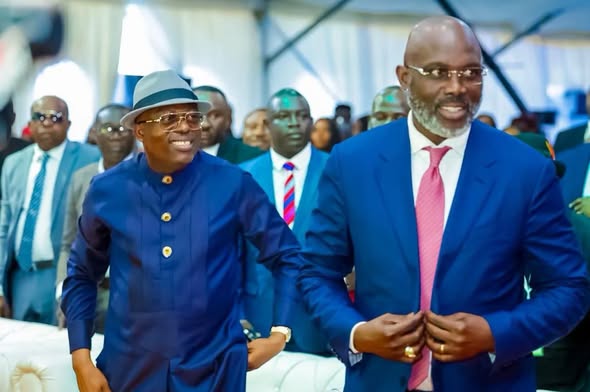
Human rights lawyer and Senior Advocate of Nigeria, Femi Falana, has criticised the Nigerian Bar Association for inviting former Liberian President George Weah to speak at its annual conference, accusing the former football star’s administration of undermining judicial independence and the rule of law in Liberia.
Falana made the remarks in a video posted on the NBA’s YouTube channel on Monday, a day after Weah delivered the keynote address at the 66th NBA Annual General Conference in Port Harcourt, Rivers State.
The senior lawyer said he was disappointed that Weah was invited to address Nigerian lawyers on democracy, judicial independence and the rule of law, alleging that his administration, which lasted from 2018 to 2024, violated those same principles.
Falana urged the leadership of the NBA to be more careful in selecting African leaders invited to address its conferences, saying individuals accused of undermining democratic institutions should not be presented as role models to lawyers.
“Ladies and gentlemen, I’m delighted to be here. But let me say this, because you know I have to be frank with the audience. And this goes for the leadership of the Bar. I want to appeal that the Bar Association must stop—stop inviting dictators in Africa to come and address us,” he said.
Falana alleged that the judiciary was weakened under Weah to the extent that some Liberians had to seek justice outside the country through the ECOWAS Court.
He cited the case involving the Mandingo people of Liberia, whose landed properties were allegedly seized during the country’s civil war.
According to him, the regional court ruled in favour of the affected people but Weah’s administration refused to comply with the judgment.
“The ECOWAS Court gave them judgment. George Weah refused to comply with the judgment. The new government of Boakai has just set up a committee for the enforcement of that judgment,” Falana said.
Liberia was badly affected by two civil wars between 1989 and 2003, conflicts that resulted in widespread destruction, loss of lives and displacement. The country has since made efforts to strengthen its democratic institutions and rebuild public confidence in the justice system.
Falana also referred to the case of a former associate justice of the Supreme Court of Liberia, who he alleged was removed from office without proper justification.
He said the matter was taken to the ECOWAS Court, which reportedly overturned the dismissal, ordered the judge’s reinstatement and awarded him $200,000 in compensation.
According to Falana, Weah’s government also refused to comply with that judgment.
“Again, we went to the ECOWAS Court. The ECOWAS Court set aside his dismissal and awarded him $200,000. He was ordered to be reinstated. Mr. George Weah refused to comply with the judgment,” he said.
Falana questioned the decision to invite Weah to speak to lawyers about democracy and the rule of law in view of the allegations.
“Now, that is the man coming here to talk to us about the rule of law and democracy,” he said.
The senior lawyer further accused the former Liberian administration of failing to deal effectively with drug trafficking in the country. He claimed that drug-related activities became a major problem during Weah’s tenure.
Falana also referred to the arrest of former Liberian Vice President Jewel Howard-Taylor, although his remarks as reported referred to her as “Madam Edith”, and alleged that she was facing a drug trafficking case involving $370 million.
The allegations were part of Falana’s wider criticism of the former Liberian government and his argument that the NBA should not use its annual conference to give a platform to leaders whose records, in his view, conflict with the values lawyers are expected to defend.
He also criticised Weah over an incident involving his son, Timothy Weah, who represented the United States at the 2022 World Cup in Qatar.
Falana alleged that the former president travelled to Qatar to watch his son play for the United States and questioned the use of public funds for the trip.
He said the NBA should instead invite African leaders with records that, in his view, promote democracy, good governance and institutional development.
Falana mentioned Namibia’s female political leaders as examples of people he considered worthy of such invitations. He also cited the late former Premier of the Western Region, Chief Obafemi Awolowo, as a Nigerian leader whose legacy deserved recognition.
However, Weah’s keynote address at the NBA conference focused strongly on the importance of judicial independence and strong democratic institutions.
The former Liberian president urged lawyers and judges to remain impartial in the discharge of their duties and stressed that justice should not be influenced by political or personal interests.
Weah said an independent judiciary, supported by a fearless legal profession, was necessary for any country that wanted to sustain democracy.
He warned that democracy could not survive on the strength of individual leaders, but depended on strong institutions.
According to him, governments that describe themselves as democratic but engage in corruption, collude with judges and manipulate institutions pose a serious danger to democracy.
Weah said democracy was tested every day and that lawyers had a major role to play in protecting democratic values and ensuring that the rule of law remained respected.
His remarks came against the background of growing concerns across Africa about the independence of the judiciary, political interference in courts and the weakening of democratic institutions.
In many African countries, lawyers and civil society groups have continued to demand stronger institutions, free courts and greater accountability from elected officials.
The issue is also important in Nigeria, where lawyers have often played a leading role in defending human rights, challenging government policies and seeking judicial remedies for citizens.
Rivers State Governor Siminalayi Fubara, who declared the NBA conference open on Sunday, also called for an independent and courageous judiciary.
Fubara said judges must remain committed to the truth and discharge their responsibilities without allowing social status, political influence or personal relationships to affect their decisions.
The governor stressed that the judiciary must remain a strong institution capable of protecting citizens and upholding the law.
The exchange over Weah’s invitation has therefore brought the question of the role of the NBA and the standards it should apply when choosing speakers for its major events to the fore.
The NBA’s annual conference is one of the biggest gatherings of lawyers in Nigeria and attracts legal practitioners, judges, government officials, academics and other stakeholders.
The 66th edition was held in Port Harcourt under the theme, “Beyond Limits.” The conference provided a platform for discussions on the justice system, democracy, governance and other issues affecting the legal profession.