
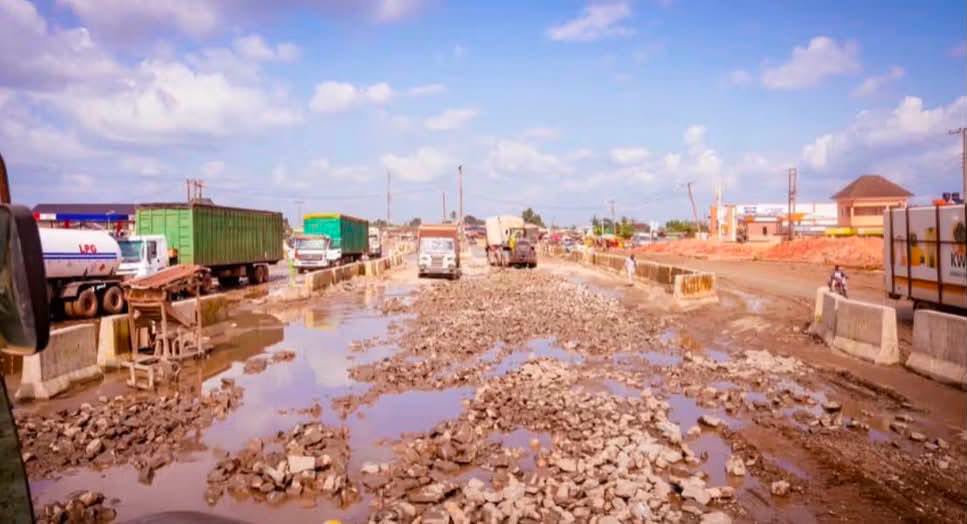
The Presidency has described the recent failure of the Benin-Agbor-Asaba Expressway as an isolated incident, saying the Federal Government moved quickly to address the problem after the road became difficult for motorists to use.
The Special Adviser to President Bola Tinubu on Media and Public Communications, Sunday Dare, said the government had immediately deployed key stakeholders to the affected section and demanded urgent action from the contractor handling the project.
Dare spoke on Channels Television on Wednesday while reacting to growing concerns over the condition of the highway and the President’s directive for the redesign and total reconstruction of the troubled road.
The presidential aide said the condition of the Benin-Agbor-Asaba road should not be used to judge the performance of federal road projects across the country.
According to him, several federal roads have either been completed or are progressing without similar complaints from road users.
“I think that first, these are isolated cases. And we all know by the nature of road construction, during rainy season, you encounter problems like this,” Dare said.
The controversy over the highway intensified after the road suffered serious damage, causing difficulties for commuters and raising questions about the quality of work being carried out on the corridor.
The Benin-Agbor-Asaba road is an important transport route linking parts of Edo and Delta states and serving as a major connection between southern and other parts of the country.
Its poor condition has affected motorists, transport operators and businesses that depend on the route for the movement of people and goods.
The Federal Government’s latest intervention followed an inspection of the troubled section by the Minister of Works, David Umahi, who visited the road on Tuesday.
During the inspection, Umahi apologised to commuters over the condition of the highway and took responsibility on behalf of the government.
The minister also condemned the performance of the concessionaire handling the reconstruction of the road.
After inspecting the failed section, Umahi concluded that temporary repairs, also known as palliative measures, would not be enough to solve the problem.
He consequently directed moves for the total reconstruction of the road, with the project expected to be redesigned to provide a more lasting solution.
Defending the government’s response, Dare said the speed with which the Works Minister, members of the National Assembly and other stakeholders visited the affected area showed that the administration was ready to respond to infrastructure problems.
He said the government had three major responsibilities in the execution of road projects: identifying roads that needed attention, providing funds and ensuring that contractors delivered quality work.
“Government has a responsibility to identify the roads that need to be fixed. Government has a responsibility to provide the funding. And then, the next responsibility goes to the contractors to do what is necessary,” he said.
Dare said the presence of the minister and other officials at the site shortly after the problem occurred was an example of the type of response expected from government.
“What we saw yesterday, the Minister, the National Assembly members, and other key stakeholders going there in record time, right on the spot. And I think that’s what good governance is about, responding as quickly and as swiftly as possible, putting the blame where it is, and requesting for immediate action,” he said.
The presidential aide also acknowledged that the contractor handling the road had offered explanations for the failure but said the explanations did not remove the contractor’s responsibility to deliver a quality project.
“Whatever played out yesterday, we had all the stakeholders there. And it’s important that even the contractor came out, even though he gave excuses, it showed a failure on their part,” Dare said.
His comments came amid wider concerns about the condition of roads across Nigeria, particularly major highways that serve as links between states and economic centres.
Poor road conditions have remained a major concern for motorists and businesses. Damaged highways can increase travel time, raise vehicle maintenance costs and contribute to higher transport fares.
For businesses, delays on major roads can also increase the cost of moving farm produce, manufactured goods and other items between cities.
The Presidency, however, maintained that the government was addressing infrastructure challenges through several ongoing road projects.
Dare said motorists should also understand that major road projects are not completed at once and that some inconvenience is unavoidable while construction is taking place.
He referred to his recent journey along the Abuja-Lokoja corridor, where he travelled with about 65 journalists and observed sections of the road that had already been completed.
He also said concrete construction was ongoing on some portions of the corridor.
According to him, road construction is usually carried out in sections, meaning that some parts of a highway may be completed and opened to traffic while work continues on other sections.
He compared the process to constructing a house, saying progress is made in stages before the entire project is completed.
“It’s like a house construction; a house is not built in a day, it’s progressive. Until the roof comes on, the rain will still pour down on the building,” he said.
Dare said the Tinubu administration was currently implementing a large number of road projects across the country.
He disclosed that the Federal Government was working on five legacy road projects as well as about 320 roads across the country.
“Is President Bola Ahmed Tinubu on top of what’s happening? Absolutely,” Dare said. “We’re talking about five legacy roads; we’re talking about 320 roads across the length and breadth of our country.”
The Federal Government has in recent years placed infrastructure development among its key priorities, with road construction and rehabilitation forming a major part of its plans.
The government has also faced pressure from citizens over the condition of several major highways, with road users regularly calling for faster repairs and better supervision of contractors.
The Benin-Agbor-Asaba corridor has attracted particular attention because of its importance to transportation and commerce in the South-South region.
The road forms part of a major route used by travellers and commercial vehicles moving between Benin City, Agbor and Asaba. Its deterioration has reportedly disrupted transportation, damaged vehicles and increased the cost of movement along the corridor.
The decision to move from palliative repairs to total reconstruction is therefore expected to bring renewed attention to the quality and supervision of the project.
While the Presidency has described the road failure as an isolated case, the incident has also renewed calls for stronger monitoring of contractors handling major public infrastructure projects.
For motorists, however, the key concern remains when the affected portions of the road will be properly reconstructed and made safe for regular use.
The government has insisted that the contractor must take responsibility for the failure and comply with the directive for immediate action.
The development also places pressure on the Works Ministry to ensure that the redesigned project meets the required standards and can withstand the heavy traffic and weather conditions along the corridor.
As reconstruction plans are developed, commuters and businesses using the route will be watching closely to see whether the Federal Government’s intervention will bring a lasting solution to the long-running problems on the Benin-Agbor-Asaba road.