
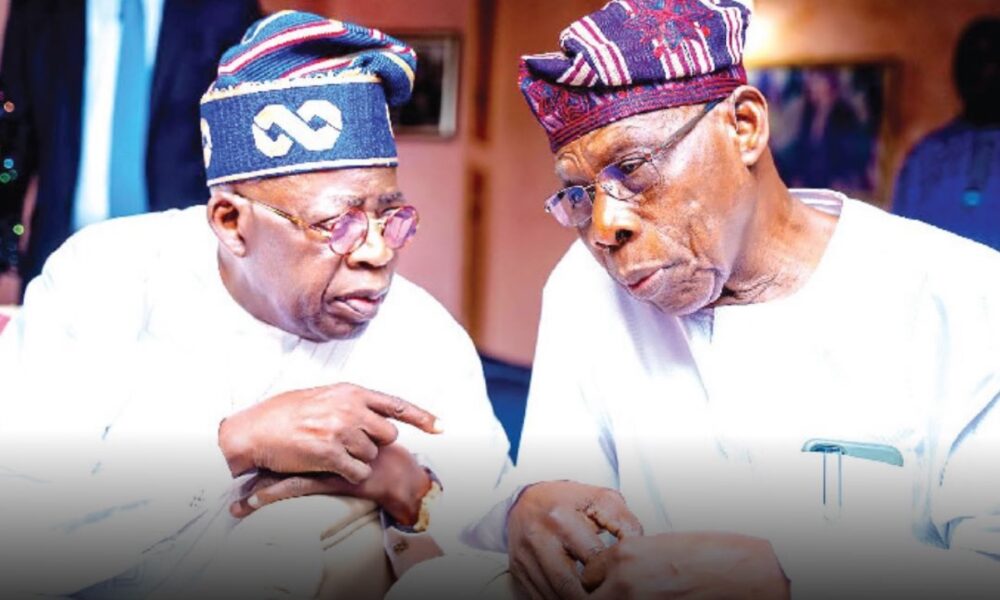
Former President Olusegun Obasanjo has sharply criticized President Bola Tinubu’s and former President Muhammadu Buhari’s leadership styles, describing Nigeria as a “deteriorating case”.
Speaking at the Chinua Achebe Leadership Forum at Yale University in Connecticut, USA, on November 17, 2024, Obasanjo painted a grim picture of the country’s state. He accused Nigeria’s leadership of deepening the nation’s crisis, saying the situation has become more chaotic and insecure under the current administration.
Obasanjo, known for his candid remarks, referred to President Tinubu using the nicknames “Emilokan” and Buhari as “Baba-go-slow.” He claimed that under Tinubu’s rule, the country had descended into a state of disarray.
“As we can see and understand, Nigeria’s situation is bad,” Obasanjo stated. “The more the immorality and corruption of a nation, the more the nation sinks into chaos, insecurity, conflict, discord, division, disunity, depression, youth restiveness, confusion, violence, and underdevelopment.”
The former president did not mince words, claiming that these issues are now deeply entrenched in Nigeria, with corruption and mismanagement running rampant.
“This is the situation mostly in Nigeria in the reign of Baba-go-slow and Emilokan. The failing state status of Nigeria is confirmed and glaringly indicated and manifested for every honest person to see,” Obasanjo added.
Obasanjo’s remarks were not only about Tinubu but also focused on the broader problems affecting Nigeria. He blamed the country’s leadership crisis on pervasive corruption, state capture, and a failure to act with integrity.
“State capture is one of the most pervasive forms of corruption,” Obasanjo explained. “It occurs when powerful individuals or groups manipulate a nation’s policies and legal environment to serve their own interests.”
According to Obasanjo, Nigeria is experiencing such state capture, where political elites are buying national assets at bargain prices and allocating resources to benefit themselves and their families. He called for stricter laws, both domestic and international, to prevent such practices.
“The purchase of national assets by political elites — and their family members at bargain prices — and the allocation of national resources to local, regional, and international actors must be prohibited,” he said.
He also pointed to the involvement of public institutions, such as the legislature, judiciary, and regulatory agencies, in facilitating state capture.
“This is the disproportionate influence of interest groups who manipulate state laws, policies, and regulations for their own gain,” he argued.
Despite his criticism of the current administration, Obasanjo expressed hope for Nigeria’s future. He reminded the audience of Chinua Achebe’s famous words in his book The Trouble with Nigeria: “The trouble with Nigeria is simply and squarely a failure of leadership.”
Obasanjo said Achebe’s analysis, written over four decades ago, still rings true today.
“There is nothing wrong with the Nigerian character. There is nothing wrong with Nigerian land, climate, water, air, or anything else,” Obasanjo quoted. “The Nigerian problem is the unwillingness or inability of its leaders to rise to the responsibility, to the challenge of personal example, which are the hallmarks of true leadership.”
While acknowledging that Achebe’s words were moderate, Obasanjo warned that Nigeria is now closer to collapse. He cited prominent U.S. scholars, Robert Rotberg and John Campbell, who described Nigeria as teetering on the brink of failure.
“Unable to keep its citizens safe and secure, Nigeria has become a failed state of critical geopolitical concern,” Obasanjo quoted, echoing the scholars’ view that Nigeria’s failure could have far-reaching consequences for Africa and the world.
Obasanjo’s speech left little doubt about his disillusionment with the current state of Nigeria. His remarks were a strong critique of Tinubu’s administration and a call for leadership that could rise above the nation’s current challenges.