
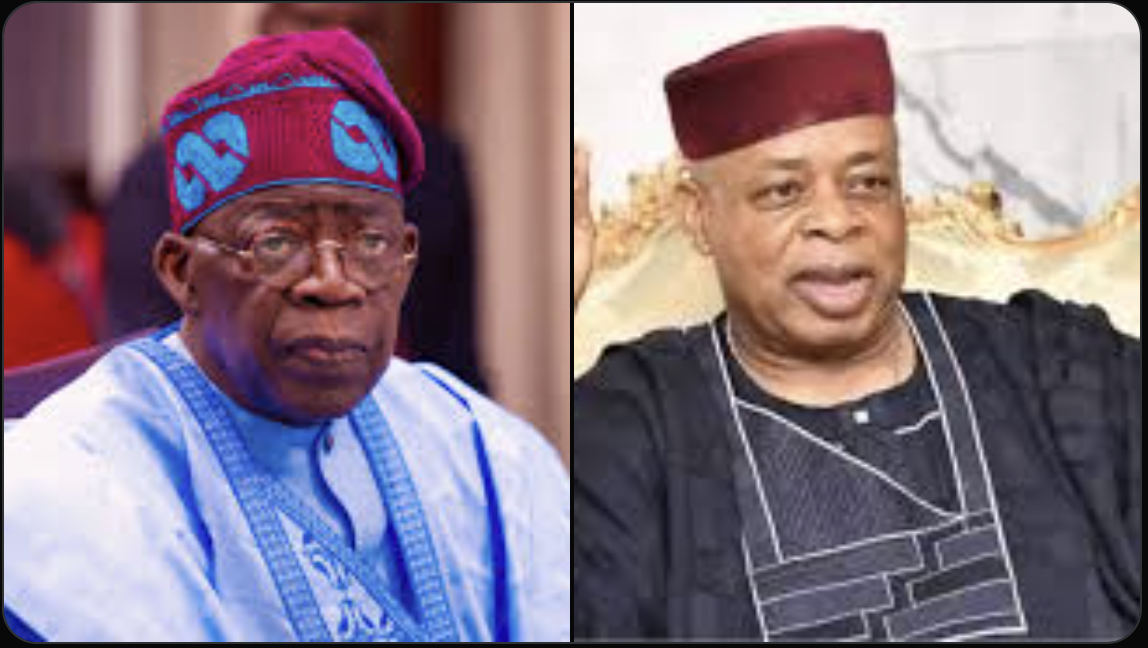
President Bola Ahmed Tinubu has taken a bold swipe at former President Olusegun Obasanjo, indirectly blaming him for attempting to undermine Nigeria’s democracy through the infamous third-term agenda. While addressing leaders in Enugu on Saturday, Tinubu lauded former Senate President Ken Nnamani for his pivotal role in defeating what he described as a “grave threat” to the nation’s constitutional order.
“Ken Nnamani and his colleagues stood firm when it mattered most. They saved Nigeria’s democracy from those who sought to derail it,” Tinubu declared during the meeting, part of his official visit to the Southeast.
Although Tinubu avoided mentioning Obasanjo directly, the context was unmistakable. Obasanjo’s controversial bid to amend the constitution for an unprecedented third term in office in 2006 was met with widespread resistance, spearheaded by Nnamani and the Senate.
A Controversial Past, A Pivotal Moment
The third-term agenda, widely viewed as an attempt to consolidate power, was one of the most contentious episodes in Nigeria’s democratic history. Obasanjo’s allies had pushed for a constitutional amendment to extend his tenure, citing the need for continuity in leadership. However, Nnamani, then Senate President, rallied lawmakers to reject the proposal, ensuring that it never saw the light of day.
Tinubu’s acknowledgment of Nnamani’s role has reignited debates about the resilience of Nigeria’s democracy and the dangers posed by authoritarian tendencies.
A Call for Unity and Development
The President’s visit to Enugu also focused on fostering development in the Southeast, a region often vocal about marginalization in national affairs. Tinubu reassured leaders that his administration is committed to delivering on key infrastructural projects, including the Eastern Rail Line connecting Port Harcourt to Maiduguri.
“This project is not just about transportation; it’s about boosting trade and creating opportunities for millions,” Tinubu emphasized.
Former Minister of Power, Professor Chinedu Nebo, stressed the rail line’s importance, describing it as a lifeline for Nigeria’s non-oil exports. “This connection will unlock the economic potential of the entire Southeast and beyond,” Nebo said.
Energy and the Anambra Basin
Another significant topic was the untapped potential of the Anambra Basin, home to an estimated one billion barrels of crude oil and 30 billion cubic feet of natural gas. Enugu State elder Chris Ugoh urged Tinubu to prioritize developing the basin, highlighting its potential to drive economic growth across the Southeast, Middle Belt, and North.
In response, Tinubu underscored his administration’s commitment to energy diversification, stating, “Gas will be central to Nigeria’s energy future. We will invest in this resource together, ensuring that no region is left behind.”
Addressing Security Challenges
Security, a perennial concern in the Southeast, also featured prominently in the discussions. Onyemauche Nnamani, National Commissioner for the Police Service Commission, advocated for modern strategies, including the deployment of advanced surveillance systems.
“Checkpoints and roadblocks are outdated and put our officers at unnecessary risk. We need smarter, technology-driven approaches,” Nnamani urged.
Tinubu assured leaders that his government was taking steps to address these challenges. “Security is a work in progress,” he said. “These problems didn’t start today, but I am committed to solving them with determination and collaboration.”
The President’s Broader Vision
The Enugu visit marked Tinubu’s continued effort to engage with leaders across Nigeria, emphasizing a unified approach to tackling national challenges. By acknowledging the Southeast’s contributions to preserving democracy and pledging to address the region’s concerns, Tinubu aims to mend longstanding divisions.
His praise for Ken Nnamani was not just a nod to the past but a reminder of the sacrifices required to safeguard Nigeria’s democratic institutions.
“Nigeria’s democracy was tested, but we prevailed because of courageous leaders who put the nation first,” Tinubu concluded.