
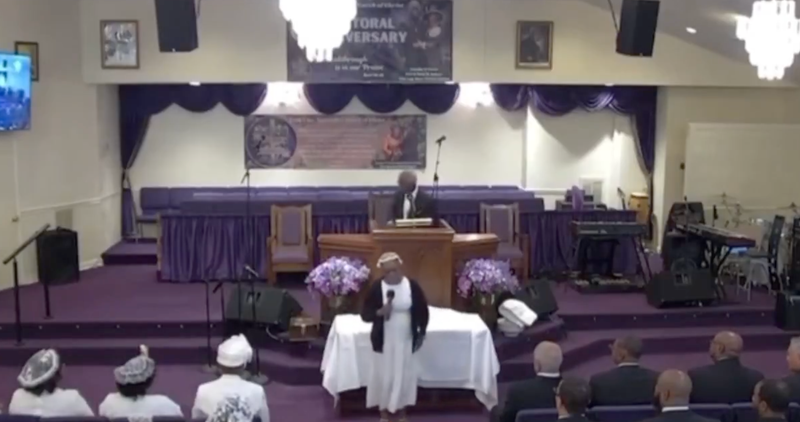
Controversy and public outcry erupted on social media following a viral video that showed Pastor Terry Jackson of True Vine Apostolic Church of Christ forcing a young woman to apologize for being pregnant out of wedlock. The incident, which took place on Sunday, has ignited a fierce debate over church discipline, public shaming, and the treatment of women within religious communities.
The footage, which quickly spread across social media platforms, captured a visibly emotional young woman standing at the front of the church, tearfully addressing the congregation. Her apology was raw and heartfelt as she said, “I want to apologize to everybody in here because I am pregnant. I’m sorry, y’all. I just hope that y’all forgive me. Keep on praying for me.”
Pastor Jackson, who was seen standing beside her, did not show sympathy. In fact, he openly condemned her actions in front of the entire church, criticizing her for the “sin” she had committed.
“Out of Order”
Pastor Jackson’s words have sparked a storm of criticism. In his response, he declared, “If you sin, you don’t wait later to repent. We don’t condone sin. Ain’t no baby showers. That’s what you lose when you have a baby out of wedlock, ain’t nobody in this church bout to attend one.”
The pastor’s harsh words continued: “Thank God that God didn’t take you out of here.” These comments, directed at the pregnant woman, have drawn widespread condemnation, especially from those who feel that the punishment was unnecessarily humiliating.
The woman, whose identity has not been revealed, is said to have been in tears during the apology, her voice shaky as she spoke before a congregation that seemed divided in their reactions.
Public Humiliation or Spiritual Discipline?
The church’s public rebuke of the young woman for being pregnant outside of marriage has ignited intense discussions on social media. Many supporters of the church argue that the pastor was merely upholding Biblical principles, asserting that sexual purity before marriage is essential to maintaining Christian values. Others, however, have expressed disgust, calling the incident an act of public humiliation that was neither fair nor Christ-like.
One social media user commented, “This is beyond shameful. How does forcing someone to publicly apologize for their personal situation help anyone? The church should be a place of support, not judgment.”
A prominent Christian counselor, who requested to remain anonymous, weighed in on the situation, stating, “This kind of public shaming can be very damaging to a person’s emotional well-being. It can also push them further away from their faith rather than guiding them toward repentance in a loving, supportive environment.”
A Divided Congregation
The incident has reportedly led to divisions within the True Vine Apostolic Church of Christ congregation. Some churchgoers have supported Pastor Jackson’s actions, believing that the punishment was justified and necessary to preserve the integrity of the church.
“I’ve been going to this church for years, and I understand the pastor’s position,” one church member said. “The Bible says that fornication is a sin, and it’s important that we hold each other accountable. We can’t just ignore the teachings of the Word because it’s uncomfortable.”
However, others have voiced their concerns, noting that the treatment of the woman was extreme. “This could have been handled privately, within the confines of the church leadership, and not made into a spectacle,” said another congregant who wished to remain unnamed. “It’s sad that a young woman who is already struggling with the challenges of her pregnancy was subjected to public ridicule.”
Religious Leaders Speak Out
The incident has not only ignited debate within the congregation but also attracted attention from religious leaders and faith-based organizations. Many have condemned Pastor Jackson’s actions, with some suggesting that the church should embrace a more compassionate approach to addressing personal struggles.
Reverend Esther Ajayi, a leading Nigerian pastor known for her emphasis on love and empathy, voiced her disagreement with the public rebuke. “The Church should be a sanctuary, a place where people feel safe, not one where they are made to feel ashamed of their mistakes. Yes, there are biblical principles, but those principles must be carried out with grace, not cruelty,” she remarked.
In contrast, Dr. Samuel Olorunfemi, a Nigerian theologian, supported the pastor’s stance, arguing that discipline is an important aspect of religious communities. “The church is supposed to lead people toward righteousness. If the pastor had allowed this to go unchecked, he would not have fulfilled his role as a spiritual guide,” he said.
The Church’s Stance
While the church has yet to release an official statement regarding the incident, Pastor Jackson’s public remarks suggest that he stands by his actions. In a later sermon, the pastor reiterated his belief that the church is meant to uphold high moral standards and that sin cannot be overlooked.
He told the congregation, “We are a church that believes in holiness. I’m not here to make you feel good about your sin. I’m here to guide you to the truth, even if it hurts.”
However, some members of the community have raised questions about the fairness of the pastor’s methods. Was this an act of spiritual discipline, or a moment of unchecked power? The answer, it seems, lies in the broader conversation about how churches in both the United States and Nigeria are responding to issues of sexual morality, public shaming, and forgiveness.
Global Implications
The debate over the treatment of the pregnant woman resonates far beyond Hampton, Virginia. In Nigeria, where religious institutions often hold significant influence over social values, similar incidents of public shaming and discipline are not unheard of. Many Nigerians have taken to social media to compare the actions of Pastor Jackson to the practices of certain Nigerian churches, where public rebukes and humiliations are sometimes used as methods of correction.
“I’ve seen similar situations in Nigerian churches where young women are shamed publicly for their mistakes,” one Nigerian user posted on Twitter. “It’s about time we start questioning these tactics and looking at more compassionate ways to deal with these issues.”