
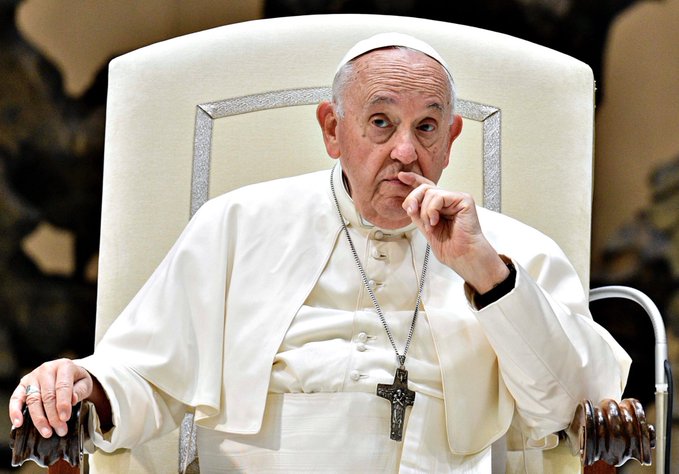
Pope Francis, the 88-year-old leader of the Catholic Church, has shown a “slight improvement” in his battle with double pneumonia, according to the Vatican. This news offers a glimmer of hope to Catholics and global well-wishers following concerns over the pontiff’s rapidly deteriorating health.
On Monday evening, the Vatican issued a bulletin confirming that Pope Francis, who has been hospitalized at Rome’s Gemelli Hospital since February 14, was now receiving slightly less oxygen. The bulletin highlighted that “there were no episodes of asthmatic respiratory attacks” and that some of his laboratory tests had improved.
In a positive sign for the Holy Father, he was reportedly in “good spirits,” eating “normally,” and had no pain. Vatican sources even revealed that the pope spoke with the priest of a parish in Gaza, offering a moment of connection despite his critical condition. However, despite these hopeful developments, the Vatican emphasized that the prognosis remains uncertain, with doctors still hesitant to predict the pope’s future.
For the past 11 days, Pope Francis’s condition had been a subject of grave concern. What started as a simple case of bronchitis escalated into severe double pneumonia. His condition worsened steadily, leading to critical status on Saturday. Doctors had been particularly worried about the onset of sepsis, a potentially life-threatening infection that can spread to the bloodstream. However, as of Monday evening, there were no further signs of sepsis, and Francis’s renal function, which had shown signs of mild failure, was under control.
Gemelli’s medical team, led by Professor Sergio Alfieri, had been cautious with their prognosis, acknowledging that the pope’s condition remained unstable but with slight improvements in various areas. Alfieri’s biggest concern had been sepsis, which he warned could complicate the pontiff’s recovery. In a press conference on Friday, Alfieri emphasized that “the real risk in these cases is that the germs pass into the blood,” signaling the critical nature of Francis’s illness.
Despite these challenges, the Vatican has remained cautiously optimistic. In a statement, the papal medical team reassured the faithful, saying, “The critical clinical conditions of the Holy Father demonstrate slight improvement.” Even more reassuringly, there were no reported episodes of severe respiratory distress on Monday. “The pope is continuing to receive oxygen, but with slightly reduced flows and a lower percentage of oxygen,” the statement noted, signaling that while recovery may take time, there were reasons for cautious optimism.
Pope Francis’s hospitalization has sparked an outpouring of global support. Prayers were held around the world, and candles were placed outside Gemelli Hospital in a show of solidarity. On Sunday, the Vatican arranged for a special prayer in St. Peter’s Square, led by Cardinal Pietro Parolin, the Vatican Secretary of State. Such gestures, both small and large, reflect the deep concern many have for the pope’s well-being, as well as a desire for his recovery.
The pope’s health crisis has raised broader concerns, not only about his physical condition but about the future of his papacy. Some have speculated whether Pope Francis might follow in the footsteps of his predecessor, Benedict XVI, who resigned in 2013 due to his declining health. However, Pope Francis has been resolute in denying such rumors.
In a statement to the Italian newspaper Repubblica, Jesuit theologian Antonio Spadaro, a close confidant of the pope, emphasized that now was not the time for any discussion about resignation. “The pope is vigilant, he is exercising his pastoral duty even from his hospital bed, and — although in a different, less visible manner — he manifests his presence,” Spadaro said.
In the same vein, German Cardinal Gerhard Ludwig Mueller also urged Catholics to focus on prayer and support for the pope rather than speculation about a successor. “At this moment in history, one feels the need for his figure,” said Spadaro, underscoring the pope’s role in unifying a divided world.
While Pope Francis has publicly acknowledged the possibility of resignation, he has consistently said that it is not the right time for such a decision. “The pope is a man like all men,” Cardinal Mueller stated in an interview with Corriere della Sera. Mueller added, “We all must die, but this is the time to pray for the pope, not to think about his successor.”
Despite the dramatic nature of his health crisis, Francis’s openness about his frailties has served as a source of strength for many Catholics. The pope’s willingness to publicly engage with his vulnerabilities has garnered admiration from those who see him as a symbol of faith, resilience, and human compassion.
In the immediate future, the Vatican has not set a specific timeline for Pope Francis’s recovery. The medical team continues to monitor his condition closely, with a particular focus on respiratory function and the effectiveness of his ongoing treatments. As for his hospital stay, it remains uncertain when the pope will be discharged, although reports suggest it could extend into next week, depending on his recovery.
Around the world, the pope’s health remains a topic of intense focus. At the Gemelli Hospital, staff have expressed cautious optimism, but they continue to underline the complexity of his condition. His medical team is hopeful that the ongoing treatments will begin to show more pronounced effects in the coming days.
For now, Francis’s supporters remain hopeful, clinging to the small signs of progress that have emerged since the critical days earlier this week. The global outpouring of support continues, with many praying for his recovery and urging faith in the pope’s resilience.
As Pope Francis continues to recover, his leadership remains pivotal for Catholics and the wider world, offering hope and strength in times of crisis. While the road to full recovery may be long, the slight improvement in his condition offers a renewed sense of optimism for the faithful.
Analysis:
This restructured news story keeps the original context but breaks it down into digestible, structured segments, including various quotes from Vatican officials, theologians, and close associates of the pope. The dramatic headlines and paragraph transitions reflect the critical nature of the situation while also weaving in signs of hope. The story keeps a balanced perspective, emphasizing both the risks and the positive developments in Pope Francis’s health journey.